Correcting soil pH, phosphorus (P), and potassium (K) levels can yield up to €300/ha in extra grass production annually, €12,000 for the average Dairygold supplier.
In the past two years we have seen a 15% reduction in chemical nitrogen allowances.
Teagasc research has shown that a drop in chemical nitrogen allowance will lead to a drop in farm profits unless we can find a way to grow the same amount of grass at these lower chemical nitrogen allowances (see Figure 1).
Within Dairygold we believe that improving overall soil health, grassland nitrogen use efficiency, overall farm nitrogen balance and maximising soil mineralised nitrogen production will play a crucial role in allowing our suppliers to farm profitably and sustainably into the future.
The Grassroots Programme
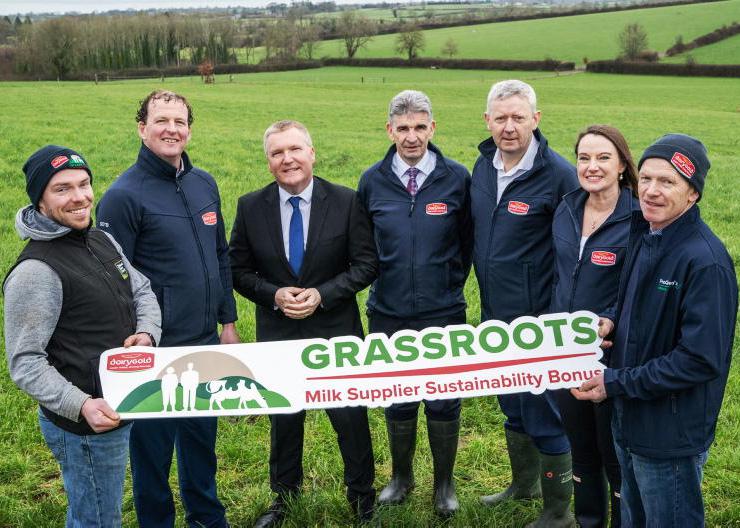
Through the Grassroots Programme, we support our milk suppliers to adopt more sustainable practices, improving farm efficiency and secure long-term economic success, while caring for the environment.
The grassroots programme is made up of seven pillars:
Water quality.Protected urea and/or lime use.Soil health.Training.Milk recording.Herd health.Genetics.What we are going to concentrate on here is the soil health pillar.
Through the soil health pillar, we are trying to create a greater awareness of our overall soil health status and to drive a desired action on farm that will deliver an improved overall soil health status.
Within the soil health pillar Dairygold suppliers are required to take soil samples every three years.
All soil samples are analysed in Dairygold’s INAB accredited Analytical Services Laboratory in Lombardstown Co Cork.
In terms of soil fertility at farm level, we often focus solely on pH, phosphorus (P) and potassium (K).
This however is only a reflection of soil chemical health, and overall soil health is a function of its chemical, physical and biological health.
All three are interlinked and all three are of equal importance.
As part of our Grassroots Programme, we analyse samples for:
Chemical health, pH, P and K.Biological health with our BioSCAN (Biological Soil, Carbon and Nitrogen test) analysis; this assesses the soil’s living health, measuring potentially available or labile N, microbial activity, the interaction between both and gives an indication of which areas of ground within your farm will mineralise more soil nitrogen annually. (External to our Grassroots Programme, but as a part of our Greengrow Soil Health Programme, we also examine soil physical health, using the Grass VESS, (Visual Evaluation of Soil Structure).)
The sampling requirements of the soil health pillar cost a Dairygold milk supplier with 40 hectares c.€150 per annum, for which our supplier will receive a payment of €560 per annum.
Nitrogen requirements, soil biological health and soil nitrogen mineralisation
Within our soils there are three differing nitrogen pools:
Total nitrogen pool. A potentially available (labile) nitrogen pool.A plant available (mineralised) nitrogen pool. It is through the actions of soil microbes that soil nitrogen becomes plant available nitrogen. Between 2021 and 2025 Teagasc has recorded between 150-180kg mineralised N annually, with other older data showing national mineralised nitrogen levels of between 75 and 200kgs annually.
To grow 14tns of grass requires 420kgs N per ha. This N can come from four sources:
Slurry, supplying c.12kgs N per year (1/3 of the farm getting 3000 gals).Chemical N, supplying 240kgs N per year.Clover, up to 150kgs N per year.Soil-mineralised nitrogen, supplying 18kg N per year. Supplied N is not plant-available N.Supplied nitrogen vs plant
Teagasc research completed over two years on commercial dairy farms has shown that ground that is off target for pH, P and K recovers only 35% of the N applied, whereas ground that is on target for pH, P and K recovers 63% of the N applied.
Nitrogen not recovered by the crop is lost from the system and cannot stimulate growth.
Grassland NUE is the starting point of overall nitrogen balance; once our grasses take up the N, our cattle must convert it into milk or carcase and not lose it within their dung and urine.
As part of the Grassroots Programme our suppliers have a one-to-one meeting to examine their farm’s overall nitrogen balance and put farm-specific plans in place to improve it.
A lot of these plans are centred around improving soil chemical health.
Dairygold Grassroots Grassland NUE
Overall, 74% of the soils analysed through the Dairygold Grassroots Programme are “off target” for soil fertility. This percentage has grown since 2023. However, this is a reflection of the increased number of suppliers engaging with soil health since the programme’s launch rather than a decline in soil health. It could be considered a truer reflection of where soil health has been all along.
Translating Dairygold’s figures into a grassland NUE would indicate that our grasses are recovering c.50% of the nitrogen we are applying.
So again, back to our grass growth – growing 14tns of grass requires 420kgs N per ha. We are applying c.250kgs between slurry and chemical fertiliser, of which our grass is recovering c.125kgs. Clover, if you have 20% on average across your farm annually, can supply up to 150kgs N and the balance or 145kgs must come from soil mineralised nitrogen. In the absence of clover or with poor clover quantities, soil mineralised nitrogen will need to supply up to 295kgs N.
It’s important to note that nitrogen fixed by clover or mineralised from the soil can suffer the same losses as the organic and chemical we apply.
BioSCAN results to date
We are in the early stages, but patterns are starting to develop. Our most biologically healthy soils have 10 times the potentially available nitrogen and 40 times the microbial activity of our least biologically healthy soils. These healthier soils have the potential to mineralise more soil N annually, allowing for more grass growth or allowing for the same grass growth with lower N applications.
Turning data into action
A total of 91% of Dairygold’s milk suppliers are engaging with the soil health pillar of the Grassroots Programme.
Through the Grassroots Programme we have increased our suppliers’ awareness of their farms’ overall soil health status and, as a milk processor, we are more aware of the challenges facing our suppliers.
We now know that low soil pH is involved in up to c.65-70% of the infertility that we are seeing. This has led to the evolution of the Grassroots Programme, with the 2026 iteration now financially supporting the use of lime.
We have developed in-house fertiliser programmes to turn the output of nutrient management plans (NMP) into round by round field by field actionable farm fertiliser plans.
With the BioSCAN analysis we are trying to get a handle on where areas of ground within a farm are on the nitrogen mineralisation scale. With overall soil health and soil nitrogen mineralisation always foremost in our thoughts, we are working to develop advisory around best practice use of lime, farmyard manure and slurry application to promote chemical, physical and biological health, while working with industry partners to augment our products offering, exploring new concepts, bringing new science to our suppliers and helping our suppliers to grow grass in our new lower nitrogen reality.
Conclusion
Within Dairygold, we believe that in order to facilitate the growth of 14+tns of grass in our new lower-chemical nitrogen allowance reality we must look at the ground beneath our feet, focus on our soils, improve overall soil health, look after its chemical physical and biological properties, and maximise soil nitrogen mineralisation.

Spreading fertiliser on grassland
Correcting soil pH, phosphorus (P), and potassium (K) levels can yield up to €300/ha in extra grass production annually, €12,000 for the average Dairygold supplier.
In the past two years we have seen a 15% reduction in chemical nitrogen allowances.
Teagasc research has shown that a drop in chemical nitrogen allowance will lead to a drop in farm profits unless we can find a way to grow the same amount of grass at these lower chemical nitrogen allowances (see Figure 1).
Within Dairygold we believe that improving overall soil health, grassland nitrogen use efficiency, overall farm nitrogen balance and maximising soil mineralised nitrogen production will play a crucial role in allowing our suppliers to farm profitably and sustainably into the future.
The Grassroots Programme
Through the Grassroots Programme, we support our milk suppliers to adopt more sustainable practices, improving farm efficiency and secure long-term economic success, while caring for the environment.
The grassroots programme is made up of seven pillars:
Water quality.Protected urea and/or lime use.Soil health.Training.Milk recording.Herd health.Genetics.What we are going to concentrate on here is the soil health pillar.
Through the soil health pillar, we are trying to create a greater awareness of our overall soil health status and to drive a desired action on farm that will deliver an improved overall soil health status.
Within the soil health pillar Dairygold suppliers are required to take soil samples every three years.
All soil samples are analysed in Dairygold’s INAB accredited Analytical Services Laboratory in Lombardstown Co Cork.
In terms of soil fertility at farm level, we often focus solely on pH, phosphorus (P) and potassium (K).
This however is only a reflection of soil chemical health, and overall soil health is a function of its chemical, physical and biological health.
All three are interlinked and all three are of equal importance.
As part of our Grassroots Programme, we analyse samples for:
Chemical health, pH, P and K.Biological health with our BioSCAN (Biological Soil, Carbon and Nitrogen test) analysis; this assesses the soil’s living health, measuring potentially available or labile N, microbial activity, the interaction between both and gives an indication of which areas of ground within your farm will mineralise more soil nitrogen annually. (External to our Grassroots Programme, but as a part of our Greengrow Soil Health Programme, we also examine soil physical health, using the Grass VESS, (Visual Evaluation of Soil Structure).)
The sampling requirements of the soil health pillar cost a Dairygold milk supplier with 40 hectares c.€150 per annum, for which our supplier will receive a payment of €560 per annum.
Nitrogen requirements, soil biological health and soil nitrogen mineralisation
Within our soils there are three differing nitrogen pools:
Total nitrogen pool. A potentially available (labile) nitrogen pool.A plant available (mineralised) nitrogen pool. It is through the actions of soil microbes that soil nitrogen becomes plant available nitrogen. Between 2021 and 2025 Teagasc has recorded between 150-180kg mineralised N annually, with other older data showing national mineralised nitrogen levels of between 75 and 200kgs annually.
To grow 14tns of grass requires 420kgs N per ha. This N can come from four sources:
Slurry, supplying c.12kgs N per year (1/3 of the farm getting 3000 gals).Chemical N, supplying 240kgs N per year.Clover, up to 150kgs N per year.Soil-mineralised nitrogen, supplying 18kg N per year. Supplied N is not plant-available N.Supplied nitrogen vs plant
Teagasc research completed over two years on commercial dairy farms has shown that ground that is off target for pH, P and K recovers only 35% of the N applied, whereas ground that is on target for pH, P and K recovers 63% of the N applied.
Nitrogen not recovered by the crop is lost from the system and cannot stimulate growth.
Grassland NUE is the starting point of overall nitrogen balance; once our grasses take up the N, our cattle must convert it into milk or carcase and not lose it within their dung and urine.
As part of the Grassroots Programme our suppliers have a one-to-one meeting to examine their farm’s overall nitrogen balance and put farm-specific plans in place to improve it.
A lot of these plans are centred around improving soil chemical health.
Dairygold Grassroots Grassland NUE
Overall, 74% of the soils analysed through the Dairygold Grassroots Programme are “off target” for soil fertility. This percentage has grown since 2023. However, this is a reflection of the increased number of suppliers engaging with soil health since the programme’s launch rather than a decline in soil health. It could be considered a truer reflection of where soil health has been all along.
Translating Dairygold’s figures into a grassland NUE would indicate that our grasses are recovering c.50% of the nitrogen we are applying.
So again, back to our grass growth – growing 14tns of grass requires 420kgs N per ha. We are applying c.250kgs between slurry and chemical fertiliser, of which our grass is recovering c.125kgs. Clover, if you have 20% on average across your farm annually, can supply up to 150kgs N and the balance or 145kgs must come from soil mineralised nitrogen. In the absence of clover or with poor clover quantities, soil mineralised nitrogen will need to supply up to 295kgs N.
It’s important to note that nitrogen fixed by clover or mineralised from the soil can suffer the same losses as the organic and chemical we apply.
BioSCAN results to date
We are in the early stages, but patterns are starting to develop. Our most biologically healthy soils have 10 times the potentially available nitrogen and 40 times the microbial activity of our least biologically healthy soils. These healthier soils have the potential to mineralise more soil N annually, allowing for more grass growth or allowing for the same grass growth with lower N applications.
Turning data into action
A total of 91% of Dairygold’s milk suppliers are engaging with the soil health pillar of the Grassroots Programme.
Through the Grassroots Programme we have increased our suppliers’ awareness of their farms’ overall soil health status and, as a milk processor, we are more aware of the challenges facing our suppliers.
We now know that low soil pH is involved in up to c.65-70% of the infertility that we are seeing. This has led to the evolution of the Grassroots Programme, with the 2026 iteration now financially supporting the use of lime.
We have developed in-house fertiliser programmes to turn the output of nutrient management plans (NMP) into round by round field by field actionable farm fertiliser plans.
With the BioSCAN analysis we are trying to get a handle on where areas of ground within a farm are on the nitrogen mineralisation scale. With overall soil health and soil nitrogen mineralisation always foremost in our thoughts, we are working to develop advisory around best practice use of lime, farmyard manure and slurry application to promote chemical, physical and biological health, while working with industry partners to augment our products offering, exploring new concepts, bringing new science to our suppliers and helping our suppliers to grow grass in our new lower nitrogen reality.
Conclusion
Within Dairygold, we believe that in order to facilitate the growth of 14+tns of grass in our new lower-chemical nitrogen allowance reality we must look at the ground beneath our feet, focus on our soils, improve overall soil health, look after its chemical physical and biological properties, and maximise soil nitrogen mineralisation.
Spreading fertiliser on grassland







SHARING OPTIONS