It’s been a pretty good year for suckler farmers, and sheep farmers to an extent, with good weather and high commodity prices making work easier and more financially rewarding.
With more cash in hand, farmers may be looking to spend on infrastructure and handling facilities to bring down any potential tax bill. With regard to animal handling for both sheep and cattle, many of these items will fall under the Farm Safety Capital Investment Scheme (FSCIS) which carries a 60% grant rate with it, making it a lucrative option for farmers, even where the reference costs aren’t in line with actual costs.
1. Semi-automatic skulling
gate and backing gate
A must have for farmers dealing with heavier cattle and suckler cows, the combination of the backing gate and skulling gate will make handling animals much safer. It can be incorporated in to an existing crush or as part of a new crush, which carries a reference cost of €132.67/linear metre for a single sided crush (crush against a wall) or €265.74 for a double sided crush. Ideally where it is incorporated in to a single sided crush, the first 2.4m of the crush (one cow length) should be angled out from the wall to allow access to both sides of the animal’s head.
Reference cost: €627.80.Planning permission required: no*.While weights aren’t everything when drafting lambs for slaughter, they are a useful guide when combined with handling animals. The weighing scale can be used with either a digital or old school clock, with some more high-tech units offering digital options only. The unit can be bought standalone or incorporated in to a larger sheep set up, and the reference cost is relatively accurate for simple, reliable scales.
Reference cost: €826.89.Planning permission required: no.Combined with an automatic/ semi-automatic skulling gate, a head scoop will take much of the donkey-work out of catching cattle for oral drenches. This item can be fitted to an existing crush or as part of a new handling unit, and again, access to both sides of the animal’s head is preferred.
Reference cost: €455.46.Planning permission required: no.
A batch footbath such as above would prove a valuable aid to farmers struggling to get on top of lameness /O'Donovan Engineering
4. Mobile sheep ‘batch’ footbath
The repeated advice of vets is that correct use of chemicals in treating diseases associated with lameness is as important as which chemical you chose.
Veterinary advice is now to hold animals in a batch footbath for between three and 10 minutes, depending on the severity of the issue, with animals then being held on a clean concrete surface to allow the chemical to penetrate in between the hoof digits.
Combined with some mobile penning (reference cost €33.74/linear metre) in a large concrete yard or passageway, a mobile batch footbath would be a wise investment for many farmers struggling to control lameness in their flock. Housing the batch footbath under a roof and using products that do not degrade could also reduce the volume of chemical used.
Reference cost: €842.68.Planning permission required: no. 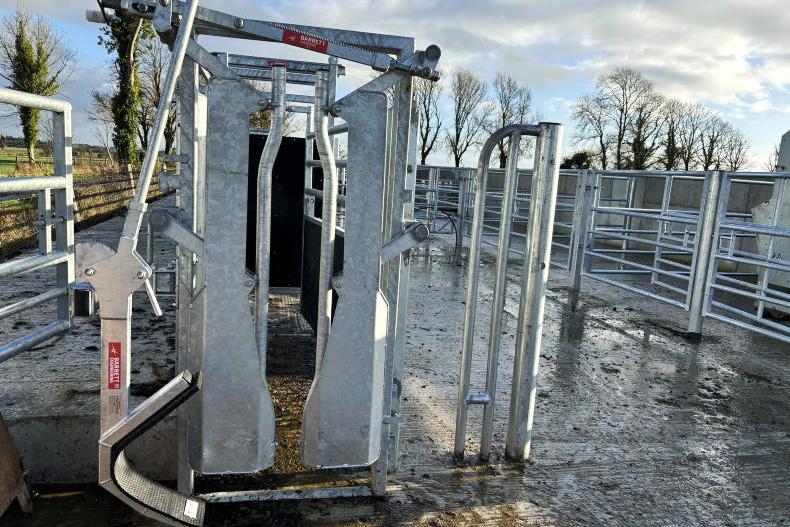
A head scoop is ideally suited to where there is access to both sides of the animals head.
5. Fixed unit with dip tank
Both farmers and vets are pointing to an increase in scab throughout Irish sheep flocks. One of the most effective ways of controlling this is through plunge dipping sheep, and while some farmers will opt to get a mobile sheep dipping unit hired in, a fixed dipping tub in-situ in the yard will allow for greater flexibility around when dipping is completed.
While not strictly coming in under €2,000 (unless you build a relatively small unit), adding on a dipping tub to a larger yard will increase the reference cost by €37.26/m2 compared to a fixed sheep yard without a dipping tub.
Reference cost: €140.97/m2.Planning permission required: yes.*planning permission will be required where this is part of a new build.
The minimum spend under TAMS III is €2,000. If you are selecting one of the above items and the cost or reference cost is below €2,000, then you will have to add an additional item to bring you to this threshold. Applications being below €2,000 is one of the most common reasons applications are rejected.Where items are classed as fixed and requiring planning permission, full planning permission or an exemption must be obtained before the application is submitted, and farmers must wait for full approval from the Department before proceeding with purchasing or building.
It’s been a pretty good year for suckler farmers, and sheep farmers to an extent, with good weather and high commodity prices making work easier and more financially rewarding.
With more cash in hand, farmers may be looking to spend on infrastructure and handling facilities to bring down any potential tax bill. With regard to animal handling for both sheep and cattle, many of these items will fall under the Farm Safety Capital Investment Scheme (FSCIS) which carries a 60% grant rate with it, making it a lucrative option for farmers, even where the reference costs aren’t in line with actual costs.
1. Semi-automatic skulling
gate and backing gate
A must have for farmers dealing with heavier cattle and suckler cows, the combination of the backing gate and skulling gate will make handling animals much safer. It can be incorporated in to an existing crush or as part of a new crush, which carries a reference cost of €132.67/linear metre for a single sided crush (crush against a wall) or €265.74 for a double sided crush. Ideally where it is incorporated in to a single sided crush, the first 2.4m of the crush (one cow length) should be angled out from the wall to allow access to both sides of the animal’s head.
Reference cost: €627.80.Planning permission required: no*.While weights aren’t everything when drafting lambs for slaughter, they are a useful guide when combined with handling animals. The weighing scale can be used with either a digital or old school clock, with some more high-tech units offering digital options only. The unit can be bought standalone or incorporated in to a larger sheep set up, and the reference cost is relatively accurate for simple, reliable scales.
Reference cost: €826.89.Planning permission required: no.Combined with an automatic/ semi-automatic skulling gate, a head scoop will take much of the donkey-work out of catching cattle for oral drenches. This item can be fitted to an existing crush or as part of a new handling unit, and again, access to both sides of the animal’s head is preferred.
Reference cost: €455.46.Planning permission required: no.
A batch footbath such as above would prove a valuable aid to farmers struggling to get on top of lameness /O'Donovan Engineering
4. Mobile sheep ‘batch’ footbath
The repeated advice of vets is that correct use of chemicals in treating diseases associated with lameness is as important as which chemical you chose.
Veterinary advice is now to hold animals in a batch footbath for between three and 10 minutes, depending on the severity of the issue, with animals then being held on a clean concrete surface to allow the chemical to penetrate in between the hoof digits.
Combined with some mobile penning (reference cost €33.74/linear metre) in a large concrete yard or passageway, a mobile batch footbath would be a wise investment for many farmers struggling to control lameness in their flock. Housing the batch footbath under a roof and using products that do not degrade could also reduce the volume of chemical used.
Reference cost: €842.68.Planning permission required: no.
A head scoop is ideally suited to where there is access to both sides of the animals head.
5. Fixed unit with dip tank
Both farmers and vets are pointing to an increase in scab throughout Irish sheep flocks. One of the most effective ways of controlling this is through plunge dipping sheep, and while some farmers will opt to get a mobile sheep dipping unit hired in, a fixed dipping tub in-situ in the yard will allow for greater flexibility around when dipping is completed.
While not strictly coming in under €2,000 (unless you build a relatively small unit), adding on a dipping tub to a larger yard will increase the reference cost by €37.26/m2 compared to a fixed sheep yard without a dipping tub.
Reference cost: €140.97/m2.Planning permission required: yes.*planning permission will be required where this is part of a new build.
The minimum spend under TAMS III is €2,000. If you are selecting one of the above items and the cost or reference cost is below €2,000, then you will have to add an additional item to bring you to this threshold. Applications being below €2,000 is one of the most common reasons applications are rejected.Where items are classed as fixed and requiring planning permission, full planning permission or an exemption must be obtained before the application is submitted, and farmers must wait for full approval from the Department before proceeding with purchasing or building. 






SHARING OPTIONS