Vastly different to the past two years, 2025 has seen good yields of straw and extremely high-quality bales relatively readily available.
Nearly all straw is now in sheds, be it on tillage farms, merchants yards or already on livestock holdings.
In reality, unless extremely well covered and lifted off the ground on pallets, straw still outside in fields or uncovered stacks will be of extremely variable quality, and dry-stored straw is likely a better buy
How much straw do I need?
Slatted tanks dominate the majority of animal housing and manure storage, mainly due to our limited tillage area and the greater specialisation in individual industries.
However, there is still a large requirement for bedding on livestock farms, primarily around calving, lambing and under youngstock (calves and weanlings).
Sheep/lambing
Looking at straw requirements for ewes, lowland ewes will require approximately 7kg straw for bedding each week to absorb all urine, while the requirement for hill ewes is significantly lower, at 4kg to 5kg.
In simpler terms, a typical 4x4 round bale of straw weighing 140kg will generally be sufficient to provide bedding for 18 to 20 lowland ewes and 30 to 35 hill ewes for a week.
This calculation is based on a silage diet, whereas where sheep are fed on a hay and haylage diet, there may be a saving of between 20-30% on the volume of bedding used.
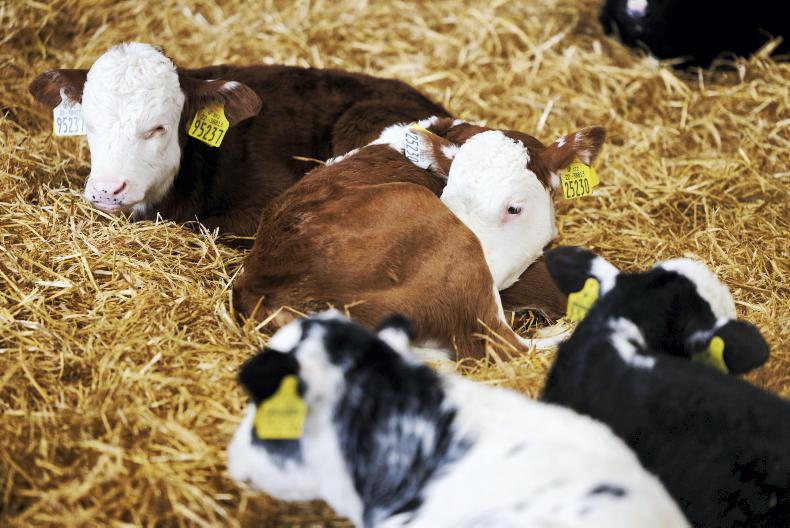
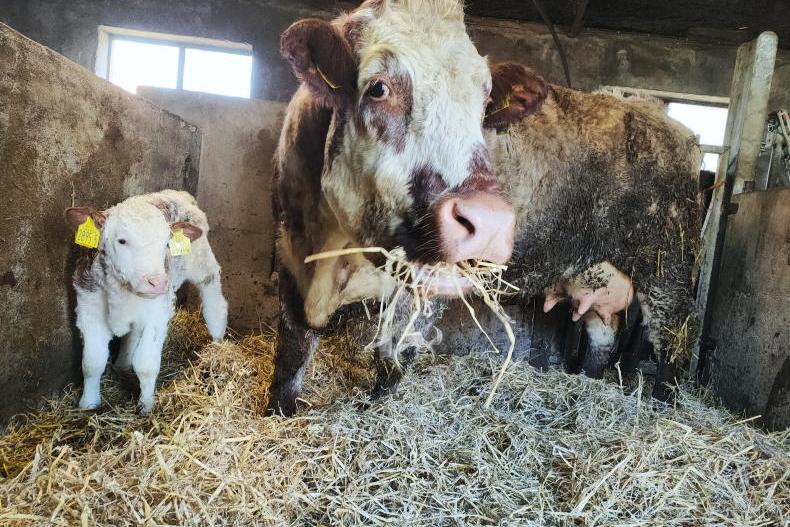
Young calves will require apporximately one 4x4 bale per 10 calves/week \ Donal O' Leary
Typically, four to five bales need to be factored in for every 100 ewes for bedding lambing pens, where ewes are turned out within 24 to 36 hours of delivering lambs.
In high-prolificacy flocks, this requirement should be increased by 20% to 30% to take account of the higher average litter size and need to keep lighter lambs indoors for longer.
While 2025 was an extremely kind spring and a rapid turnout post-lambing was seen, it’s always wise to factor in a 20% buffer to insure against shortages.
Suckler/dairy cows
A suckler/dairy cow will likely be housed on slatted floors/cubicles over the course of winter. However, the likelihood is that she will spend circa one week on average in and around calving on straw.
Teagasc estimates that cows require 49-55kg of straw per week, equivalent to roughly one third of a round bale. For me this is on the conservative side, and I would be budgeting closer to half a bale/cow/week, especially where individual calving boxes as opposed to batch calving is used.
Organic farmers, be they recent or veteran organic farmers, will likely adopt a system of feeding on slats, with a dry lie back area available.
With approximately 40% of dunging and urinating done while animals are eating, it’s safe to cut back the straw by 40% to 33kg-40kg/cow/week.
Weanlings/store cattle/finishing cattle
Finishing cattle (greater than two years old) will require a straw equivalent similar to that of suckler cows at 49kg/head/week, with this slightly reduced to 46kg/head/week for yearling cattle (above 450kg liveweight).
Weanlings (be they spring-born weaned cattle or autumn-born calves still suckling cows) weighing 250-450kg will require circa 26kg of straw per week.
Similar to the organic’s situation above, most finishing units in this country will incorporate bedded areas with slatted feeding areas, with the straw requirement suitably reduced then.
Calves
Calves are likely the most important animal on the list when it comes to getting it right with straw; skimping on straw for calves is a high risk: low reward action.
Both spring-born suckler calves with access to a creep area and dairy bred calves fed artificially will both require roughly 15kg of straw per week, equivalent to one small square bale or one round 4x4 bale per 10 calves/week.

Using bale choppers will lessen requirements by about 15%.
Even when calf coats are taken in to consideration for warmth, a dry bed needs to be kept under calves at all times to prevent disease build up and prevent energy being wasted on calves keeping themselves warm due to damp lying conditions.
Bale sizes and weights
Round 4x4 bales typically weigh 150kg on average, but can weigh 140kg to 180kg. Then 8x4x3 bales weigh about 360kg (range between 350kg to 380kg), while 8x4x4 bales vary more and can weigh just below 500kg to 600kg, with an average weight of 550kg.
While straw is generally sold by the tonne in the UK, in Ireland we remain selling it by the bale, with the result being the varying weights we see in the above bales.
Well-packed bales of chopped straw will contain significantly more volume than those made by older balers or those that have been ‘turned down’.
However, heavy bales of straw are not always a positive, and can often indicate damp straw rather than well-packed bales. Straw should be 15% or lower in moisture content to be stored without risk of rot.
Lessening straw requirements
While straw can not generally be skimped on without negatively impacting animal health and welfare, there are a number of measures farmers can take to reduce straw requirements.
Chopping straw: chopping straw, especially long, fibrous straw, will help break up the cuticle and increase absorbability, reducing straw requirements by about 10%. The real saving with straw chopping is in the labour reduced in spreading our bales through using a chopper. Where a straw chopper is not available, talking to your straw supplying tillage farmer before baling and striking up a deal to have bales chopped is an option.
Non-bedded feed areas: slatted or solid floors should be utilised where possible as standing areas for feeding to reduce straw usage. As mentioned above, up to 40% of dunging and urinating takes place when animals are feeding. While animals will likely not lie close to feed areas, the damp conditions underfoot by not bedding along barriers can lead to foot problems, especially in ewes or store lambs. Non-bedded feed areas can also be used for group calving, where cows have access to a slatted area for feeding with a straw lie back.
Limiting time on straw: with most straw being used at calving on dairy and suckler farms, having up-to-date calving dates and frequent checking for physical signs of calving (pin bones dropped, flagging of udder, softening of genitalia) will allow for accurate drafting of cows into calving boxes, so that cows spend ideally 24-36 hours on straw before calving. Storing straw
As mentioned, straw is best stored indoors. Ideally, it should be elevated from the ground on pallets to prevent dampness from the floor creeping on to the bottom bales of straw. Where open sided sheds are used (as is common) then covers or canopies should be used to prevent wind driven rain hitting straw.
We commonly get asked about wrapping straw for storage outdoors. While straw stored this way is generally fine, especially when of a low dry matter like this year’s straw, cost is quite prohibitive. With silage wrap at circa €100/roll and a roll covering approximately 33 bales, with four layers of film, costs for plastic alone are €3/bale.
Vastly different to the past two years, 2025 has seen good yields of straw and extremely high-quality bales relatively readily available.
Nearly all straw is now in sheds, be it on tillage farms, merchants yards or already on livestock holdings.
In reality, unless extremely well covered and lifted off the ground on pallets, straw still outside in fields or uncovered stacks will be of extremely variable quality, and dry-stored straw is likely a better buy
How much straw do I need?
Slatted tanks dominate the majority of animal housing and manure storage, mainly due to our limited tillage area and the greater specialisation in individual industries.
However, there is still a large requirement for bedding on livestock farms, primarily around calving, lambing and under youngstock (calves and weanlings).
Sheep/lambing
Looking at straw requirements for ewes, lowland ewes will require approximately 7kg straw for bedding each week to absorb all urine, while the requirement for hill ewes is significantly lower, at 4kg to 5kg.
In simpler terms, a typical 4x4 round bale of straw weighing 140kg will generally be sufficient to provide bedding for 18 to 20 lowland ewes and 30 to 35 hill ewes for a week.
This calculation is based on a silage diet, whereas where sheep are fed on a hay and haylage diet, there may be a saving of between 20-30% on the volume of bedding used.
Young calves will require apporximately one 4x4 bale per 10 calves/week \ Donal O' Leary
Typically, four to five bales need to be factored in for every 100 ewes for bedding lambing pens, where ewes are turned out within 24 to 36 hours of delivering lambs.
In high-prolificacy flocks, this requirement should be increased by 20% to 30% to take account of the higher average litter size and need to keep lighter lambs indoors for longer.
While 2025 was an extremely kind spring and a rapid turnout post-lambing was seen, it’s always wise to factor in a 20% buffer to insure against shortages.
Suckler/dairy cows
A suckler/dairy cow will likely be housed on slatted floors/cubicles over the course of winter. However, the likelihood is that she will spend circa one week on average in and around calving on straw.
Teagasc estimates that cows require 49-55kg of straw per week, equivalent to roughly one third of a round bale. For me this is on the conservative side, and I would be budgeting closer to half a bale/cow/week, especially where individual calving boxes as opposed to batch calving is used.
Organic farmers, be they recent or veteran organic farmers, will likely adopt a system of feeding on slats, with a dry lie back area available.
With approximately 40% of dunging and urinating done while animals are eating, it’s safe to cut back the straw by 40% to 33kg-40kg/cow/week.
Weanlings/store cattle/finishing cattle
Finishing cattle (greater than two years old) will require a straw equivalent similar to that of suckler cows at 49kg/head/week, with this slightly reduced to 46kg/head/week for yearling cattle (above 450kg liveweight).
Weanlings (be they spring-born weaned cattle or autumn-born calves still suckling cows) weighing 250-450kg will require circa 26kg of straw per week.
Similar to the organic’s situation above, most finishing units in this country will incorporate bedded areas with slatted feeding areas, with the straw requirement suitably reduced then.
Calves
Calves are likely the most important animal on the list when it comes to getting it right with straw; skimping on straw for calves is a high risk: low reward action.
Both spring-born suckler calves with access to a creep area and dairy bred calves fed artificially will both require roughly 15kg of straw per week, equivalent to one small square bale or one round 4x4 bale per 10 calves/week.
Using bale choppers will lessen requirements by about 15%.
Even when calf coats are taken in to consideration for warmth, a dry bed needs to be kept under calves at all times to prevent disease build up and prevent energy being wasted on calves keeping themselves warm due to damp lying conditions.
Bale sizes and weights
Round 4x4 bales typically weigh 150kg on average, but can weigh 140kg to 180kg. Then 8x4x3 bales weigh about 360kg (range between 350kg to 380kg), while 8x4x4 bales vary more and can weigh just below 500kg to 600kg, with an average weight of 550kg.
While straw is generally sold by the tonne in the UK, in Ireland we remain selling it by the bale, with the result being the varying weights we see in the above bales.
Well-packed bales of chopped straw will contain significantly more volume than those made by older balers or those that have been ‘turned down’.
However, heavy bales of straw are not always a positive, and can often indicate damp straw rather than well-packed bales. Straw should be 15% or lower in moisture content to be stored without risk of rot.
Lessening straw requirements
While straw can not generally be skimped on without negatively impacting animal health and welfare, there are a number of measures farmers can take to reduce straw requirements.
Chopping straw: chopping straw, especially long, fibrous straw, will help break up the cuticle and increase absorbability, reducing straw requirements by about 10%. The real saving with straw chopping is in the labour reduced in spreading our bales through using a chopper. Where a straw chopper is not available, talking to your straw supplying tillage farmer before baling and striking up a deal to have bales chopped is an option.
Non-bedded feed areas: slatted or solid floors should be utilised where possible as standing areas for feeding to reduce straw usage. As mentioned above, up to 40% of dunging and urinating takes place when animals are feeding. While animals will likely not lie close to feed areas, the damp conditions underfoot by not bedding along barriers can lead to foot problems, especially in ewes or store lambs. Non-bedded feed areas can also be used for group calving, where cows have access to a slatted area for feeding with a straw lie back.
Limiting time on straw: with most straw being used at calving on dairy and suckler farms, having up-to-date calving dates and frequent checking for physical signs of calving (pin bones dropped, flagging of udder, softening of genitalia) will allow for accurate drafting of cows into calving boxes, so that cows spend ideally 24-36 hours on straw before calving. Storing straw
As mentioned, straw is best stored indoors. Ideally, it should be elevated from the ground on pallets to prevent dampness from the floor creeping on to the bottom bales of straw. Where open sided sheds are used (as is common) then covers or canopies should be used to prevent wind driven rain hitting straw.
We commonly get asked about wrapping straw for storage outdoors. While straw stored this way is generally fine, especially when of a low dry matter like this year’s straw, cost is quite prohibitive. With silage wrap at circa €100/roll and a roll covering approximately 33 bales, with four layers of film, costs for plastic alone are €3/bale.







SHARING OPTIONS