At Stal de Muze in Belgium, breeding success has never been accidental but neither has it ever been hurried.
The de Brabander family’s world-class show jumping breeding programme has been built less on fashionable stallions and more on patient accumulation: one mare, then a daughter, then a granddaughter, until a line becomes recognisable in its own right. Many studs speak about families; Stal de Muze has spent decades quietly breeding them.
The talented Ultra Flip de Muze represents one of Stal de Muze’s most modern success stories, the H&M Butterfly Flip line, and, in many ways, also illustrates the stable’s philosophy in its purest form. Christophe de Brabander, son of world-respected breeder and dealer, Joris de Brabander, does not describe it as strategy so much as continuity.
“The story of this family has now reached its third chapter and fits perfectly with the philosophy on which we build our breeding programme. The foundation mare, H&M Butterfly Flip, came to our stable thanks to the efforts of the late Bjorn Van Bunder of Merelsnest Stud. The goal was to create a strong new mare line around her.
“With the sporting successes achieved with Malin Baryard-Johnsson, H&M Butterfly Flip’s record speaks for itself. Medals at European Championships, World Equestrian Games, and silver at the Olympic Games makes it a dream to work with such a mare.” Christophe says.
“The timing was perfect, as the great Vigo d’Arsouilles had just won World Championship gold in 2010. That cross almost felt written in the stars. Before coming to us, the mare had already produced offspring in Sweden, including the well-known Flip’s Little Sparrow.
“If we follow the old breeding wisdom ‘breed with the best to get the best’, this family is a perfect example of that philosophy in action.”
Strengthen the potential
For Christophe and his family, the de Muze emphasis remains on reinforcing proven performance – stallions chosen not to add novelty, but to underline what already works rather brilliantly.
“When we look at Ultra Flip’s dam line, every generation has been built with what we call a true ‘flag bearer’ of the stable. These stallions were selected to express and strengthen the potential we saw in the young mares. Sometimes with more success than others,” says Christophe.
“The cross with Mosito van het Hellehof was an important step. Quick Flip, the dam, is a first-generation daughter of his. It was not only about discovering the strength of the mare line but also about recognising Mosito’s qualities as a sire.
“A few years later, we chose Kasanova de la Pomme. As a young stallion, he was leased to Germany, where he was popular. As a son of Bamako de Muze out of the Qerly Chin line, and as Champion Stallion at the BWP approval, he had already proven his value.”
Breeders often debate whether scope or technique is the most heritable trait. Christophe’s answer is more practical, and arguably more modern.
“If I could choose one quality to pass on most reliably, I would hope for rideability. We always try to find pleasure in our breeding and in our daily work. Ultra is one of those stallions that simply makes you happy, both at home and in the ring. That said, we also expect him to pass on scope.
His pedigree is directly built on top-level sport, with mares that have proven themselves in competition. His offspring seem to inherit more of the dam’s type; good size, long-legged, and athletic in build,” he says.
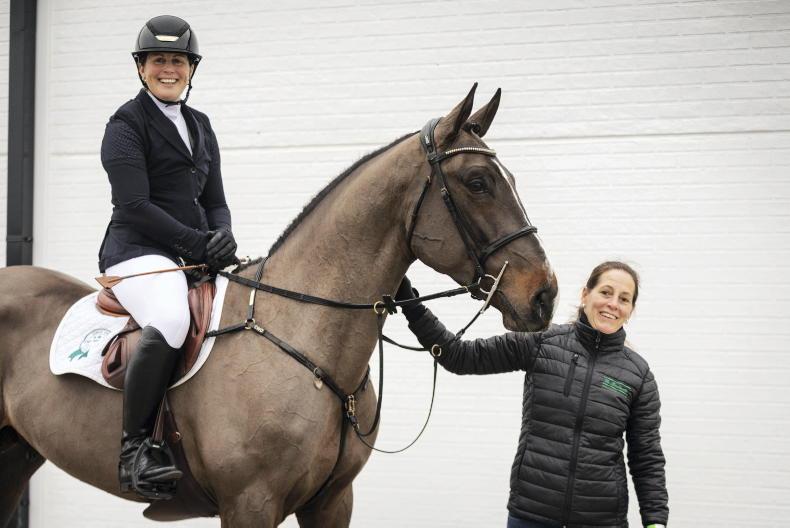
Ultra Flip de Muze.
For now, de Muze resists categorising Ultra Flip too early, something increasingly rare in a market eager for labels before offspring are even backed. “His first crop are now two-year-olds, and they already show correctness in type and model. It would not surprise me to see some of them at stallion approvals next year.
It is still too early to place him in one specific category. We believe he deserves every opportunity, both in sport and as a breeding stallion, supported by his genetically proven pedigree.”
Notably, even a programme as structured as this still allows room for timing.
“As often in life, there is always an element of coincidence. H&M Butterfly Flip arrived the year after Vigo became World Champion, so that cross was an obvious decision. Mosito was chosen because as a three-year-old he showed exceptional ability in free jumping. Sometimes you do not need to look far to be convinced.
The same applied to Kasanova, who was at the start of his sport career. Proven sport performance is the common thread in our breeding, and it has often given us the results we were hoping for.”
If you study his offspring, Ultra Flip de Muze certainly appears very versatile as a stallion so far.
“We are still discovering exactly what he passes on. For now, he seems to give a more athletic and sporty model than his own type suggests.
“To date, nothing specific has appeared that clearly suits or does not suit him. From next winter, when we start working more intensively with his first crop, we will know much more.”
If the sire attracts attention, the dam line remains the foundation.
“We place great importance on the immediate dam’s sport record. In recent years, we have focused strongly on connecting our stallions with proven top mares. These dam lines are built on solid, tested genetics and sport results.
“Having direct offspring from mares such as Carlina V, Fit For Fun and Oilily de Muze is quite unique. And we always welcome new additions of that level.”
Mentality, however, remains the least measurable, and perhaps most valued, inheritance. Christophe says on this, “Mentality is a complex concept, but it shows itself at important moments. A good example is Bamako de Muze, who is known for giving his rider confidence at every level, almost saying, ‘Enjoy the ride, I’ll take care of it!’
“It takes time to discover whether this quality is truly intrinsic.
But there are early signs: how he works daily, how he interacts in a group – even as a yearling. We prefer to observe carefully before judging.
“Joris’s experience is invaluable here. He often sees similarities with previous generations, especially with his grandsire Vigo and even Nabab de Rêve.”
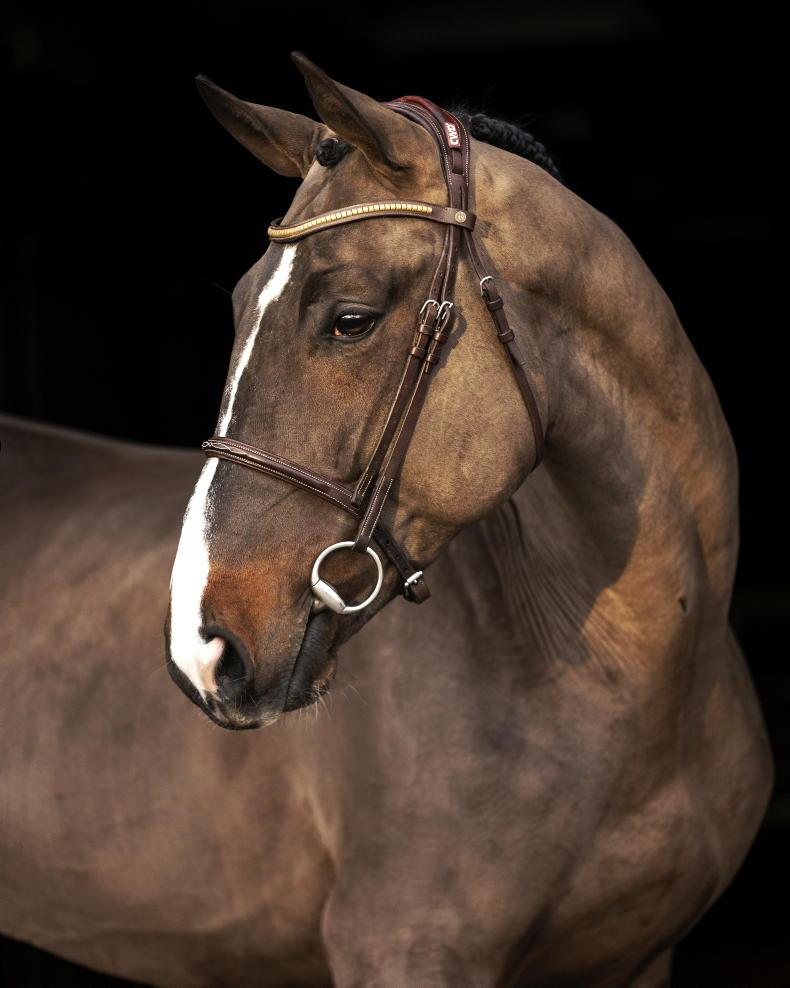
Ultra Flip de Muze.
Predicting production type is, in his view, a dangerous game.
“If I knew the answer to that, I would also give you next week’s lottery numbers.
“The sport has changed so much in recent decades that we must redefine what a championship horse really is. Our focus is mainly long-term. Correct conformation, quick technique, good balance, and rideability will ultimately determine durability and success.”
Systematic approach
Standing young stallions early is less science than observation and at de Muze time and consideration remain key.
“The only way to discover a stallion’s qualities is to work with him. That is always our systematic approach with our young horses. Some stallions need to convince you, others confirm their quality time and again.
Sometimes you should not overcomplicate things, give them time and proper attention. First of all, we hope to enjoy Ultra ourselves at the highest level of sport. That would prove both his jumping quality and durability.
“It would be even more special if some of his first-generation offspring could compete against him in the ring. Ultimately, it would be a pleasure to see him follow his three predecessors: Kasanova, Mosito and Vigo into the World Breeding Federation For Sport Horses sire rankings.”
Talk of Ireland immediately changes the tone. The respect is clearly genuine, and well-considered.
“Ireland is truly a horse country. Similar to the Belgians, the Irish have a special talent for recognising quality in horses.
“But what makes it so special is also the motivation to develop that talent fully. It is the combination of seeing potential and knowing how to work with it that makes the Irish system so successful.
“Ireland has a rich breeding history, strongly influenced by thoroughbred racing knowledge.
Often the goal is not to compensate for weaknesses, but to preserve quality into the next generation.
“In the past, stallion choices were sometimes influenced by availability. That is why we focus strongly on service – fresh semen collected daily and delivered the next day with payment only upon results. It’s a story we write together with breeders at Stal de Muze.
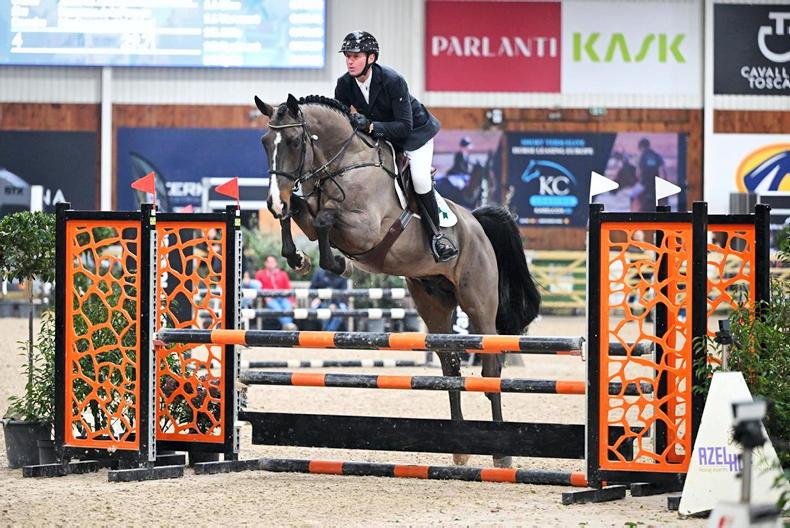
Ultra Flip de Muze.
“The culture between breeder and rider in Ireland is very close too. With so many talented riders, breeders always have the opportunity to discuss what modern sport requires. Open conversation leads to new ideas, not only in mare selection, but also in stallion choice. I believe both traditional and advanced breeding systems can coexist.
Techniques like ET and AI complement each other rather than compete. It will take time to find the perfect balance, but I do not believe one system will replace the other.”
Christophe’s advice to horse breeders remains almost stubbornly uncomplicated.
“First, identify the strengths of your mares. Then surround yourself with the right people to obtain proper advice before making decisions.
“Anyone who wants information is always welcome for a cup of tea at Stal de Muze. Service and after-service have become essential parts of the business.”
At Stal de Muze, the central philosophy still comes back to the same idea, not producing the next big horse but producing the next generation that makes champions inevitable.
At Stal de Muze in Belgium, breeding success has never been accidental but neither has it ever been hurried.
The de Brabander family’s world-class show jumping breeding programme has been built less on fashionable stallions and more on patient accumulation: one mare, then a daughter, then a granddaughter, until a line becomes recognisable in its own right. Many studs speak about families; Stal de Muze has spent decades quietly breeding them.
The talented Ultra Flip de Muze represents one of Stal de Muze’s most modern success stories, the H&M Butterfly Flip line, and, in many ways, also illustrates the stable’s philosophy in its purest form. Christophe de Brabander, son of world-respected breeder and dealer, Joris de Brabander, does not describe it as strategy so much as continuity.
“The story of this family has now reached its third chapter and fits perfectly with the philosophy on which we build our breeding programme. The foundation mare, H&M Butterfly Flip, came to our stable thanks to the efforts of the late Bjorn Van Bunder of Merelsnest Stud. The goal was to create a strong new mare line around her.
“With the sporting successes achieved with Malin Baryard-Johnsson, H&M Butterfly Flip’s record speaks for itself. Medals at European Championships, World Equestrian Games, and silver at the Olympic Games makes it a dream to work with such a mare.” Christophe says.
“The timing was perfect, as the great Vigo d’Arsouilles had just won World Championship gold in 2010. That cross almost felt written in the stars. Before coming to us, the mare had already produced offspring in Sweden, including the well-known Flip’s Little Sparrow.
“If we follow the old breeding wisdom ‘breed with the best to get the best’, this family is a perfect example of that philosophy in action.”
Strengthen the potential
For Christophe and his family, the de Muze emphasis remains on reinforcing proven performance – stallions chosen not to add novelty, but to underline what already works rather brilliantly.
“When we look at Ultra Flip’s dam line, every generation has been built with what we call a true ‘flag bearer’ of the stable. These stallions were selected to express and strengthen the potential we saw in the young mares. Sometimes with more success than others,” says Christophe.
“The cross with Mosito van het Hellehof was an important step. Quick Flip, the dam, is a first-generation daughter of his. It was not only about discovering the strength of the mare line but also about recognising Mosito’s qualities as a sire.
“A few years later, we chose Kasanova de la Pomme. As a young stallion, he was leased to Germany, where he was popular. As a son of Bamako de Muze out of the Qerly Chin line, and as Champion Stallion at the BWP approval, he had already proven his value.”
Breeders often debate whether scope or technique is the most heritable trait. Christophe’s answer is more practical, and arguably more modern.
“If I could choose one quality to pass on most reliably, I would hope for rideability. We always try to find pleasure in our breeding and in our daily work. Ultra is one of those stallions that simply makes you happy, both at home and in the ring. That said, we also expect him to pass on scope.
His pedigree is directly built on top-level sport, with mares that have proven themselves in competition. His offspring seem to inherit more of the dam’s type; good size, long-legged, and athletic in build,” he says.
Ultra Flip de Muze.
For now, de Muze resists categorising Ultra Flip too early, something increasingly rare in a market eager for labels before offspring are even backed. “His first crop are now two-year-olds, and they already show correctness in type and model. It would not surprise me to see some of them at stallion approvals next year.
It is still too early to place him in one specific category. We believe he deserves every opportunity, both in sport and as a breeding stallion, supported by his genetically proven pedigree.”
Notably, even a programme as structured as this still allows room for timing.
“As often in life, there is always an element of coincidence. H&M Butterfly Flip arrived the year after Vigo became World Champion, so that cross was an obvious decision. Mosito was chosen because as a three-year-old he showed exceptional ability in free jumping. Sometimes you do not need to look far to be convinced.
The same applied to Kasanova, who was at the start of his sport career. Proven sport performance is the common thread in our breeding, and it has often given us the results we were hoping for.”
If you study his offspring, Ultra Flip de Muze certainly appears very versatile as a stallion so far.
“We are still discovering exactly what he passes on. For now, he seems to give a more athletic and sporty model than his own type suggests.
“To date, nothing specific has appeared that clearly suits or does not suit him. From next winter, when we start working more intensively with his first crop, we will know much more.”
If the sire attracts attention, the dam line remains the foundation.
“We place great importance on the immediate dam’s sport record. In recent years, we have focused strongly on connecting our stallions with proven top mares. These dam lines are built on solid, tested genetics and sport results.
“Having direct offspring from mares such as Carlina V, Fit For Fun and Oilily de Muze is quite unique. And we always welcome new additions of that level.”
Mentality, however, remains the least measurable, and perhaps most valued, inheritance. Christophe says on this, “Mentality is a complex concept, but it shows itself at important moments. A good example is Bamako de Muze, who is known for giving his rider confidence at every level, almost saying, ‘Enjoy the ride, I’ll take care of it!’
“It takes time to discover whether this quality is truly intrinsic.
But there are early signs: how he works daily, how he interacts in a group – even as a yearling. We prefer to observe carefully before judging.
“Joris’s experience is invaluable here. He often sees similarities with previous generations, especially with his grandsire Vigo and even Nabab de Rêve.”
Ultra Flip de Muze.
Predicting production type is, in his view, a dangerous game.
“If I knew the answer to that, I would also give you next week’s lottery numbers.
“The sport has changed so much in recent decades that we must redefine what a championship horse really is. Our focus is mainly long-term. Correct conformation, quick technique, good balance, and rideability will ultimately determine durability and success.”
Systematic approach
Standing young stallions early is less science than observation and at de Muze time and consideration remain key.
“The only way to discover a stallion’s qualities is to work with him. That is always our systematic approach with our young horses. Some stallions need to convince you, others confirm their quality time and again.
Sometimes you should not overcomplicate things, give them time and proper attention. First of all, we hope to enjoy Ultra ourselves at the highest level of sport. That would prove both his jumping quality and durability.
“It would be even more special if some of his first-generation offspring could compete against him in the ring. Ultimately, it would be a pleasure to see him follow his three predecessors: Kasanova, Mosito and Vigo into the World Breeding Federation For Sport Horses sire rankings.”
Talk of Ireland immediately changes the tone. The respect is clearly genuine, and well-considered.
“Ireland is truly a horse country. Similar to the Belgians, the Irish have a special talent for recognising quality in horses.
“But what makes it so special is also the motivation to develop that talent fully. It is the combination of seeing potential and knowing how to work with it that makes the Irish system so successful.
“Ireland has a rich breeding history, strongly influenced by thoroughbred racing knowledge.
Often the goal is not to compensate for weaknesses, but to preserve quality into the next generation.
“In the past, stallion choices were sometimes influenced by availability. That is why we focus strongly on service – fresh semen collected daily and delivered the next day with payment only upon results. It’s a story we write together with breeders at Stal de Muze.
Ultra Flip de Muze.
“The culture between breeder and rider in Ireland is very close too. With so many talented riders, breeders always have the opportunity to discuss what modern sport requires. Open conversation leads to new ideas, not only in mare selection, but also in stallion choice. I believe both traditional and advanced breeding systems can coexist.
Techniques like ET and AI complement each other rather than compete. It will take time to find the perfect balance, but I do not believe one system will replace the other.”
Christophe’s advice to horse breeders remains almost stubbornly uncomplicated.
“First, identify the strengths of your mares. Then surround yourself with the right people to obtain proper advice before making decisions.
“Anyone who wants information is always welcome for a cup of tea at Stal de Muze. Service and after-service have become essential parts of the business.”
At Stal de Muze, the central philosophy still comes back to the same idea, not producing the next big horse but producing the next generation that makes champions inevitable.





SHARING OPTIONS