It was only relatively recently, in the late 2010s, when the term ‘adulting’ came into our vocabulary. The idea behind it – that an adult is no longer someone that you are but something that you do – took off, and it was shortlisted by Oxford Dictionary for its Word of the Year designation in 2016.
Perhaps one of the reasons why the noun-turned-verb became so relatable so fast was because it captured the kind of dislocation in how young adults see themselves contrasted with the duties they have to perform. Lots of people in their 20s or 30s don’t feel grown up. Yes, they might have learnt to drive, completed a college degree or got a job. But the fact that many young adults in Ireland are still living in their parental homes leaves them feeling like they haven’t fully entered adulthood.
Across Europe as a whole, the percentage of students living in the parental home has been increasing over time. But the increase has been largest in Ireland, according to a new report by Eurofound, a European Union agency that researches living and working conditions.
Ireland has seen the biggest increase in the proportion of 25 to 34-year-olds living in the parental home out of all European countries over a five-year period. In 2018, the figure stood at 23% and this jumped to 40% by 2023, an increase of 17%.
Marie Hyland, one of the authors of the Eurofound report, tells Irish Country Living that Ireland also “stands out” as a country that “has very little on offer that is affordable”, particularly in the rental segment of the market.
The Eurofound report maps Europe’s rental market affordability for young adults by analysing the share of a young adult’s monthly wage required to rent a starter flat. If you are spending roughly 30% or less of your salary on your rent, that is generally considered affordable. But in Ireland, more than 60% of a young adult’s average wage is required to rent a standard two-room apartment, and above 80% in some regions. What this means, in practical terms, is that two incomes are likely required to be able to rent a starter flat, making it hard for solo adults to leave the parental home.
Back at home
Jack Bergin (25) is back in his parental home in Riverchapel, a village just outside Gorey in Co Wexford. He moved back home three years ago, after graduating from college in Dublin where he had lived during his studies.
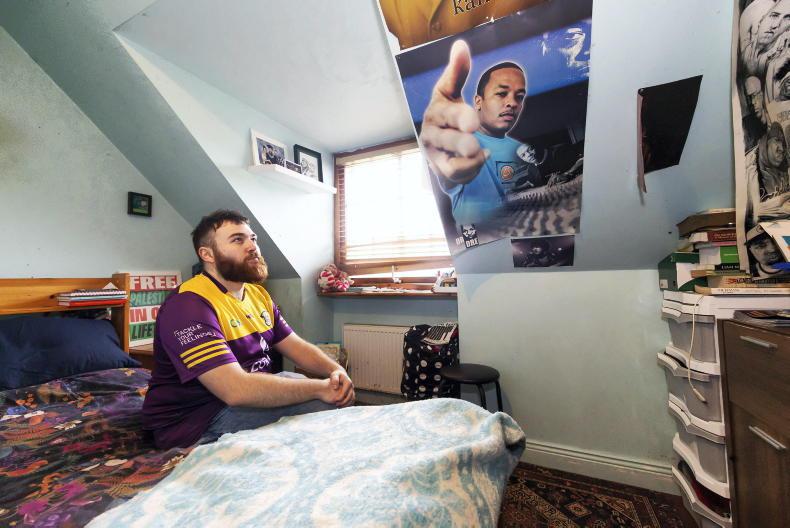
“I live in a converted bedroom that used to be a bathroom. It’s kind of funny but it’s fine. It’s just how I’m used to things now.”
Jack works in Maynooth, and he makes the two-and-a-half-hour commute to Kildare at least three days a week – what he describes as a “weird transport scenario”.
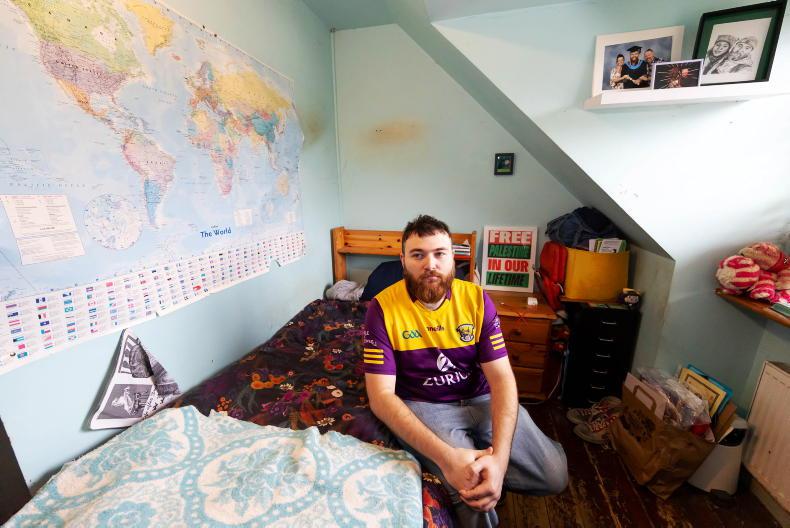
Jack Bergin photographed in his bedroom in Riverchapel, Co Wexford. \ Mary Browne
“I’m on a bus for a good four to five hours a day.” Jack is also learning to drive and waiting for a date to sit his test.
“I contribute to the house, paying for the bills and the shopping. But I am ultimately at home because I really need to save as much as possible. It makes more sense for me to do this and the two-and-a-half-hour commute than it is to rent somewhere. That’s the picture put very plainly.
Jack is also a representative for CATU (Community Action Tenants Union) for the South Wicklow-Wexford branch. He says that, in Gorey, “the average rent is anything between €1,300 to potentially €1,700”.
The Bergin family home is busy. Four of Jack’s five siblings (aged between 14 and 30 years old) all live under the same roof.
He says he is fortunate to have a good relationship with his siblings and parents. Jack points out that when his parents were his age, they were living in Drimnagh in Dublin city “because it was possible back then”. He adds, “I won’t be able to reach that milestone.
“I find that I am doing a lot of things that are just not typical of an adult in their 20s. I’d try to find some sort of outlet, read or try to chat with friends or listen to music, but you don’t even have a space for yourself.
“You can go into your room and then you’re locked away. If I’m at home, I should also be contributing to a big house that constantly needs cleaning, constantly needs maintaining, with lots of us at home, including teenagers. You’re tending to many different things at once, but you don’t have a space for yourself. That does affect my wellbeing.
“For me, on a personal level, it’s really hard to think long-term or focus. Even if I’m working from home, I find it really difficult to focus. There’s no real environment for me to work or study.
“Because it’s a busy house, it’s hard to switch off. There’s no sense of routine at all. This kind of lifestyle enables executive dysfunction, or enables your ability to make decisions that are less effective or less long-term.
“Maybe when I turn 30, I might be able to look towards getting a mortgage or something. But I just don’t know either because we recently had a roof leak and our back door has been broken. I have to contribute in some way to help the family home. I give back to my parents in that kind of way.”
Couples living at home
Moving home to save for a deposit is usually intended as a short-term plan, but for some, it becomes a much longer, open-ended chapter.
This is the case for Alanagh Tennanty (31) who moved back into her parental home outside Trim in Co Meath four years ago.
“My initial process was to get home and save for a year and a half or two years, and then be ready to buy.”

Alanagh Tennanty moved back into her parental home outside Trim, Co Meath.
“My partner Philip and I are together three years, and we’re looking at buying a house. Both of us are living in our family homes. Thankfully, we only live about 15 minutes away from each other. But it does mean we’re both heavily reliant on the car to get around the place, and it also means we are living in our childhood bedrooms. That itself comes with its challenges.”
Alanagh is the only one of her four other siblings to be at home. “Look, it has good days and bad days,” she says, honestly.
“I’m really, really grateful. And I get along so well with my parents most of the time. I’m so lucky that I have the opportunity to live at home, but I am a 31-year-old woman. I am working a full-time job, and I’m doing quite well in work as well.
“To be basically stuck in my childhood bedroom actually feels like a slap in the face a lot of mornings.”
With no space for themselves, Alanagh and her partner are “kind of at a stage where we just need some space, some time together ourselves.
“So we’ll book a weekend away and that’s always welcome. We’re spending money going away, but it’s nearly out of a necessity for our relationship that we do that.
“At home, I give €200 a month, which is nothing, but it is just something to keep some of the lights on. I do my own grocery shopping, I do my own washing. I live as independently as possible.
“Thankfully, again, we’re so lucky that we have our deposit ready to go. We have a nice deposit saved – and we worked damn hard for it as well – but it’s now a process with the banks and getting the mortgage. And then of course, there’s the challenge of actually finding somewhere to buy.”
The couple’s difficulty in finding a suitable home to buy is reflected in new ESRI research that shows home buying in Ireland is characterised by conveyancing delays and online bidding systems that encourage people to overbid.
“Hopefully this year is going to be the end. Or else we’re just going to go mad this year.”
It was only relatively recently, in the late 2010s, when the term ‘adulting’ came into our vocabulary. The idea behind it – that an adult is no longer someone that you are but something that you do – took off, and it was shortlisted by Oxford Dictionary for its Word of the Year designation in 2016.
Perhaps one of the reasons why the noun-turned-verb became so relatable so fast was because it captured the kind of dislocation in how young adults see themselves contrasted with the duties they have to perform. Lots of people in their 20s or 30s don’t feel grown up. Yes, they might have learnt to drive, completed a college degree or got a job. But the fact that many young adults in Ireland are still living in their parental homes leaves them feeling like they haven’t fully entered adulthood.
Across Europe as a whole, the percentage of students living in the parental home has been increasing over time. But the increase has been largest in Ireland, according to a new report by Eurofound, a European Union agency that researches living and working conditions.
Ireland has seen the biggest increase in the proportion of 25 to 34-year-olds living in the parental home out of all European countries over a five-year period. In 2018, the figure stood at 23% and this jumped to 40% by 2023, an increase of 17%.
Marie Hyland, one of the authors of the Eurofound report, tells Irish Country Living that Ireland also “stands out” as a country that “has very little on offer that is affordable”, particularly in the rental segment of the market.
The Eurofound report maps Europe’s rental market affordability for young adults by analysing the share of a young adult’s monthly wage required to rent a starter flat. If you are spending roughly 30% or less of your salary on your rent, that is generally considered affordable. But in Ireland, more than 60% of a young adult’s average wage is required to rent a standard two-room apartment, and above 80% in some regions. What this means, in practical terms, is that two incomes are likely required to be able to rent a starter flat, making it hard for solo adults to leave the parental home.
Back at home
Jack Bergin (25) is back in his parental home in Riverchapel, a village just outside Gorey in Co Wexford. He moved back home three years ago, after graduating from college in Dublin where he had lived during his studies.
“I live in a converted bedroom that used to be a bathroom. It’s kind of funny but it’s fine. It’s just how I’m used to things now.”
Jack works in Maynooth, and he makes the two-and-a-half-hour commute to Kildare at least three days a week – what he describes as a “weird transport scenario”.
Jack Bergin photographed in his bedroom in Riverchapel, Co Wexford. \ Mary Browne
“I’m on a bus for a good four to five hours a day.” Jack is also learning to drive and waiting for a date to sit his test.
“I contribute to the house, paying for the bills and the shopping. But I am ultimately at home because I really need to save as much as possible. It makes more sense for me to do this and the two-and-a-half-hour commute than it is to rent somewhere. That’s the picture put very plainly.
Jack is also a representative for CATU (Community Action Tenants Union) for the South Wicklow-Wexford branch. He says that, in Gorey, “the average rent is anything between €1,300 to potentially €1,700”.
The Bergin family home is busy. Four of Jack’s five siblings (aged between 14 and 30 years old) all live under the same roof.
He says he is fortunate to have a good relationship with his siblings and parents. Jack points out that when his parents were his age, they were living in Drimnagh in Dublin city “because it was possible back then”. He adds, “I won’t be able to reach that milestone.
“I find that I am doing a lot of things that are just not typical of an adult in their 20s. I’d try to find some sort of outlet, read or try to chat with friends or listen to music, but you don’t even have a space for yourself.
“You can go into your room and then you’re locked away. If I’m at home, I should also be contributing to a big house that constantly needs cleaning, constantly needs maintaining, with lots of us at home, including teenagers. You’re tending to many different things at once, but you don’t have a space for yourself. That does affect my wellbeing.
“For me, on a personal level, it’s really hard to think long-term or focus. Even if I’m working from home, I find it really difficult to focus. There’s no real environment for me to work or study.
“Because it’s a busy house, it’s hard to switch off. There’s no sense of routine at all. This kind of lifestyle enables executive dysfunction, or enables your ability to make decisions that are less effective or less long-term.
“Maybe when I turn 30, I might be able to look towards getting a mortgage or something. But I just don’t know either because we recently had a roof leak and our back door has been broken. I have to contribute in some way to help the family home. I give back to my parents in that kind of way.”
Couples living at home
Moving home to save for a deposit is usually intended as a short-term plan, but for some, it becomes a much longer, open-ended chapter.
This is the case for Alanagh Tennanty (31) who moved back into her parental home outside Trim in Co Meath four years ago.
“My initial process was to get home and save for a year and a half or two years, and then be ready to buy.”
Alanagh Tennanty moved back into her parental home outside Trim, Co Meath.
“My partner Philip and I are together three years, and we’re looking at buying a house. Both of us are living in our family homes. Thankfully, we only live about 15 minutes away from each other. But it does mean we’re both heavily reliant on the car to get around the place, and it also means we are living in our childhood bedrooms. That itself comes with its challenges.”
Alanagh is the only one of her four other siblings to be at home. “Look, it has good days and bad days,” she says, honestly.
“I’m really, really grateful. And I get along so well with my parents most of the time. I’m so lucky that I have the opportunity to live at home, but I am a 31-year-old woman. I am working a full-time job, and I’m doing quite well in work as well.
“To be basically stuck in my childhood bedroom actually feels like a slap in the face a lot of mornings.”
With no space for themselves, Alanagh and her partner are “kind of at a stage where we just need some space, some time together ourselves.
“So we’ll book a weekend away and that’s always welcome. We’re spending money going away, but it’s nearly out of a necessity for our relationship that we do that.
“At home, I give €200 a month, which is nothing, but it is just something to keep some of the lights on. I do my own grocery shopping, I do my own washing. I live as independently as possible.
“Thankfully, again, we’re so lucky that we have our deposit ready to go. We have a nice deposit saved – and we worked damn hard for it as well – but it’s now a process with the banks and getting the mortgage. And then of course, there’s the challenge of actually finding somewhere to buy.”
The couple’s difficulty in finding a suitable home to buy is reflected in new ESRI research that shows home buying in Ireland is characterised by conveyancing delays and online bidding systems that encourage people to overbid.
“Hopefully this year is going to be the end. Or else we’re just going to go mad this year.”






SHARING OPTIONS