Ever wondered what young person are thinking about these days? The Stripe Young Scientist & Technology Exhibition (YSTE), which took place last week in the RDS in Dublin, provides a snapshot into what makes Ireland’s young people tick and the kind of problems they want to solve.
Both AI and sustainability were standout themes this year. One quarter of projects focused on or used AI, whilst sustainability and climate change entries increased 41% from last year.
It may have been the 62nd Young Scientist & Technology Exhibition, but it was the first that Stripe, the payments company founded by two Tipperary brothers, has hosted the competition as the title sponsor – taking over from BT.
Stripe cofounders, Patrick and John Collison, participated in the Young Scientist & Technology Exhibition over two decades ago. Addressing over 1,000 students in this year’s opening ceremony, Patrick said that winning the competition in 2005 changed the course of his life.
Incidentally, someone who also has strong memories of that moment 21 years ago is Jamie Heaslip, the former Irish rugby captain who has worked for Stripe for the past five years. The Leinster player recalls being in the RDS and seeing Patrick scoop the top prize.
“I was training up in Donnybrook, and I popped in and saw Patrick actually win it back in 2005,” he says.
“So when we [Stripe] won the bid [for title sponsorship], it was this lovely full circle moment for myself, Patrick, John.
“It had a massive influence on them in terms of sparking that curiosity. They followed that path of curiosity that science and technology gave them at a young age.”
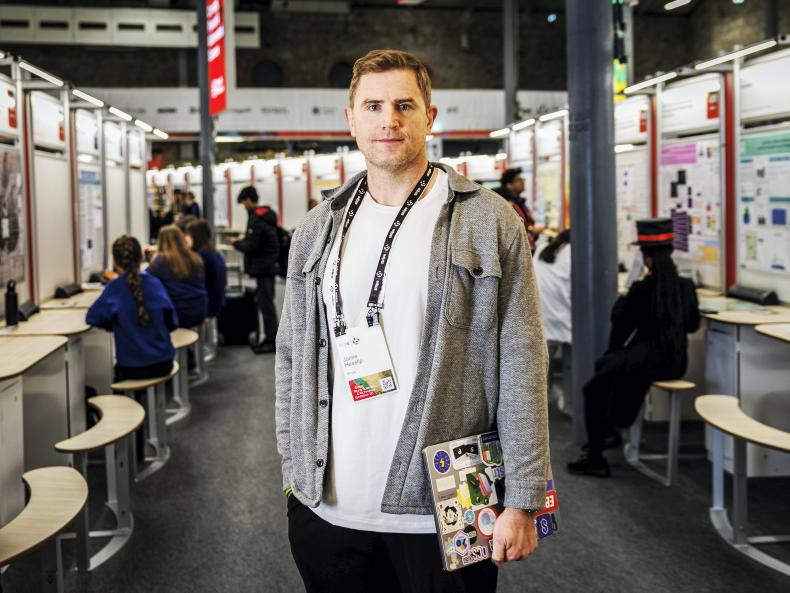
Jamie Heaslip is the EMEA Alliances and Channels Growth Lead at Stripe. \ Philip Doyle
Reflecting on this year’s competition, Jamie says: “It’s just really interesting to see what students are considerate about. It makes me feel incredibly stupid [compared to] when I go back to when I was a student, and not as worldly thinking as a lot of them now.”
Evidently, any ideas related to sport and health pique Jamie’s interest. “There’s one project that I’ve seen about the effect of the inflation pressure of a rugby ball,” he says with a grin.
Top prizes
This year, Aoibheann Daly from Mercy Secondary School Mounthawk in Kerry won the competition, taking home the Stripe YSTE trophy for her project to improve the treatment of brain cancer. Aoibheann’s project is designed to help doctors to predict what genetic mutation is likely to be present from a simple MRI brain scan, so they can make quicker treatment decisions and reduce risk for the cancer patient.
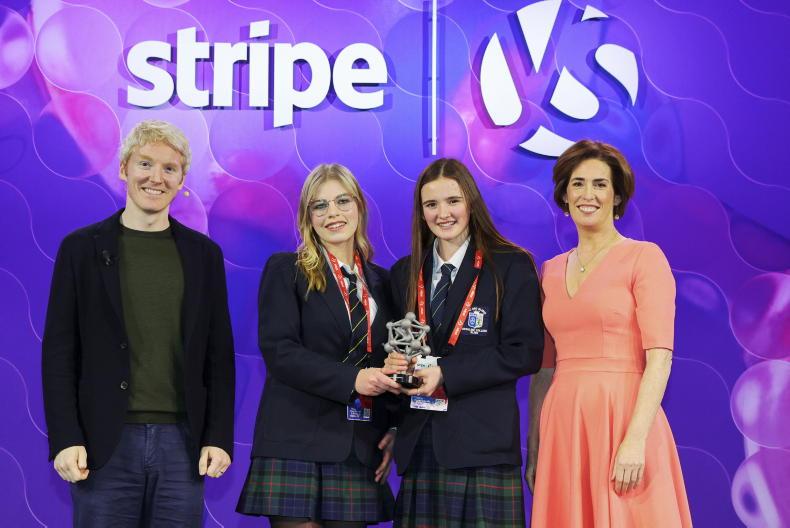
Aoife Fadian and Jessica O’Connor from Ursuline College in Sligo were named Best Group, with their project using sheep’s wool to reinforce concrete.
Like many of the agricultural projects, Aoife and Jessica took inspiration for their project from conversations unfolding on the farm.
“Sheep wool is a waste product and farmers are struggling to sell it. My dad [a sheep farmer] doesn’t stop complaining that he can never sell the sheep wool,” Aoife explains.
“Polypropylene fibres are what is currently used in concrete to strengthen it. But it’s plastic so it’s really unsustainable and it’s really bad for the environment,” she says. “So we wondered about using sheep wool instead.”
Last year, Aoife and Jessica did some initial testing to see if sheep wool worked as an alternative. They found it completely outperformed polypropylene in terms of cost and energy efficiency.
Just like Patrick Collison, who won on his second year entering the competition, the Sligo students used 2025 as an opportunity to refine and improve on their project, following excellent feedback from the judges.
Over the past 12 months, Aoife and Jessica have made 200 sample blocks of concrete using sheep wool, one of which they had on display at their stall.
They also partnered with a construction company in Germany and academia as part of their research.
“Last year, all the judges were saying, there’s so much more you can do with your project. So, this year, our aim was to expand on our work and refine the type of sheep wool that worked.”
Aoife and Jessica tested 15 different varieties of sheep wool and found that raw sheep wool soaked in salt water performed the best.
One of the biggest challenges facing the agricultural sector is methane emission reduction, and every year students come up with creative ways to wrap their arms around the problem.
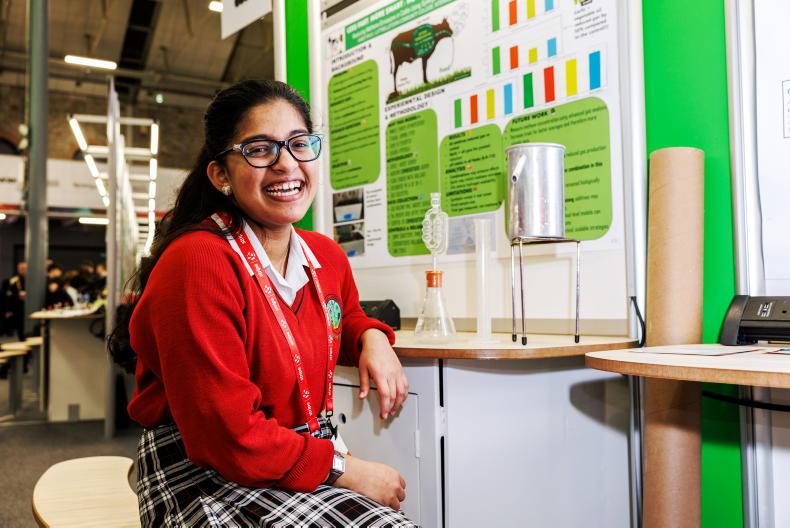
Aimee Maju, from Luttrellstrown Community College in Dublin, is looking at what cattle are fed to reduce methane emissions. \ Philip Doyle
One such student is Aimee Maju (15) from Luttrellstrown Community College in Dublin.
“I’m trying to reduce the fatality of cow farts,” Aimee jokes, “but in scientific terms, the project investigates how to reduce methane emissions using synergistic natural feed additives. I wanted to do something within climate change and greenhouse gas emissions.”
Aimee’s project looks at combining natural feed additives rather than using single ingredients, and she tested mixtures of garlic powder, vegetable oil and seaweed to see which is most effective.
“Garlic powder and vegetable oil was the strongest combination,” she says.
“Another main point of this project is to make sure that the combinations and the model is accessible, low-cost and is ethical for both small-scale farmers and large-scale farmers alike. If we want to reduce methane emissions, we’re not just targeting large-scale farmers, we’re also targeting small-scale farmers.”
Farm safety
Given the amount of serious accidents that occur on farms every year, it was little wonder to see farm safety surfacing among agricultural exhibits.
After one of their cattle was injured in an incident involving a slurry tank, Riordan O’Driscoll and Jack O’Donoghue wanted to do something about it.
The pair from De La Salle College, Co Cork designed and created an aluminium manhole cover for a slurry tank to reduce farm fatalities.
“The reason we decided to do it is because one of our cows decided to go for a bit of a swim in the slaughter pit, and just fell into it,” says Riordan.
They made an aluminium manhole cover, added features like a safety cage, and tested it with farmers. “Everyone has been saying, we could do with it on the farm. It isn’t out there [at the moment],” says Jack.
Learning is a process
Walking out of the RDS, it’s hard not to be hopeful about the future. We undoubtedly face many pressing challenges, but the next generation are already working on them.
It’s a feeling articulated by Nina Carberry MEP, who, reflecting on the agricultural exhibitions, told Irish Country Living: “I think it’s excellent. It’s so wonderful to see so many kids here. There’s a range of projects as well.
“Kids are so much more engaged with the environment now and they want to make it better. That’s a key theme for today that I’ve found. The kids want to have an impact on the environment as well.”
Ever wondered what young person are thinking about these days? The Stripe Young Scientist & Technology Exhibition (YSTE), which took place last week in the RDS in Dublin, provides a snapshot into what makes Ireland’s young people tick and the kind of problems they want to solve.
Both AI and sustainability were standout themes this year. One quarter of projects focused on or used AI, whilst sustainability and climate change entries increased 41% from last year.
It may have been the 62nd Young Scientist & Technology Exhibition, but it was the first that Stripe, the payments company founded by two Tipperary brothers, has hosted the competition as the title sponsor – taking over from BT.
Stripe cofounders, Patrick and John Collison, participated in the Young Scientist & Technology Exhibition over two decades ago. Addressing over 1,000 students in this year’s opening ceremony, Patrick said that winning the competition in 2005 changed the course of his life.
Incidentally, someone who also has strong memories of that moment 21 years ago is Jamie Heaslip, the former Irish rugby captain who has worked for Stripe for the past five years. The Leinster player recalls being in the RDS and seeing Patrick scoop the top prize.
“I was training up in Donnybrook, and I popped in and saw Patrick actually win it back in 2005,” he says.
“So when we [Stripe] won the bid [for title sponsorship], it was this lovely full circle moment for myself, Patrick, John.
“It had a massive influence on them in terms of sparking that curiosity. They followed that path of curiosity that science and technology gave them at a young age.”
Jamie Heaslip is the EMEA Alliances and Channels Growth Lead at Stripe. \ Philip Doyle
Reflecting on this year’s competition, Jamie says: “It’s just really interesting to see what students are considerate about. It makes me feel incredibly stupid [compared to] when I go back to when I was a student, and not as worldly thinking as a lot of them now.”
Evidently, any ideas related to sport and health pique Jamie’s interest. “There’s one project that I’ve seen about the effect of the inflation pressure of a rugby ball,” he says with a grin.
Top prizes
This year, Aoibheann Daly from Mercy Secondary School Mounthawk in Kerry won the competition, taking home the Stripe YSTE trophy for her project to improve the treatment of brain cancer. Aoibheann’s project is designed to help doctors to predict what genetic mutation is likely to be present from a simple MRI brain scan, so they can make quicker treatment decisions and reduce risk for the cancer patient.
Aoife Fadian and Jessica O’Connor from Ursuline College in Sligo were named Best Group, with their project using sheep’s wool to reinforce concrete.
Like many of the agricultural projects, Aoife and Jessica took inspiration for their project from conversations unfolding on the farm.
“Sheep wool is a waste product and farmers are struggling to sell it. My dad [a sheep farmer] doesn’t stop complaining that he can never sell the sheep wool,” Aoife explains.
“Polypropylene fibres are what is currently used in concrete to strengthen it. But it’s plastic so it’s really unsustainable and it’s really bad for the environment,” she says. “So we wondered about using sheep wool instead.”
Last year, Aoife and Jessica did some initial testing to see if sheep wool worked as an alternative. They found it completely outperformed polypropylene in terms of cost and energy efficiency.
Just like Patrick Collison, who won on his second year entering the competition, the Sligo students used 2025 as an opportunity to refine and improve on their project, following excellent feedback from the judges.
Over the past 12 months, Aoife and Jessica have made 200 sample blocks of concrete using sheep wool, one of which they had on display at their stall.
They also partnered with a construction company in Germany and academia as part of their research.
“Last year, all the judges were saying, there’s so much more you can do with your project. So, this year, our aim was to expand on our work and refine the type of sheep wool that worked.”
Aoife and Jessica tested 15 different varieties of sheep wool and found that raw sheep wool soaked in salt water performed the best.
One of the biggest challenges facing the agricultural sector is methane emission reduction, and every year students come up with creative ways to wrap their arms around the problem.
Aimee Maju, from Luttrellstrown Community College in Dublin, is looking at what cattle are fed to reduce methane emissions. \ Philip Doyle
One such student is Aimee Maju (15) from Luttrellstrown Community College in Dublin.
“I’m trying to reduce the fatality of cow farts,” Aimee jokes, “but in scientific terms, the project investigates how to reduce methane emissions using synergistic natural feed additives. I wanted to do something within climate change and greenhouse gas emissions.”
Aimee’s project looks at combining natural feed additives rather than using single ingredients, and she tested mixtures of garlic powder, vegetable oil and seaweed to see which is most effective.
“Garlic powder and vegetable oil was the strongest combination,” she says.
“Another main point of this project is to make sure that the combinations and the model is accessible, low-cost and is ethical for both small-scale farmers and large-scale farmers alike. If we want to reduce methane emissions, we’re not just targeting large-scale farmers, we’re also targeting small-scale farmers.”
Farm safety
Given the amount of serious accidents that occur on farms every year, it was little wonder to see farm safety surfacing among agricultural exhibits.
After one of their cattle was injured in an incident involving a slurry tank, Riordan O’Driscoll and Jack O’Donoghue wanted to do something about it.
The pair from De La Salle College, Co Cork designed and created an aluminium manhole cover for a slurry tank to reduce farm fatalities.
“The reason we decided to do it is because one of our cows decided to go for a bit of a swim in the slaughter pit, and just fell into it,” says Riordan.
They made an aluminium manhole cover, added features like a safety cage, and tested it with farmers. “Everyone has been saying, we could do with it on the farm. It isn’t out there [at the moment],” says Jack.
Learning is a process
Walking out of the RDS, it’s hard not to be hopeful about the future. We undoubtedly face many pressing challenges, but the next generation are already working on them.
It’s a feeling articulated by Nina Carberry MEP, who, reflecting on the agricultural exhibitions, told Irish Country Living: “I think it’s excellent. It’s so wonderful to see so many kids here. There’s a range of projects as well.
“Kids are so much more engaged with the environment now and they want to make it better. That’s a key theme for today that I’ve found. The kids want to have an impact on the environment as well.”





SHARING OPTIONS