With their strong upright canes in green, grey and blue, creating impressive clumps of evergreen foliage, bamboo has great presence in the garden. They are structural and permanent, which is useful when designing a garden planting scheme that needs signature plants tying the design together. They can work just as well as trees do in dividing a garden space or providing privacy.
Bamboo is a member of the grass family which might seem strange to some, however if you look at a stalk of grass you immediately see the similarity. Bamboo canes are known as culms.
When using bamboo in your garden you must distinguish between clumpers and runners. Clumping bamboos have short, thick rhizomes that stay close to the plant forming the clump. Running bamboos have long, spreading rhizomes that travel outward and become invasive, but that can have its uses too.
Lets focus first on the clumping varieties, which are my favourites and the ones that I most recommend to gardeners. Fargesia, as a bamboo group are native to the high elevation alpine conifer forests of east and southeast Asia. There are about 80 species in all and countless cultivars. As a group they range in height from 1m to 5m tall.
Fargesia murieliae ‘Bimbo’ grows to 1m high. It has a compact growth resembling a fountain with thin canes, perfect for the small garden or growing in pots or containers. F. murieliae ‘Lava’ is also a small plant attaining 1.5m. It has light green canes that are fountain shaped arching under the weight of fine grey green leaves. It can also be grown in a pot or container.
When growing bamboo in containers, watering is critical for success as they do not tolerate drought. Fargesia murieliae ‘Simba’ is taller, growing to 2m but still compact growing. It has green yellowish canes holding its fresh green lance shaped leaves. Similar again is Fargesia murieliae ‘Jumbo’, but more vigorous with yellow green canes and bright green foliage. It will reach 3m in height, which is very useful for enclosing a space or hiding unsightly objects.
F. murieliae ‘Winter Joy’ is beautiful with its dusky blue canes and delicate green foliage. Truly a joy in winter. It is a good clumper that can reach up to 4m, so it needs careful placing in the garden to show it off to best advantage.
Black Bamboo
Fargesia nitida is commonly known as the ‘Black Bamboo’. It is stunning and certainly brings a black colour to the garden and with blue grey bloom to the canes.
I have seen this grown with the bottom third of its height stripped of foliage and this highlights this feature better. F. nitida ‘Volcano’ is commonly called the red fountain bamboo because of its light brown canes and drooping green leaves,
Look out for F. nitida ‘Blackpearl’ with light green drooping foliage, a lovely contrast to the dark canes. It can reach heights up to 4m, an impressive sight.
If it is height you require and are looking for something to dominate any space use Thamnocalamus crassinodus ‘Kew Beauty’, it was named at Royal Botanic Gardens, Kew, for its beauty and size. It was selected from plants collected in the Himalayas. It has purple-blue canes and can get to 5m in height.
Cultivation: bamboos prefer a sheltered spot to grow, as they are a woodland species. They like bright light but with dappled shade. The are not happy in coastal or windswept gardens. They tolerate most soil types, however, moist fertile soil that does not get waterlogged or indeed is prone to drought is preferred.
Pruning is necessary only to maintain shape. Remove the oldest canes that are losing colour by cutting them out at ground level.
Plant combinations: all bamboo species are best appreciated where space is available allowing them to grow to their full potential, unhindered.
It is best to position them where they will work to achieve your desired design. Never plant where they will be overpowered by competing plants, as this will not get you best value for money.
The species discussed have foliage which is fine and with low growing types, a simple rule to follow is to underplant with larger foliaged but low growing plants like Bergenia, Hosta, Ajuga, Brunnera, Helleborus and Epimedium. With taller bamboo species, under plant with ornamental
Rhubarb palmatum, Ligularia desdemona, Farfugium japonicum, Hosta ‘Empress Wu’. Using this planting method, you get a lovely contrast of shape and form.
Q&A: How can I prevent weed growth?
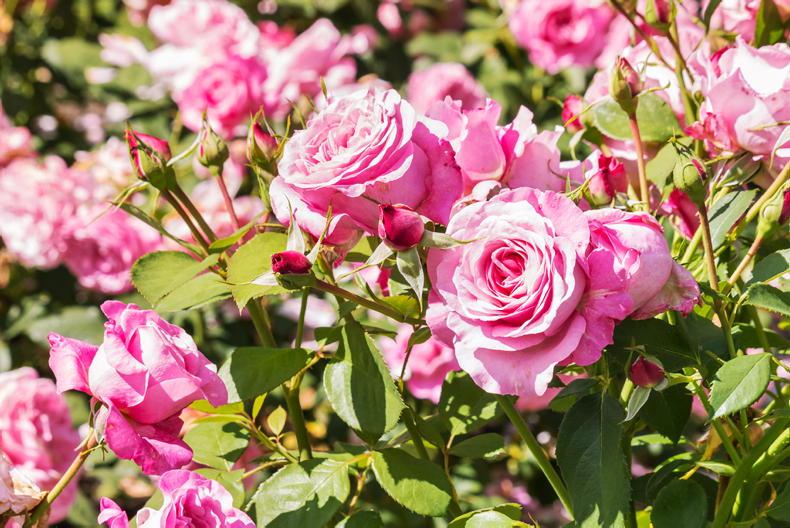
Pink double tea roses in bloom. \iStock
Can you advise on the best way to prevent weed growth in my rose beds? Hoeing did not work for me last year and weeds are appearing now. – Jim, Co Sligo.
We have had a very mild and wet winter and weed growth is certainly happening now. Hoeing is generally a good way to control weeds, however, only when the weeds are at the seedling stage. Larger weeds which may contain seed might perpetuate the problem. I don’t recommend a chemical approach as there are better ways.
I suggest you clean your beds now of all weed growth. Depending on the size of your beds, I suggest overlaying it with some soil-based compost. Once you have done that, mulch heavily with fine bark mulch. For certain success before you apply the mulch, line the bed with landscape fabric, which is available from good garden centres.
Trees, shrubs and roses: there is still time to do some pruning to shrubs to keep them in shape, in particular remove any crossing branches. Begin rose
pruning now by removing old woody stems, leaving young fresher growth.
Flowers: decide what your
summer bedding requirements are and purchase seed, now available in
garden centres.
Lawn: in most parts of the country lawns are still very wet so avoid any foot traffic where possible. If water is still lying, use a digging fork to create small drainage holes.
With their strong upright canes in green, grey and blue, creating impressive clumps of evergreen foliage, bamboo has great presence in the garden. They are structural and permanent, which is useful when designing a garden planting scheme that needs signature plants tying the design together. They can work just as well as trees do in dividing a garden space or providing privacy.
Bamboo is a member of the grass family which might seem strange to some, however if you look at a stalk of grass you immediately see the similarity. Bamboo canes are known as culms.
When using bamboo in your garden you must distinguish between clumpers and runners. Clumping bamboos have short, thick rhizomes that stay close to the plant forming the clump. Running bamboos have long, spreading rhizomes that travel outward and become invasive, but that can have its uses too.
Lets focus first on the clumping varieties, which are my favourites and the ones that I most recommend to gardeners. Fargesia, as a bamboo group are native to the high elevation alpine conifer forests of east and southeast Asia. There are about 80 species in all and countless cultivars. As a group they range in height from 1m to 5m tall.
Fargesia murieliae ‘Bimbo’ grows to 1m high. It has a compact growth resembling a fountain with thin canes, perfect for the small garden or growing in pots or containers. F. murieliae ‘Lava’ is also a small plant attaining 1.5m. It has light green canes that are fountain shaped arching under the weight of fine grey green leaves. It can also be grown in a pot or container.
When growing bamboo in containers, watering is critical for success as they do not tolerate drought. Fargesia murieliae ‘Simba’ is taller, growing to 2m but still compact growing. It has green yellowish canes holding its fresh green lance shaped leaves. Similar again is Fargesia murieliae ‘Jumbo’, but more vigorous with yellow green canes and bright green foliage. It will reach 3m in height, which is very useful for enclosing a space or hiding unsightly objects.
F. murieliae ‘Winter Joy’ is beautiful with its dusky blue canes and delicate green foliage. Truly a joy in winter. It is a good clumper that can reach up to 4m, so it needs careful placing in the garden to show it off to best advantage.
Black Bamboo
Fargesia nitida is commonly known as the ‘Black Bamboo’. It is stunning and certainly brings a black colour to the garden and with blue grey bloom to the canes.
I have seen this grown with the bottom third of its height stripped of foliage and this highlights this feature better. F. nitida ‘Volcano’ is commonly called the red fountain bamboo because of its light brown canes and drooping green leaves,
Look out for F. nitida ‘Blackpearl’ with light green drooping foliage, a lovely contrast to the dark canes. It can reach heights up to 4m, an impressive sight.
If it is height you require and are looking for something to dominate any space use Thamnocalamus crassinodus ‘Kew Beauty’, it was named at Royal Botanic Gardens, Kew, for its beauty and size. It was selected from plants collected in the Himalayas. It has purple-blue canes and can get to 5m in height.
Cultivation: bamboos prefer a sheltered spot to grow, as they are a woodland species. They like bright light but with dappled shade. The are not happy in coastal or windswept gardens. They tolerate most soil types, however, moist fertile soil that does not get waterlogged or indeed is prone to drought is preferred.
Pruning is necessary only to maintain shape. Remove the oldest canes that are losing colour by cutting them out at ground level.
Plant combinations: all bamboo species are best appreciated where space is available allowing them to grow to their full potential, unhindered.
It is best to position them where they will work to achieve your desired design. Never plant where they will be overpowered by competing plants, as this will not get you best value for money.
The species discussed have foliage which is fine and with low growing types, a simple rule to follow is to underplant with larger foliaged but low growing plants like Bergenia, Hosta, Ajuga, Brunnera, Helleborus and Epimedium. With taller bamboo species, under plant with ornamental
Rhubarb palmatum, Ligularia desdemona, Farfugium japonicum, Hosta ‘Empress Wu’. Using this planting method, you get a lovely contrast of shape and form.
Q&A: How can I prevent weed growth?
Pink double tea roses in bloom. \iStock
Can you advise on the best way to prevent weed growth in my rose beds? Hoeing did not work for me last year and weeds are appearing now. – Jim, Co Sligo.
We have had a very mild and wet winter and weed growth is certainly happening now. Hoeing is generally a good way to control weeds, however, only when the weeds are at the seedling stage. Larger weeds which may contain seed might perpetuate the problem. I don’t recommend a chemical approach as there are better ways.
I suggest you clean your beds now of all weed growth. Depending on the size of your beds, I suggest overlaying it with some soil-based compost. Once you have done that, mulch heavily with fine bark mulch. For certain success before you apply the mulch, line the bed with landscape fabric, which is available from good garden centres.
Trees, shrubs and roses: there is still time to do some pruning to shrubs to keep them in shape, in particular remove any crossing branches. Begin rose
pruning now by removing old woody stems, leaving young fresher growth.
Flowers: decide what your
summer bedding requirements are and purchase seed, now available in
garden centres.
Lawn: in most parts of the country lawns are still very wet so avoid any foot traffic where possible. If water is still lying, use a digging fork to create small drainage holes.





SHARING OPTIONS