That uplifting feeling of turning a corner in spring and being greeted by a sudden pop of colour or unexpected fragrance is one of the great joys of gardening. It’s the reward for wrapping up and venturing outside, even on cold, gloomy spring days.
A few days ago, while cutting back last year’s old growth in a perennial border, I stood up for a moment to stretch and spotted a haze of soft yellow in the distance. Having woken from its winter slumber, Corylopsis pauciflora, a relative of witch hazel, was bursting into life. Closer investigation revealed masses of bell-shaped, sweetly scented, primrose-yellow flowers all along its bare branches.
For most of the year, it’s an anonymous-looking shrub but for a valuable few weeks in spring, it becomes a picture of understated beauty. It prefers an acid soil and because our garden soil is alkaline, we grow it in a raised bed filled with an ericaceous compost. Here, its delicate flowers are shown to best advantage against the dark evergreen foliage of rhododendrons and pieris.
Beneath it is a swathe of Pulmonaria ‘Blue Ensign’, one of the first perennials to bloom in our garden. It offers showy clusters of bright, gentian blue flowers above broad, fuzzy, dark green leaves. At the front of a nearby border, Pulmonaria ‘Raspberry Splash’ is also in peak bloom with clusters of raspberry-red, bell-shaped flowers that fade to purple as they mature. Narrow, pointed, deep green leaves, dotted with pale silvery-green spots, it makes a lovely contrast for the flowers. Pulmonarias are great for shady areas of the garden and are perfect for weaving through beds and borders as weed-suppressing ground cover.
Elsewhere in the garden, another ground-covering perennial, Pachyphragma macrophyllum has colonised a section of the shaded embankment beside the stream, forming a carpet of glossy, almost circular leaves with softly scalloped edges. In spring, frothy clusters of tiny, gleaming white flowers hover above the foliage and harmonise beautifully with the white-eyed, bright blue, forget-me-not-like flowers of Omphalodes cappadocica.
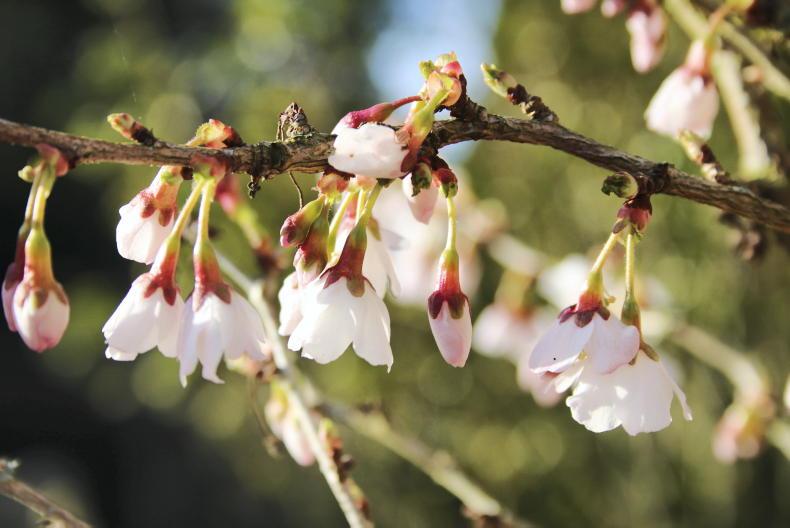
In a sunnier spot, the first buds are opening on the dwarf flowering cherry, Prunus incisa ‘Kojo-no-mai’. It’s distinctive, zig-zagging stems will soon be smothered in dainty, pink-tinged white blossoms. Forming a vase-shaped shrub to around 1.2m tall and wide, it offers multi-season interest, making it ideal for a small garden. Bronze-tinged new leaves follow the spring flowers, while autumn brings vibrant shades of orange and red before the foliage falls. Several camellias are also in bloom, their exotic, waxy flowers set against handsome, glossy, evergreen foliage. These shrubs prefer neutral to acidic soil, but gardeners with alkaline or lime-rich soil can still grow them successfully in containers or raised beds filled with lime-free ericaceous compost. In our garden, we have found camellias surprisingly tolerant of slightly alkaline soil, provided it is regularly enriched with well-rotted leaf mould.
Each spring, we also apply a liquid feed of sequestered iron plant tonic around their root area. This supplies iron, along with magnesium and manganese, to help correct deficiencies that can occur in limey soils, thus enabling the plants to thrive.
One of my favourites is Camellia x williamsii ‘Jury’s Yellow’. The colour is that of clotted cream, tinged with yellow in the centre, and it flowers with outstanding abundance. I also like Camellia x williamsii ‘Golden Spangles’, not just for its single, bright pink flowers, but also for its striking variegated foliage.
The leaves are dark green with a central splash of soft greenish yellow, providing subtle colour long after the flowers have faded.
Make sure to position camellias in a spot that avoids strong morning sun. This helps to prolong the life of the flowers when blooming and reduces damage after frost. A sheltered position in dappled shade is ideal in a north or west-facing aspect.
Not so subtle are the brilliant yellow flowers of Forsythia x intermedia ‘Mikador’. The vivid blooms appear before the foliage emerges, bringing a cheerful burst of sunshine to the garden at a time when colour is still scarce.
Make sure to position camellias in a spot that avoids strong morning sun
In our garden, it grows against the bright green backdrop of an evergreen leylandii hedge, which shows off the flowers to striking effect. Once the display fades, its mid-green leaves can look rather plain, so it’s worth planning nearby planting to provide summer interest.
Mary Keenan and Ross Doyle run Gash Gardens, Co Laois. www.gashgardens.ie
Q&A: Can I propagate my dahlias?
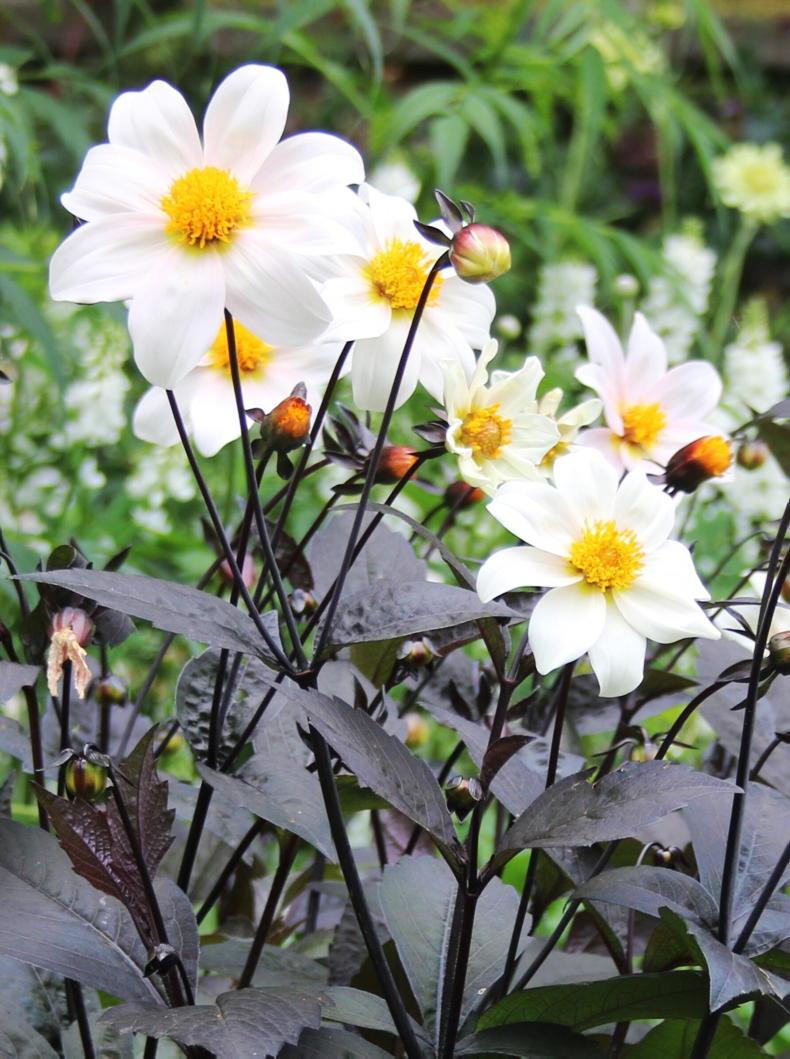
Expand your planting of dahlias, such as Dahlia ‘Twyning’s After Eight’, by taking cuttings from tubers in spring.
I‘ve heard that you can propagate dahlias from over-wintered tubers before replanting them outdoors. How can I do this? – Niamh, Co Clare
From mid-February to April, start the tubers by planting them shallowly, with the tops exposed into trays of moist potting compost. Place in a greenhouse or on windowsill.
When the new shoots reach about 8cm, use a sharp knife to cut a shoot right at the base, ideally with a small sliver of tuber attached. Trim off the lower leaves and pinch out the tip to form a cutting. Insert into a pot of gritty compost and place in a heated propagator or a polythene bag indoors.
In about four weeks, the cuttings will have formed roots. Carefully pot each individually into a 7.5cm pot and grow on. Plant out after the risk of frosts has passed. They will flower later the same summer and form tubers.
Lawn: redefine your lawn edges using a half-moon edging iron or sharp spade to cut a clean, 90-degree
vertical edge between the grass and the border. This will make it easier to regularly trim the edges with
edging shears while instantly creating a smart appearance.
Containers: start feeding permanent plants growing in containers to replenish nutrients lost over the winter and fuel new growth. Use slow-release pellets mixed into the surface layer of compost, or apply regular liquid feeds, such as seaweed extract.
That uplifting feeling of turning a corner in spring and being greeted by a sudden pop of colour or unexpected fragrance is one of the great joys of gardening. It’s the reward for wrapping up and venturing outside, even on cold, gloomy spring days.
A few days ago, while cutting back last year’s old growth in a perennial border, I stood up for a moment to stretch and spotted a haze of soft yellow in the distance. Having woken from its winter slumber, Corylopsis pauciflora, a relative of witch hazel, was bursting into life. Closer investigation revealed masses of bell-shaped, sweetly scented, primrose-yellow flowers all along its bare branches.
For most of the year, it’s an anonymous-looking shrub but for a valuable few weeks in spring, it becomes a picture of understated beauty. It prefers an acid soil and because our garden soil is alkaline, we grow it in a raised bed filled with an ericaceous compost. Here, its delicate flowers are shown to best advantage against the dark evergreen foliage of rhododendrons and pieris.
Beneath it is a swathe of Pulmonaria ‘Blue Ensign’, one of the first perennials to bloom in our garden. It offers showy clusters of bright, gentian blue flowers above broad, fuzzy, dark green leaves. At the front of a nearby border, Pulmonaria ‘Raspberry Splash’ is also in peak bloom with clusters of raspberry-red, bell-shaped flowers that fade to purple as they mature. Narrow, pointed, deep green leaves, dotted with pale silvery-green spots, it makes a lovely contrast for the flowers. Pulmonarias are great for shady areas of the garden and are perfect for weaving through beds and borders as weed-suppressing ground cover.
Elsewhere in the garden, another ground-covering perennial, Pachyphragma macrophyllum has colonised a section of the shaded embankment beside the stream, forming a carpet of glossy, almost circular leaves with softly scalloped edges. In spring, frothy clusters of tiny, gleaming white flowers hover above the foliage and harmonise beautifully with the white-eyed, bright blue, forget-me-not-like flowers of Omphalodes cappadocica.
In a sunnier spot, the first buds are opening on the dwarf flowering cherry, Prunus incisa ‘Kojo-no-mai’. It’s distinctive, zig-zagging stems will soon be smothered in dainty, pink-tinged white blossoms. Forming a vase-shaped shrub to around 1.2m tall and wide, it offers multi-season interest, making it ideal for a small garden. Bronze-tinged new leaves follow the spring flowers, while autumn brings vibrant shades of orange and red before the foliage falls. Several camellias are also in bloom, their exotic, waxy flowers set against handsome, glossy, evergreen foliage. These shrubs prefer neutral to acidic soil, but gardeners with alkaline or lime-rich soil can still grow them successfully in containers or raised beds filled with lime-free ericaceous compost. In our garden, we have found camellias surprisingly tolerant of slightly alkaline soil, provided it is regularly enriched with well-rotted leaf mould.
Each spring, we also apply a liquid feed of sequestered iron plant tonic around their root area. This supplies iron, along with magnesium and manganese, to help correct deficiencies that can occur in limey soils, thus enabling the plants to thrive.
One of my favourites is Camellia x williamsii ‘Jury’s Yellow’. The colour is that of clotted cream, tinged with yellow in the centre, and it flowers with outstanding abundance. I also like Camellia x williamsii ‘Golden Spangles’, not just for its single, bright pink flowers, but also for its striking variegated foliage.
The leaves are dark green with a central splash of soft greenish yellow, providing subtle colour long after the flowers have faded.
Make sure to position camellias in a spot that avoids strong morning sun. This helps to prolong the life of the flowers when blooming and reduces damage after frost. A sheltered position in dappled shade is ideal in a north or west-facing aspect.
Not so subtle are the brilliant yellow flowers of Forsythia x intermedia ‘Mikador’. The vivid blooms appear before the foliage emerges, bringing a cheerful burst of sunshine to the garden at a time when colour is still scarce.
Make sure to position camellias in a spot that avoids strong morning sun
In our garden, it grows against the bright green backdrop of an evergreen leylandii hedge, which shows off the flowers to striking effect. Once the display fades, its mid-green leaves can look rather plain, so it’s worth planning nearby planting to provide summer interest.
Mary Keenan and Ross Doyle run Gash Gardens, Co Laois. www.gashgardens.ie
Q&A: Can I propagate my dahlias?
Expand your planting of dahlias, such as Dahlia ‘Twyning’s After Eight’, by taking cuttings from tubers in spring.
I‘ve heard that you can propagate dahlias from over-wintered tubers before replanting them outdoors. How can I do this? – Niamh, Co Clare
From mid-February to April, start the tubers by planting them shallowly, with the tops exposed into trays of moist potting compost. Place in a greenhouse or on windowsill.
When the new shoots reach about 8cm, use a sharp knife to cut a shoot right at the base, ideally with a small sliver of tuber attached. Trim off the lower leaves and pinch out the tip to form a cutting. Insert into a pot of gritty compost and place in a heated propagator or a polythene bag indoors.
In about four weeks, the cuttings will have formed roots. Carefully pot each individually into a 7.5cm pot and grow on. Plant out after the risk of frosts has passed. They will flower later the same summer and form tubers.
Lawn: redefine your lawn edges using a half-moon edging iron or sharp spade to cut a clean, 90-degree
vertical edge between the grass and the border. This will make it easier to regularly trim the edges with
edging shears while instantly creating a smart appearance.
Containers: start feeding permanent plants growing in containers to replenish nutrients lost over the winter and fuel new growth. Use slow-release pellets mixed into the surface layer of compost, or apply regular liquid feeds, such as seaweed extract.







SHARING OPTIONS