‘We can’t go over it. We can’t go under it. We have to go through it.” This a refrain chanted again and again in the picture book, We’re Going On A Bear Hunt, written by Michael Rosen. The story charts a family who set off in search of bears, only to be set back on their journey by thick oozy mud, a big dark forest, a swirling whirling snowstorm, among other natural obstacles.
Each time the family encounter a stumbling block, the line is repeated. “We can’t go over it. We can’t go under it. We have to go through it.”
It may be a children’s storybook, but the lesson of ‘having to go through it’ is something we constantly come back to in adult life. Particularly when it comes to grief and mourning the loss of someone we love. Like the thick oozy mud, grief must be waded through. Step-by-step.
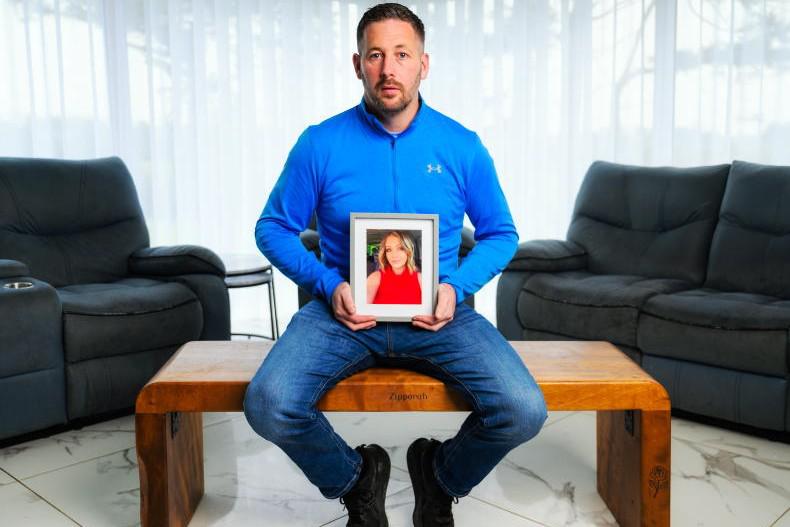
Widow Bernard Branagan is someone who knows there are no shortcuts when it comes to navigating pain and loss. Bernard’s wife, Zipporah, died on 29 April of this year, leaving behind her husband and seven sons: Noah (11), Theo (9), Teddy (8), Isaac (7), Hugo (3), Ezra (2) and Cooper (1).
Zipporah was 34 years old, and described by Bernard as an “unbelievable” person. “She loved people and she loved seeing people happy. She was special,” he tells Irish Country Living. Bernard and Zipporah were together for 13 years and married for eight.
The Branagan family home in Hilltown, Co Down, is full of photographs of Zipporah. She is pictured alongside Bernard and their seven sons: her smile beaming from every corner in the kitchen and every shelf in the hallway.
Sudden death
Zipporah’s death was very sudden and the family still do not have answers as to why she died. Bernard explains that he drove Zipporah to A&E in Daisy Hill Hospital in Newry on Monday morning because she “wasn’t feeling great” after complaining of a headache the day before.
“After I dropped her in A&E, I came home and picked the boys up and she rang me and told me: they’re going to admit me.
“I packed her a few clothes and went back to the hospital. She told me to kiss the boys and tell them she’d be there in the morning. That evening she rang me to tell me she was in a ward and felt a lot better and that she was going to go to sleep.” He pauses. “And that was it.”
“I got a phone call at 1.49am saying to come to hospital. There was a problem with my wife. 1.49am changed our lives forever. That night broke me.” Bernard was “broken again” the next morning when he had to tell his sons what had happened.
Wiping away tears and taking some breaks as he talks, it is extremely difficult and emotional for Bernard to share the story of losing his beloved wife. But he wants to start a conversation around grief “to help others”.
“Grief is a taboo subject”, he says. “Everyone is afraid to speak about grief. Death is something that is real because it happens every single day. But we don’t talk about it.”
Having grown up on a sheep and beef farm just down the road, Bernard feels his message is important for farmers who “are not surrounded by loads of people or support” and who struggle to talk about their feelings. “Growing up in the farm, I saw how my father was a closed off person,” he reflects. “I saw my father crying for the first time when he walked in the door on the morning that he found out Zipporah was dead. I’ve never seen him cry over anything my whole life.”
Bernard says he encourages his seven boys to cry and to process emotions and talk about how they are feeling. “I never cried in my life but I find it very difficult not to now,” he says.
“We all think we’re superman at times. We all think we’re hard as stone. It’s okay to be to be down. It’s okay to be vulnerable, and it’s okay to cry. We’re human. We’re built on emotion. We’re built on a connection. We need to connect. If humans don’t connect with one another, what do we become? We close off.”
Bernard has now fully retired from his previous role as the director of a construction company. His sole focus is on looking after and caring for his seven sons. “I have no choice but to lift myself up and keep going,” he tells Irish Country Living. “Otherwise, these children will crumple.”

A treasured family picture of the late Zipporah Branagan (34), pictured alongside her husband Bernard and their seven sons and on their wedding day. \ Colum Lynch
Bernard has shared several videos on social media where he talks freely about Zipporah, and about love, bereavement and loss. At the end of October, he also organised an event in Newcastle, Co Down, called ‘Let’s Share Grief’ which was attended by over 200 people who have all lost someone they love. His goal was to facilitate a space for people to talk about mourning and what they are going through.
“My main reason for doing that is because that I just felt that there was no support,” Bernard says. “Since I put my videos out, I’ve received over 3,000 messages. There is a huge amount of people suffering. But I feel that I’ve helped people. Some of the messages have said ‘you’ve inspired me to speak to my family’, ‘you’ve inspired me to speak out about grief’.
“I’m not saying I’m the messiah here to save everyone,” he adds. “But if I can create something that everyone gets involved in and if someone wants to come into this safe space, that’s great.”
Grief is not depression
Bernard is extremely grateful for all the support that he has received from family, neighbours, friends, as well as the Presbyterian Church, the Catholic Church, his GAA club and soccer club.
“Everyone has given me loads of support. But I am thinking about how I get messages from people with no support. I can understand how someone could get so low and become depressed.” But Bernard sees grief as “different” to depression. He understands it as “something special”.
“I’m longing for someone to be here who is not”, he explains. “It’s like a longing. Grief isn’t depression but I think grief can drive you to depression.
“What I need to do now is keep myself like a heart monitor. Keep it level. You don’t want to spike, because once you spike, you fall off. And if you go down, it’s very hard to come back up then.
“I’m trying to go to the gym twice a week. It’s only twice a week, but it’s a release. For farmers, they have to go milk their cows, they have to go and plant spuds, or whatever they do. But they’ve no outlet.”
Over six months on from Zipporah’s death, Bernard is still “broken” but he insists that “if I wasn’t talking about it, I don’t know where I’d be.
“I never thought I would have been doing this and speaking now. I never could imagine myself speaking out”.
For anyone mourning the loss of someone they love, Bernard encourages them to speak up, especially those in farming and rural communities.
“I do think the best thing you can do if you’re in trouble is share your load, and the load is halved.”
If you need bereavement support, there are organisations that can help.
The Irish Hospice Foundation has a Bereavement Support Line available from Monday to Friday, 10am to 1pm, at 1800 80 70 77. hospicefoundation.ie.
Barnardos Helpline offer bereavement information and support for children and families. Their phone line is available Monday to Thursday, 10am to 12pm, at 01 473 2110. barnardos.ie.
The Samaritans freephone is available any time at 116 123. samaritans.ie.
Cruse Bereavement Support is a UK organisation offering support and information about grief. The helpline is run by trained bereavement volunteers and is available at 0808 808 1677. cruse.org.uk.
Rainbows Ireland provides peer group support for children experiencing parental bereavement. See rainbowsireland.ie.
‘We can’t go over it. We can’t go under it. We have to go through it.” This a refrain chanted again and again in the picture book, We’re Going On A Bear Hunt, written by Michael Rosen. The story charts a family who set off in search of bears, only to be set back on their journey by thick oozy mud, a big dark forest, a swirling whirling snowstorm, among other natural obstacles.
Each time the family encounter a stumbling block, the line is repeated. “We can’t go over it. We can’t go under it. We have to go through it.”
It may be a children’s storybook, but the lesson of ‘having to go through it’ is something we constantly come back to in adult life. Particularly when it comes to grief and mourning the loss of someone we love. Like the thick oozy mud, grief must be waded through. Step-by-step.
Widow Bernard Branagan is someone who knows there are no shortcuts when it comes to navigating pain and loss. Bernard’s wife, Zipporah, died on 29 April of this year, leaving behind her husband and seven sons: Noah (11), Theo (9), Teddy (8), Isaac (7), Hugo (3), Ezra (2) and Cooper (1).
Zipporah was 34 years old, and described by Bernard as an “unbelievable” person. “She loved people and she loved seeing people happy. She was special,” he tells Irish Country Living. Bernard and Zipporah were together for 13 years and married for eight.
The Branagan family home in Hilltown, Co Down, is full of photographs of Zipporah. She is pictured alongside Bernard and their seven sons: her smile beaming from every corner in the kitchen and every shelf in the hallway.
Sudden death
Zipporah’s death was very sudden and the family still do not have answers as to why she died. Bernard explains that he drove Zipporah to A&E in Daisy Hill Hospital in Newry on Monday morning because she “wasn’t feeling great” after complaining of a headache the day before.
“After I dropped her in A&E, I came home and picked the boys up and she rang me and told me: they’re going to admit me.
“I packed her a few clothes and went back to the hospital. She told me to kiss the boys and tell them she’d be there in the morning. That evening she rang me to tell me she was in a ward and felt a lot better and that she was going to go to sleep.” He pauses. “And that was it.”
“I got a phone call at 1.49am saying to come to hospital. There was a problem with my wife. 1.49am changed our lives forever. That night broke me.” Bernard was “broken again” the next morning when he had to tell his sons what had happened.
Wiping away tears and taking some breaks as he talks, it is extremely difficult and emotional for Bernard to share the story of losing his beloved wife. But he wants to start a conversation around grief “to help others”.
“Grief is a taboo subject”, he says. “Everyone is afraid to speak about grief. Death is something that is real because it happens every single day. But we don’t talk about it.”
Having grown up on a sheep and beef farm just down the road, Bernard feels his message is important for farmers who “are not surrounded by loads of people or support” and who struggle to talk about their feelings. “Growing up in the farm, I saw how my father was a closed off person,” he reflects. “I saw my father crying for the first time when he walked in the door on the morning that he found out Zipporah was dead. I’ve never seen him cry over anything my whole life.”
Bernard says he encourages his seven boys to cry and to process emotions and talk about how they are feeling. “I never cried in my life but I find it very difficult not to now,” he says.
“We all think we’re superman at times. We all think we’re hard as stone. It’s okay to be to be down. It’s okay to be vulnerable, and it’s okay to cry. We’re human. We’re built on emotion. We’re built on a connection. We need to connect. If humans don’t connect with one another, what do we become? We close off.”
Bernard has now fully retired from his previous role as the director of a construction company. His sole focus is on looking after and caring for his seven sons. “I have no choice but to lift myself up and keep going,” he tells Irish Country Living. “Otherwise, these children will crumple.”
A treasured family picture of the late Zipporah Branagan (34), pictured alongside her husband Bernard and their seven sons and on their wedding day. \ Colum Lynch
Bernard has shared several videos on social media where he talks freely about Zipporah, and about love, bereavement and loss. At the end of October, he also organised an event in Newcastle, Co Down, called ‘Let’s Share Grief’ which was attended by over 200 people who have all lost someone they love. His goal was to facilitate a space for people to talk about mourning and what they are going through.
“My main reason for doing that is because that I just felt that there was no support,” Bernard says. “Since I put my videos out, I’ve received over 3,000 messages. There is a huge amount of people suffering. But I feel that I’ve helped people. Some of the messages have said ‘you’ve inspired me to speak to my family’, ‘you’ve inspired me to speak out about grief’.
“I’m not saying I’m the messiah here to save everyone,” he adds. “But if I can create something that everyone gets involved in and if someone wants to come into this safe space, that’s great.”
Grief is not depression
Bernard is extremely grateful for all the support that he has received from family, neighbours, friends, as well as the Presbyterian Church, the Catholic Church, his GAA club and soccer club.
“Everyone has given me loads of support. But I am thinking about how I get messages from people with no support. I can understand how someone could get so low and become depressed.” But Bernard sees grief as “different” to depression. He understands it as “something special”.
“I’m longing for someone to be here who is not”, he explains. “It’s like a longing. Grief isn’t depression but I think grief can drive you to depression.
“What I need to do now is keep myself like a heart monitor. Keep it level. You don’t want to spike, because once you spike, you fall off. And if you go down, it’s very hard to come back up then.
“I’m trying to go to the gym twice a week. It’s only twice a week, but it’s a release. For farmers, they have to go milk their cows, they have to go and plant spuds, or whatever they do. But they’ve no outlet.”
Over six months on from Zipporah’s death, Bernard is still “broken” but he insists that “if I wasn’t talking about it, I don’t know where I’d be.
“I never thought I would have been doing this and speaking now. I never could imagine myself speaking out”.
For anyone mourning the loss of someone they love, Bernard encourages them to speak up, especially those in farming and rural communities.
“I do think the best thing you can do if you’re in trouble is share your load, and the load is halved.”
If you need bereavement support, there are organisations that can help.
The Irish Hospice Foundation has a Bereavement Support Line available from Monday to Friday, 10am to 1pm, at 1800 80 70 77. hospicefoundation.ie.
Barnardos Helpline offer bereavement information and support for children and families. Their phone line is available Monday to Thursday, 10am to 12pm, at 01 473 2110. barnardos.ie.
The Samaritans freephone is available any time at 116 123. samaritans.ie.
Cruse Bereavement Support is a UK organisation offering support and information about grief. The helpline is run by trained bereavement volunteers and is available at 0808 808 1677. cruse.org.uk.
Rainbows Ireland provides peer group support for children experiencing parental bereavement. See rainbowsireland.ie.






SHARING OPTIONS