The Irish agricultural contractor has become one of the most essential yet often under-appreciated pillars of the farming sector.
According to the Teagasc National Farm Survey (NFS), the Irish contracting sector has an estimated value of €990m annually to 137,000 farms across rural Ireland. Therefore, contractors play a critical role in ensuring farms operate efficiently.
While this work is most visible during busy seasons, like silage or grain harvesting, the real value of agricultural contractors becomes especially clear during extreme weather like heavy thundershowers – when time, machine capacity and experience make the difference between success and loss, according to Kildare contractor, Norman Egar, who is also chairman of the Farm & Forestry Contractors Association (FCI).
A vital partner in modern farming
Irish agriculture has evolved dramatically over the past few decades, farms have become bigger and more specialised, machinery has also become more sophisticated, while the cost of acquiring such equipment has increased dramatically.
Norman states that many farmers simply cannot justify owning every piece of machinery required for modern production: “This is where our members step in and fill this void with high-tech machinery whether it’s for grass, grain or timber operations.”
Everyone in the country is aware of price inflation across all sectors, but agricultural contractors have seen their overheads for machinery, diesel, labour, parts, tyres increase immensely.
“These machines can cost hundreds of thousands of euros and keeping them running requires significant investment, but this is not always fully understood or appreciated. By providing these various agricultural services to farmers, contractors allow farmers to benefit from access to this advanced equipment without the massive capital investment themselves,” outlined Offaly contractor and FCI managing director Ann Gleeson Hanrahan.
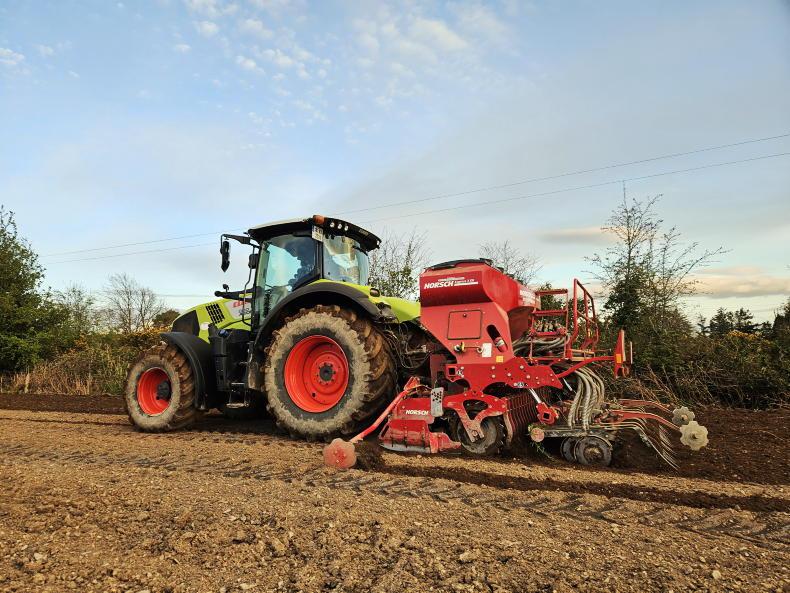
'Contractors operate under intense pressure during narrow working windows. It’s more than just operating a piece of equipment, it’s organising drivers, diesel, parts, customers and much more.'
Working against the clock
“As we all know, farming is massively dictated by the weather. However, crops must be harvested at their optimum and often before conditions deteriorate. Slurry and fertiliser must also be spread within regulatory windows. Everyone is working against the clock,” Norman outlines.
“Contractors operate under intense pressure during narrow working windows, it’s more than just operating a piece of equipment. It’s organising drivers, diesel, parts, customers and much more. Most farmers today use weather apps, which can update every 10 to 15 minutes. A farmer could therefore change their mind two to three times in the same day now whether they want to cut, spread, sow or whatever it may be. If a contractor has multiple customers changing their minds throughout the day, then it can create serious headaches for us,” Norman explained.
Rising fuel costs:
One of the biggest challenges currently facing agricultural contractors is the sharp rise in fuel costs. Recent changes have resulted in approximately a 50% increase in the cost of green diesel so far this year, a rise that is hugely disproportionate to the roughly 10% increase in white road diesel, the big question here, according to Ann, is why?
“It is currently impossible to set guide pricing and rates for work. For contractors, whose businesses rely on machinery operating day and night during peak seasons, fuel represents one of the largest operating costs and there is something wrong with this increase ratio. Across Ireland, agricultural and forestry contractors consume an estimated 350 million litres of green diesel each year while working on Irish farms.
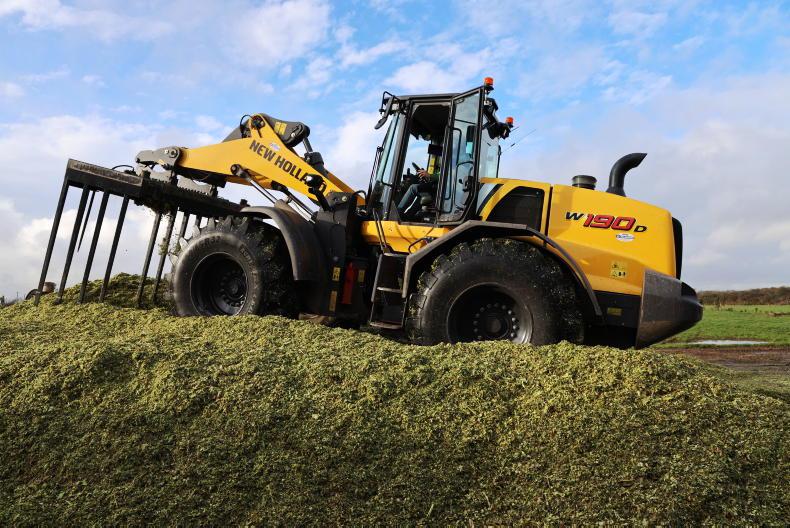
In many cases, while herd numbers have increased and more fodder is harvested, yards and pits on some farms have not expanded accordingly to take extra grass.
“With a 50% increase in fuel costs, this translates to an additional €175m cost to the sector annually.
“Our members are on average talking about increased overheads of between €50-€150,000 due to fuel alone, add in tyre levies and auto enrolment and it’s starting to get very severe. Contractors have limited ability to absorb such increases and this inflation inevitably affects the entire agricultural supply chain as these costs will have to be passed on to the farming community and this will therefore see food prices rise,” Ann stated.
Ann also says that the 2c/l NORA (National Oil Reserve Agency) levy is something that also needs to be looked at as it was initially a tax to help build a 90-day reserve and help buffer or insulate Irish fuel users from these sudden spikes in prices, but it’s not doing that. According to Norman, the talk of farmers possibly supplying diesel directly for contractors’ equipment in case of shortages or further price hikes often won’t work as in a lot of instances their tanks are too small alongside the unknowns of potential contaminants within the tank entering modern fuel systems, which could cause untold harm.
Expanding dairy herds
With farms becoming more and more fragmented, particularly dairy farms, it also significantly increases the workload and cost for contractors, and this seems to be completely forgotten or just not understood. Transporting crops from distant fields to farmyards requires larger trailers with commercial axles, more tractors, more fuel and drivers.
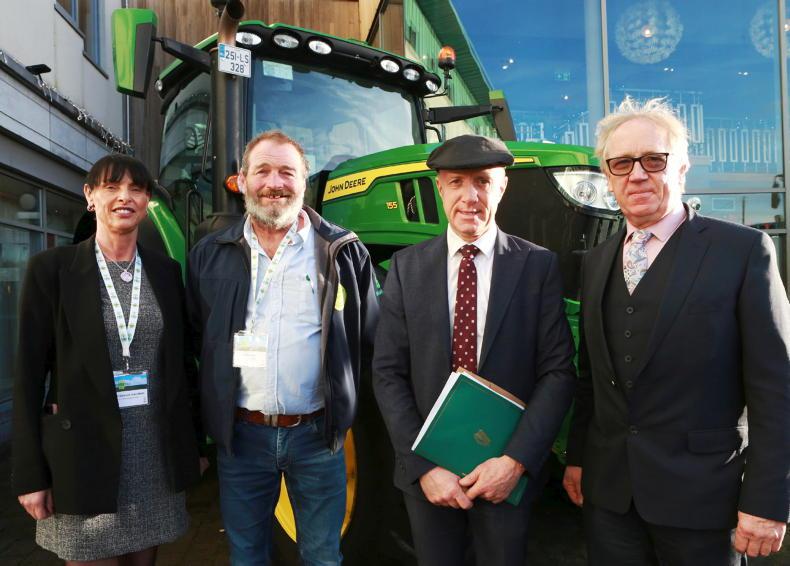
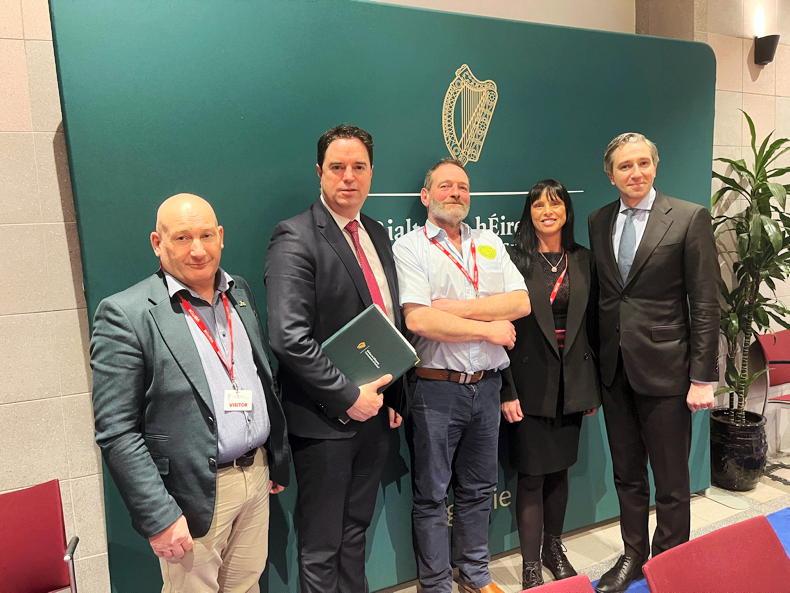
From left: Ann Hanrahan, MD FCI; Norman Egar, incoming national chair FCI; Michael Healy-Rae, Minister for State at the Department of Agriculture, Food and the Marine; and John Hughes, outgoing national chair FCI.
“Contractors have certainly responded to the dairy expansion between investing in bigger and faster tractors to keep their customers happy and this is often forgotten or not fully understood by farmers or advisers. We simply cannot cut everyone’s silage at noon on the same day no matter the moisture content or sugar levels,” Norman said.
The growth in the dairy herd has also created a challenge in another area – silage storage. In many cases, while herd numbers have increased and more fodder is harvested, yards and pits on some farms have not expanded accordingly to take extra grass.
As a result, contractors often must build higher silage pits to store the extra feed. This creates serious safety concerns for loader drivers working on pits. Driving heavy loading shovels on increasingly high and steep silage pits raises the risk of machinery instability and accidents. Addressing pit size and design is an important safety issue that needs greater attention across the industry.
“Farmers planned for the calf shed, the bigger parlour and so on but forget about the pit and that bigger trailers and loaders need more room. Steering axles can only do so much in a yard,” Ann said.
She therefore advised any farmer who is looking at updating their silage slab to talk to their contractor or loader driver as they often see issues that a farm planner may not.
“We had instances of farmers paying professionals to draw up designs but some of these planners don’t seem to understand there has to be room for equipment to tip and turn, so please ask your contractor too for advice as the new regulations around silage yards and pit heights are coming.”
Farm infrastructure must keep up
Many farms still have very narrow gateways and tight entrances that were built for much smaller machinery decades ago.
“We want to promote farm safety and improve road safety as the FCI work with the RSA and HSA; and our members are 100% behind us on all this.
Improving gateway widths and farmyard access can greatly assist contractors in their work, while also reducing delays and potential damage to equipment.
“It’s often the simple things like cutting branches and bushes around gateways to help improve vision and having signs ready, informing other road users when harvesting is commencing.”
Members of FCI also notice that earlier turnout dates for cattle can often lead to poaching and stones surfacing. Therefore, farmers need to consider rolling again and proper land preparation.
“Wheel ruts particularly at gaps and headlands dry out and harden and we find every year picking up debris around headlands from winter storms and damaged fencing. Farmers need to prepare better in some instances,” Ann pointed out.
Helping young contractors
“We need young drivers to operate machines properly and understand the controls, gear selection, braking performance and how to attach various implements and set up the hydraulic services correctly for implements or work guidance and ISOBUS systems.
“The FCI have developed a new QQI course for operators of agricultural machinery due to the demand from our members to help contractors, which will be 80% practical and 20% theory and this will be delivered by the ETB.”
This course will be open to everyone; inexperienced operators will start with a simulator and build from there. It will meet the needs of this industry; and “we hope to have it up and running in early 2027”, Norman said.
“We have five young contractors wanting to join us now and these are only starting out, but they want to start on the right footing,” according to Ann. To get into this sector you need to understand modern machinery, how it works, how to set up machines, as well as what farmers require.
“We have an FCI WhatsApp group for technical advice on various machinery, but we also help members with financial and legal advice and much more besides.”
FCI runs six regional meetings across Ireland where they discuss relevant topics and give updates from other counterparts in Europe, it is also a member of CEETTAR, that represents contractors at a European level.
“We want contractors to be registered as this will show the true value of this sector and how much we are contributing overall, it is something we are working with Government on here.”
Supporting rural communities
Agricultural contractors are more than service providers – they are deeply embedded in rural communities. Many contracting businesses are family operations passed down through generations. They provide local employment, support agricultural productivity, and maintain strong relationships with the farmers they serve.
That relationship is built on reliability, hard work, and mutual respect. Norman highlights that if the Government is serious about environmental targets it needs to understand the sector better and who is doing the bulk of the work on farms today.
Some very specialised tasks like slurry piping, slurry separation and injection cannot be justified by most Irish farmers as the scale is different to that on the continent. The technology has proven environmental benefits, yet a contractor cannot access the grant. There needs to be equality here.
“The Government should consider grant aiding the invoice, not the machine, therefore the farmer benefits from the use of this technology and not burdened with the purchase of it,” Norman outlined.
Time for greater appreciation
While farmers rightly receive recognition for feeding the nation, the role of agricultural contractors deserves much greater appreciation as well. Without contractors, many farms would struggle to operate efficiently or at all.
“If agricultural contractors are guilty of anything it is probably staying quiet and not shouting loud enough. The massive machinery price increases and sudden green diesel rise could well be the straw that breaks the camel’s back, as our members are getting very worried and it could get very bleak very quick.” Farmers are more demanding now than ever due to their scale, but some only see it from their point of view and only think about their needs. Farmers must communicate better in some instances, book their contractors in advance and be more patient.
“Silage equipment probably looks great in a field when someone is passing by in a car and the sun is shining, but behind all this are people where bills need to be paid and cashflow is a major concern.”
Ann is talking to Government about road safety and training young car drivers to be more aware when they are sitting their test.
“Road users now seem to almost ignore flashing beacons, and keep driving right up to tractors. I’d like if the RSA or Department of Transport could run a campaign to help make the public better understand agricultural machinery and how to approach machines on the road.”
Another vital piece of advice the FCI would also like to give to contractors is to get better at invoicing.
“Our members need to be paid promptly, we hope farmers, farm advisers and farming bodies stop taking the sector for granted as it’s going to soon hit a catastrophe,” Ann stated.
As agriculture continues to evolve, Ann and Norman are firm that one thing remains certain: the agricultural contractor will remain a cornerstone of productive, resilient farming communities across Ireland.
The Irish agricultural contractor has become one of the most essential yet often under-appreciated pillars of the farming sector.
According to the Teagasc National Farm Survey (NFS), the Irish contracting sector has an estimated value of €990m annually to 137,000 farms across rural Ireland. Therefore, contractors play a critical role in ensuring farms operate efficiently.
While this work is most visible during busy seasons, like silage or grain harvesting, the real value of agricultural contractors becomes especially clear during extreme weather like heavy thundershowers – when time, machine capacity and experience make the difference between success and loss, according to Kildare contractor, Norman Egar, who is also chairman of the Farm & Forestry Contractors Association (FCI).
A vital partner in modern farming
Irish agriculture has evolved dramatically over the past few decades, farms have become bigger and more specialised, machinery has also become more sophisticated, while the cost of acquiring such equipment has increased dramatically.
Norman states that many farmers simply cannot justify owning every piece of machinery required for modern production: “This is where our members step in and fill this void with high-tech machinery whether it’s for grass, grain or timber operations.”
Everyone in the country is aware of price inflation across all sectors, but agricultural contractors have seen their overheads for machinery, diesel, labour, parts, tyres increase immensely.
“These machines can cost hundreds of thousands of euros and keeping them running requires significant investment, but this is not always fully understood or appreciated. By providing these various agricultural services to farmers, contractors allow farmers to benefit from access to this advanced equipment without the massive capital investment themselves,” outlined Offaly contractor and FCI managing director Ann Gleeson Hanrahan.
'Contractors operate under intense pressure during narrow working windows. It’s more than just operating a piece of equipment, it’s organising drivers, diesel, parts, customers and much more.'
Working against the clock
“As we all know, farming is massively dictated by the weather. However, crops must be harvested at their optimum and often before conditions deteriorate. Slurry and fertiliser must also be spread within regulatory windows. Everyone is working against the clock,” Norman outlines.
“Contractors operate under intense pressure during narrow working windows, it’s more than just operating a piece of equipment. It’s organising drivers, diesel, parts, customers and much more. Most farmers today use weather apps, which can update every 10 to 15 minutes. A farmer could therefore change their mind two to three times in the same day now whether they want to cut, spread, sow or whatever it may be. If a contractor has multiple customers changing their minds throughout the day, then it can create serious headaches for us,” Norman explained.
Rising fuel costs:
One of the biggest challenges currently facing agricultural contractors is the sharp rise in fuel costs. Recent changes have resulted in approximately a 50% increase in the cost of green diesel so far this year, a rise that is hugely disproportionate to the roughly 10% increase in white road diesel, the big question here, according to Ann, is why?
“It is currently impossible to set guide pricing and rates for work. For contractors, whose businesses rely on machinery operating day and night during peak seasons, fuel represents one of the largest operating costs and there is something wrong with this increase ratio. Across Ireland, agricultural and forestry contractors consume an estimated 350 million litres of green diesel each year while working on Irish farms.
In many cases, while herd numbers have increased and more fodder is harvested, yards and pits on some farms have not expanded accordingly to take extra grass.
“With a 50% increase in fuel costs, this translates to an additional €175m cost to the sector annually.
“Our members are on average talking about increased overheads of between €50-€150,000 due to fuel alone, add in tyre levies and auto enrolment and it’s starting to get very severe. Contractors have limited ability to absorb such increases and this inflation inevitably affects the entire agricultural supply chain as these costs will have to be passed on to the farming community and this will therefore see food prices rise,” Ann stated.
Ann also says that the 2c/l NORA (National Oil Reserve Agency) levy is something that also needs to be looked at as it was initially a tax to help build a 90-day reserve and help buffer or insulate Irish fuel users from these sudden spikes in prices, but it’s not doing that. According to Norman, the talk of farmers possibly supplying diesel directly for contractors’ equipment in case of shortages or further price hikes often won’t work as in a lot of instances their tanks are too small alongside the unknowns of potential contaminants within the tank entering modern fuel systems, which could cause untold harm.
Expanding dairy herds
With farms becoming more and more fragmented, particularly dairy farms, it also significantly increases the workload and cost for contractors, and this seems to be completely forgotten or just not understood. Transporting crops from distant fields to farmyards requires larger trailers with commercial axles, more tractors, more fuel and drivers.
From left: Ann Hanrahan, MD FCI; Norman Egar, incoming national chair FCI; Michael Healy-Rae, Minister for State at the Department of Agriculture, Food and the Marine; and John Hughes, outgoing national chair FCI.
“Contractors have certainly responded to the dairy expansion between investing in bigger and faster tractors to keep their customers happy and this is often forgotten or not fully understood by farmers or advisers. We simply cannot cut everyone’s silage at noon on the same day no matter the moisture content or sugar levels,” Norman said.
The growth in the dairy herd has also created a challenge in another area – silage storage. In many cases, while herd numbers have increased and more fodder is harvested, yards and pits on some farms have not expanded accordingly to take extra grass.
As a result, contractors often must build higher silage pits to store the extra feed. This creates serious safety concerns for loader drivers working on pits. Driving heavy loading shovels on increasingly high and steep silage pits raises the risk of machinery instability and accidents. Addressing pit size and design is an important safety issue that needs greater attention across the industry.
“Farmers planned for the calf shed, the bigger parlour and so on but forget about the pit and that bigger trailers and loaders need more room. Steering axles can only do so much in a yard,” Ann said.
She therefore advised any farmer who is looking at updating their silage slab to talk to their contractor or loader driver as they often see issues that a farm planner may not.
“We had instances of farmers paying professionals to draw up designs but some of these planners don’t seem to understand there has to be room for equipment to tip and turn, so please ask your contractor too for advice as the new regulations around silage yards and pit heights are coming.”
Farm infrastructure must keep up
Many farms still have very narrow gateways and tight entrances that were built for much smaller machinery decades ago.
“We want to promote farm safety and improve road safety as the FCI work with the RSA and HSA; and our members are 100% behind us on all this.
Improving gateway widths and farmyard access can greatly assist contractors in their work, while also reducing delays and potential damage to equipment.
“It’s often the simple things like cutting branches and bushes around gateways to help improve vision and having signs ready, informing other road users when harvesting is commencing.”
Members of FCI also notice that earlier turnout dates for cattle can often lead to poaching and stones surfacing. Therefore, farmers need to consider rolling again and proper land preparation.
“Wheel ruts particularly at gaps and headlands dry out and harden and we find every year picking up debris around headlands from winter storms and damaged fencing. Farmers need to prepare better in some instances,” Ann pointed out.
Helping young contractors
“We need young drivers to operate machines properly and understand the controls, gear selection, braking performance and how to attach various implements and set up the hydraulic services correctly for implements or work guidance and ISOBUS systems.
“The FCI have developed a new QQI course for operators of agricultural machinery due to the demand from our members to help contractors, which will be 80% practical and 20% theory and this will be delivered by the ETB.”
This course will be open to everyone; inexperienced operators will start with a simulator and build from there. It will meet the needs of this industry; and “we hope to have it up and running in early 2027”, Norman said.
“We have five young contractors wanting to join us now and these are only starting out, but they want to start on the right footing,” according to Ann. To get into this sector you need to understand modern machinery, how it works, how to set up machines, as well as what farmers require.
“We have an FCI WhatsApp group for technical advice on various machinery, but we also help members with financial and legal advice and much more besides.”
FCI runs six regional meetings across Ireland where they discuss relevant topics and give updates from other counterparts in Europe, it is also a member of CEETTAR, that represents contractors at a European level.
“We want contractors to be registered as this will show the true value of this sector and how much we are contributing overall, it is something we are working with Government on here.”
Supporting rural communities
Agricultural contractors are more than service providers – they are deeply embedded in rural communities. Many contracting businesses are family operations passed down through generations. They provide local employment, support agricultural productivity, and maintain strong relationships with the farmers they serve.
That relationship is built on reliability, hard work, and mutual respect. Norman highlights that if the Government is serious about environmental targets it needs to understand the sector better and who is doing the bulk of the work on farms today.
Some very specialised tasks like slurry piping, slurry separation and injection cannot be justified by most Irish farmers as the scale is different to that on the continent. The technology has proven environmental benefits, yet a contractor cannot access the grant. There needs to be equality here.
“The Government should consider grant aiding the invoice, not the machine, therefore the farmer benefits from the use of this technology and not burdened with the purchase of it,” Norman outlined.
Time for greater appreciation
While farmers rightly receive recognition for feeding the nation, the role of agricultural contractors deserves much greater appreciation as well. Without contractors, many farms would struggle to operate efficiently or at all.
“If agricultural contractors are guilty of anything it is probably staying quiet and not shouting loud enough. The massive machinery price increases and sudden green diesel rise could well be the straw that breaks the camel’s back, as our members are getting very worried and it could get very bleak very quick.” Farmers are more demanding now than ever due to their scale, but some only see it from their point of view and only think about their needs. Farmers must communicate better in some instances, book their contractors in advance and be more patient.
“Silage equipment probably looks great in a field when someone is passing by in a car and the sun is shining, but behind all this are people where bills need to be paid and cashflow is a major concern.”
Ann is talking to Government about road safety and training young car drivers to be more aware when they are sitting their test.
“Road users now seem to almost ignore flashing beacons, and keep driving right up to tractors. I’d like if the RSA or Department of Transport could run a campaign to help make the public better understand agricultural machinery and how to approach machines on the road.”
Another vital piece of advice the FCI would also like to give to contractors is to get better at invoicing.
“Our members need to be paid promptly, we hope farmers, farm advisers and farming bodies stop taking the sector for granted as it’s going to soon hit a catastrophe,” Ann stated.
As agriculture continues to evolve, Ann and Norman are firm that one thing remains certain: the agricultural contractor will remain a cornerstone of productive, resilient farming communities across Ireland.






SHARING OPTIONS