Telehandlers and articulated wheel loaders are extremely versatile machines and are widely used throughout the year among all farming enterprises. Today, there are more options than ever on the market in terms of size and the number of brands to choose from.
As with all used machines, it can often be a challenge to locate a good example that has been well minded, maintained and serviced regularly.

The engine bay should be clean and dry.
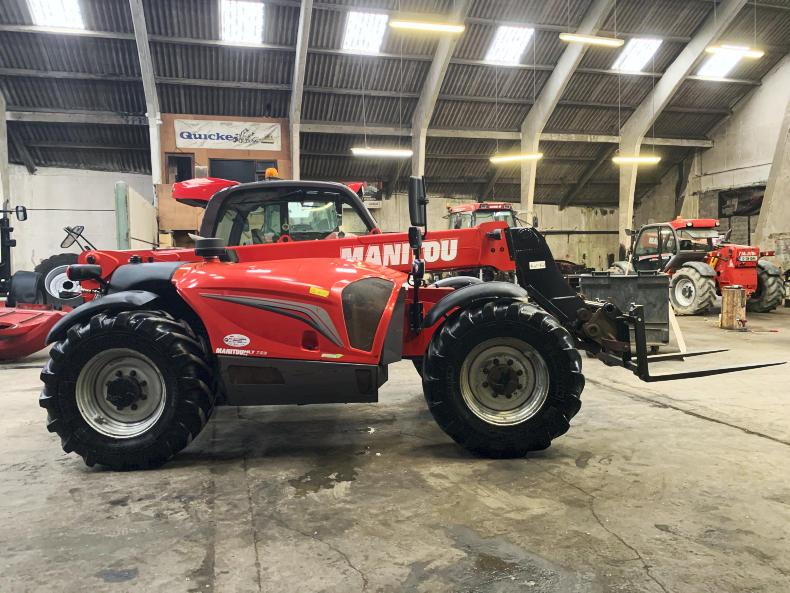
Here we take a look at a 2014 Manitou MLT 735, which would be a popular machine in its category, ideal for both tillage and livestock farmers given its 3.5t lift capacity and a 7m boom reach. The machine photographed here had 4,360 hours on the clock.
The MLT735-120 was first introduced in 2008, fitted with the firm’s Joystick Switch & Move (JSM) mouse-like joystick offering built-in shuttle and powershift functions in addition to the usual hydraulic functions. This allowed users to leave their left hand on the steering wheel at all times as the shuttle lever was made redundant.
Up until late 2012 and 2013, the MLT735 was fitted with a Perkins engine until emission regulations brought about change. An interim period saw Mercedes engines fitted before Deutz power took over in 2014, which is the case today with the 735’s direct replacement.
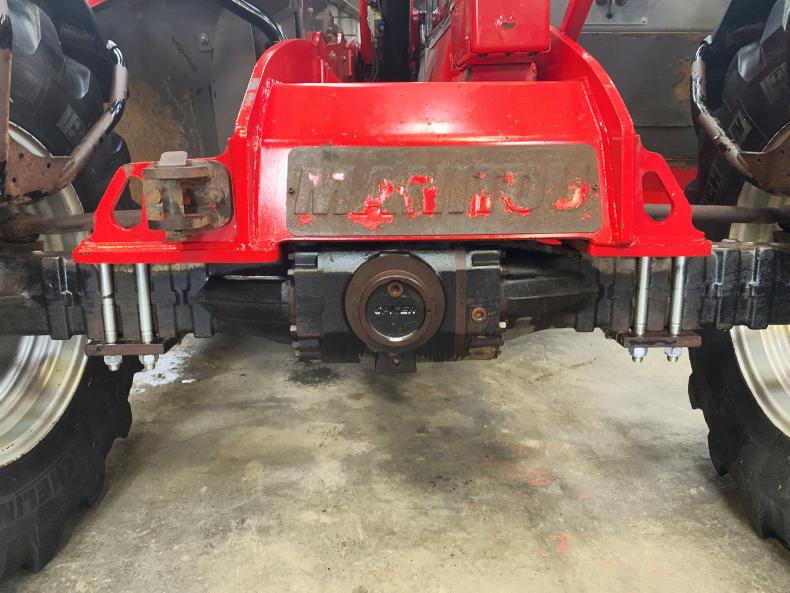
Axle oil should be recplaced every 500hrs.
First impressions
A first glance will generally tell you a lot about the machine’s past and how it was treated by the previous owners. Broken or missing panels should be taken into account as these can often be costly to replace. If all lights, mirrors, glass and panels are working and in good condition, this usually indicates that the previous owner cared for it, leading one to assume it was mechanically well cared for too.
However, the telehandler should be started from cold and let run for approximately 10 minutes before taking it for a drive. Tyres should be a good indication – a set should last 2,500-3,000hrs on average. As with any machine, regular service intervals and consistent greasing will increase its lifespan.
Engine bay
The engine should be clean and dry. Once the dipstick is pulled, oil should have good viscosity, showing no traces of unwanted particles which may have serious consequences.
Heavily burnt black oil generally indicates the machine has gone by its required service interval (500hrs). The engine’s breather pipe should be checked for blowback and free of dripping oil. Blowback generally indicates the engine is burning oil, meaning the ideal fix is a full engine overhaul, a costly procedure.
The radiator and expansion tank should be checked, ensuring coolant is at the desired level.
It is worthwhile dipping your finger in here and inspecting for unwanted residue such as oil. This may indicate head gasket issues. Generally a machine from a dealer will be fully serviced and checked over by the workshop, as was the case with the MLT735-120 we looked at.
Transmission and brakes
After the machine has idled for 10 minutes, take it for a drive and see how the six-speed transmission is shifting up and down through each gear. Shifts should be smooth with no slippage. Brakes should be functioning and reacting proportionally to the force applied. Poor brakes pose a potential safety hazard.
Front and rear axles should be checked, and ball joints, track rod ends, and the kingpins should be free of play. Oil in wheel hubs should be replaced every 1,000hrs along with transmission and angle-box oil.
This is often an area overlooked by owners during service.

Ball joints, track rod ends and kingpins should be checked on both axles for play and wear.
Hydraulics and boom
Hydraulics should be checked by testing all functions, ensuring a fast response at the same time. Multiple movements should be possible at the one time. The hydraulic system should be leak-free. It goes without saying hydraulic filters should be changed at their intervals (1,000hrs) and oil should always be at its desired level on the sight glass.
The boom should be fully extended and checked thoroughly for strain, wear or damage. Boom wear pad condition should be checked.
Boom suspension (if fitted) should be tested by pressing the switch in the cab and working correctly. Pins and bushings should be checked for wear, in particular the boom’s compensator rams bushings.
The load monitoring indicator should be working. This is a safety device on all telehandlers. The system analyses the load pressure on the rear axle and prevents the operator over-exerting the boom with a heavy weight, locking out the ability to lift or exert the boom any more. The headstock is a typical area where wear or abuse might be seen.
A well-maintained headstock will show little signs of wear and that it was greased regularly.
Cab
Firstly, take a look at the seat. This is a good indication of wear on the machine. Typically a seat will rip due to wear around 3,000hrs. The handbrake should be functioning. If seized, this needs to be rectified which is often just a seized cable.
All functions on the JSM (joystick) should be working and tested. The reversible fan (if fitted) should be tested by pressing the switch – this proves a great feature while working in dusty conditions. The ESC (Easy Connect System) or third service pressure release system should be working once the button is pressed leaving oil fittings easily connected.
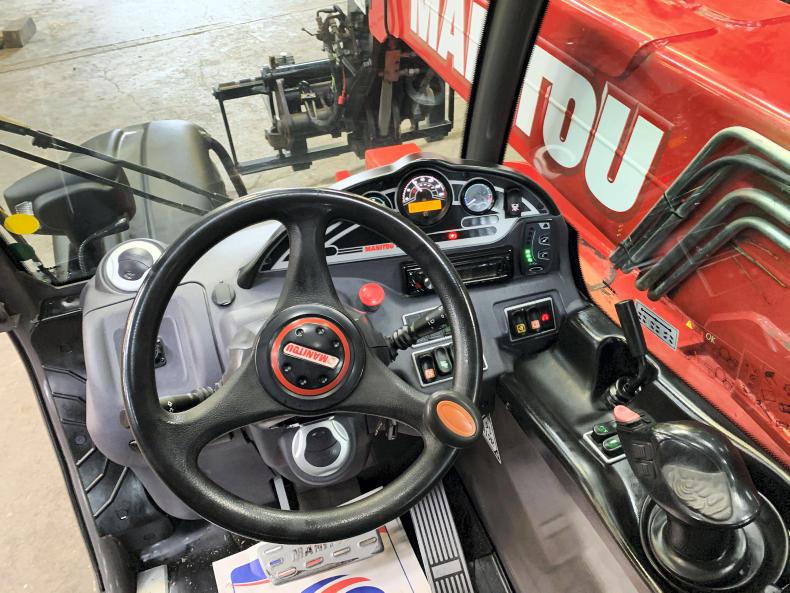
The cab should be in good conditon overall. In particular, the joystick should be in good working order.
The dashboard should be checked for warning lights or error codes on startup. The temperature gauge should be monitored, not passing the halfway mark. The heater should be tested. If not working, this could mean the thermostat could be missing or broken.
The Irish Farmers Journal would like to thank Mid-Louth Garage for the use of the machine.
Machine spec
Featured model: 2014 Manitou MLT735-120 LSU 4,360hrs.Engine: Deutz 120hp, four-cylinder.Transmission: Six-speed powershift, 40km/h.Hydraulics: Max flow 150l/min.Max lift capacity: 3.5t.Max lift height: 7m.Unladen weight: 7,154kg.
Telehandlers and articulated wheel loaders are extremely versatile machines and are widely used throughout the year among all farming enterprises. Today, there are more options than ever on the market in terms of size and the number of brands to choose from.
As with all used machines, it can often be a challenge to locate a good example that has been well minded, maintained and serviced regularly.
The engine bay should be clean and dry.
Here we take a look at a 2014 Manitou MLT 735, which would be a popular machine in its category, ideal for both tillage and livestock farmers given its 3.5t lift capacity and a 7m boom reach. The machine photographed here had 4,360 hours on the clock.
The MLT735-120 was first introduced in 2008, fitted with the firm’s Joystick Switch & Move (JSM) mouse-like joystick offering built-in shuttle and powershift functions in addition to the usual hydraulic functions. This allowed users to leave their left hand on the steering wheel at all times as the shuttle lever was made redundant.
Up until late 2012 and 2013, the MLT735 was fitted with a Perkins engine until emission regulations brought about change. An interim period saw Mercedes engines fitted before Deutz power took over in 2014, which is the case today with the 735’s direct replacement.
Axle oil should be recplaced every 500hrs.
First impressions
A first glance will generally tell you a lot about the machine’s past and how it was treated by the previous owners. Broken or missing panels should be taken into account as these can often be costly to replace. If all lights, mirrors, glass and panels are working and in good condition, this usually indicates that the previous owner cared for it, leading one to assume it was mechanically well cared for too.
However, the telehandler should be started from cold and let run for approximately 10 minutes before taking it for a drive. Tyres should be a good indication – a set should last 2,500-3,000hrs on average. As with any machine, regular service intervals and consistent greasing will increase its lifespan.
Engine bay
The engine should be clean and dry. Once the dipstick is pulled, oil should have good viscosity, showing no traces of unwanted particles which may have serious consequences.
Heavily burnt black oil generally indicates the machine has gone by its required service interval (500hrs). The engine’s breather pipe should be checked for blowback and free of dripping oil. Blowback generally indicates the engine is burning oil, meaning the ideal fix is a full engine overhaul, a costly procedure.
The radiator and expansion tank should be checked, ensuring coolant is at the desired level.
It is worthwhile dipping your finger in here and inspecting for unwanted residue such as oil. This may indicate head gasket issues. Generally a machine from a dealer will be fully serviced and checked over by the workshop, as was the case with the MLT735-120 we looked at.
Transmission and brakes
After the machine has idled for 10 minutes, take it for a drive and see how the six-speed transmission is shifting up and down through each gear. Shifts should be smooth with no slippage. Brakes should be functioning and reacting proportionally to the force applied. Poor brakes pose a potential safety hazard.
Front and rear axles should be checked, and ball joints, track rod ends, and the kingpins should be free of play. Oil in wheel hubs should be replaced every 1,000hrs along with transmission and angle-box oil.
This is often an area overlooked by owners during service.
Ball joints, track rod ends and kingpins should be checked on both axles for play and wear.
Hydraulics and boom
Hydraulics should be checked by testing all functions, ensuring a fast response at the same time. Multiple movements should be possible at the one time. The hydraulic system should be leak-free. It goes without saying hydraulic filters should be changed at their intervals (1,000hrs) and oil should always be at its desired level on the sight glass.
The boom should be fully extended and checked thoroughly for strain, wear or damage. Boom wear pad condition should be checked.
Boom suspension (if fitted) should be tested by pressing the switch in the cab and working correctly. Pins and bushings should be checked for wear, in particular the boom’s compensator rams bushings.
The load monitoring indicator should be working. This is a safety device on all telehandlers. The system analyses the load pressure on the rear axle and prevents the operator over-exerting the boom with a heavy weight, locking out the ability to lift or exert the boom any more. The headstock is a typical area where wear or abuse might be seen.
A well-maintained headstock will show little signs of wear and that it was greased regularly.
Cab
Firstly, take a look at the seat. This is a good indication of wear on the machine. Typically a seat will rip due to wear around 3,000hrs. The handbrake should be functioning. If seized, this needs to be rectified which is often just a seized cable.
All functions on the JSM (joystick) should be working and tested. The reversible fan (if fitted) should be tested by pressing the switch – this proves a great feature while working in dusty conditions. The ESC (Easy Connect System) or third service pressure release system should be working once the button is pressed leaving oil fittings easily connected.
The cab should be in good conditon overall. In particular, the joystick should be in good working order.
The dashboard should be checked for warning lights or error codes on startup. The temperature gauge should be monitored, not passing the halfway mark. The heater should be tested. If not working, this could mean the thermostat could be missing or broken.
The Irish Farmers Journal would like to thank Mid-Louth Garage for the use of the machine.
Machine spec
Featured model: 2014 Manitou MLT735-120 LSU 4,360hrs.Engine: Deutz 120hp, four-cylinder.Transmission: Six-speed powershift, 40km/h.Hydraulics: Max flow 150l/min.Max lift capacity: 3.5t.Max lift height: 7m.Unladen weight: 7,154kg. 






SHARING OPTIONS