Unlike other industries, none of the perceived premium ATV brands have come to market with an electric battery powered solution. Well, that has changed with the arrival of the Can-Am Outlander Electric, claiming to be the world’s first mass-produced electric battery powered ATV (E-ATV).
Credit where credit is due, whether it’s unique features like the LinQ quick attach accessories or frequent model updates, Can-Am is one of the most active and innovative brands in the market.
Keen to show off the capabilities of the Outlander Electric as well as experience its other product updates for the 2026 model year, the Canadian company invited us out to the famous Le Commes off-road facility located just one hour north of Barcelona. Other updates, which we expect to cover in detail over the coming weeks include the new Outlander 6x6 ATV and Traxter HD11 UTV.
Who is Can-Am?
While the Can-Am brand continues to gain traction here in Ireland and across Europe, it remains a household name closer to home on Canadian and North American markets, accounting for a large share of what are massive ATV and UTV markets.
Can-Am forms the larger subsidiary of Bombardier Recreational Products (BRP), based in Quebec, Canada. BRP is the parent company of the well-known Sea-Doo, Rotax, Ski-Doo and Lynx brands. The BRP group had total annual sales of $7.8 billion for the 2025 fiscal year.
All Can-Am ATVs and UTVs are designed and engineered at its headquarters in Valcourt in Quebec and then manufactured in Juarez, Mexico.
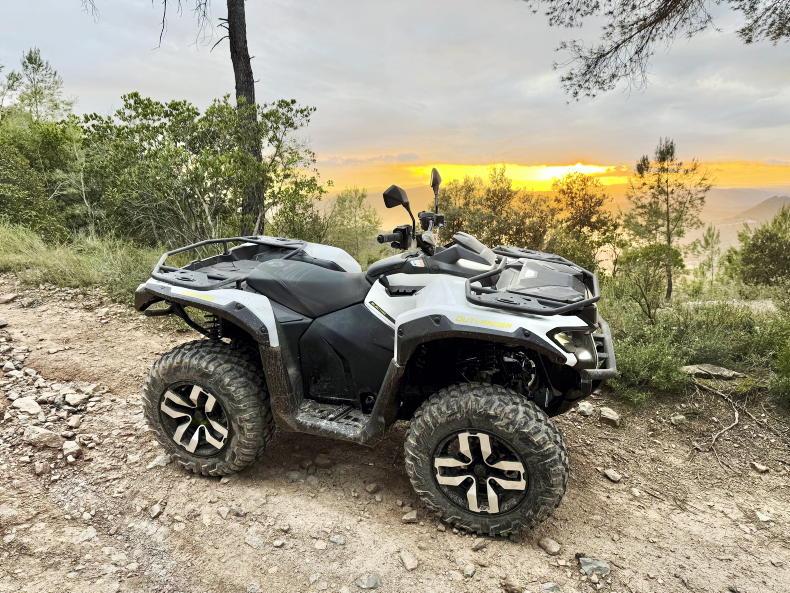
The Outlander Electric uses the same E-Power drive system as the firm uses in its electric motorcycles.
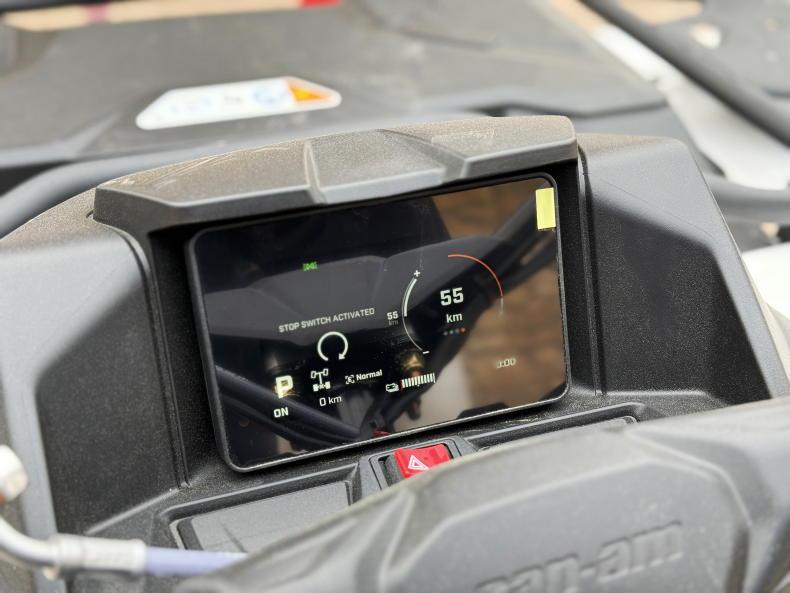
The 5in LCD colour display is very cleanly laid out.
Closer to home, Can-Am continues to build its Irish dealer network with the recent appointment of Paudy Buckley Tractors in Co Cork, who joins existing dealers Kilkenny Quads (Kilkenny), McGinty Tractors (Donegal), Pro Trailers & Machinery (Roscommon) and Cowan Bros (Co Antrim and Derry) who cover the northern counties.
Outlander Electric
News broke last August that Can-Am was on the cusp of launching its first E-ATV, first seen by ourselves at Agritechnica in November.
Since engine capacity in cc is the terminology we all use as a reference point for internal combustion engine (ICE) ATVs, Can-Am says that the 700cc Outlander 700 DPS is the closest petrol counterpart in which it shares a lot of its structural components.
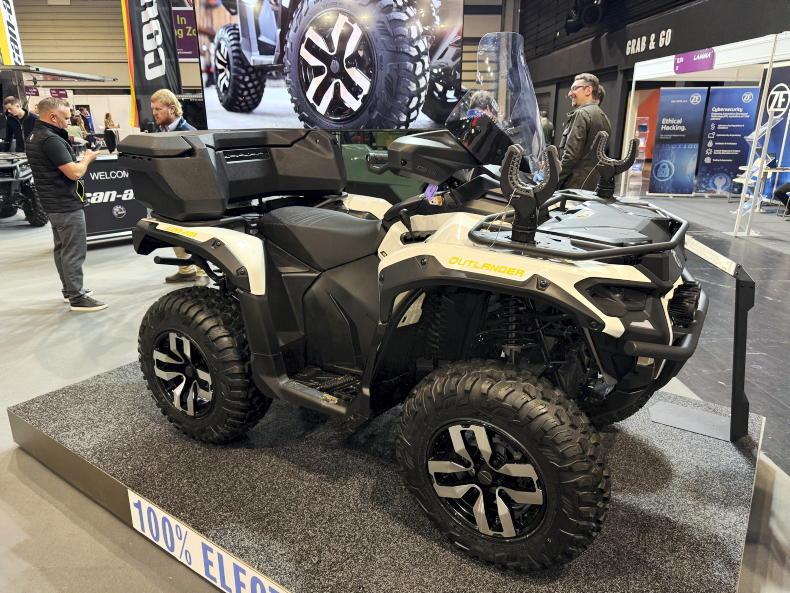
Can-Am has worked hard to retain as many characteristics as possible with its Petrol-ICE range, both in terms of looks, rider experience and performance. However, the Outlander Electric does feature some changes, particularly to better suit its electric powertrain which we will come to shortly. The Outlander Electric differentiates itself with its white body colour and diamond cut wheel rims which come as standard.
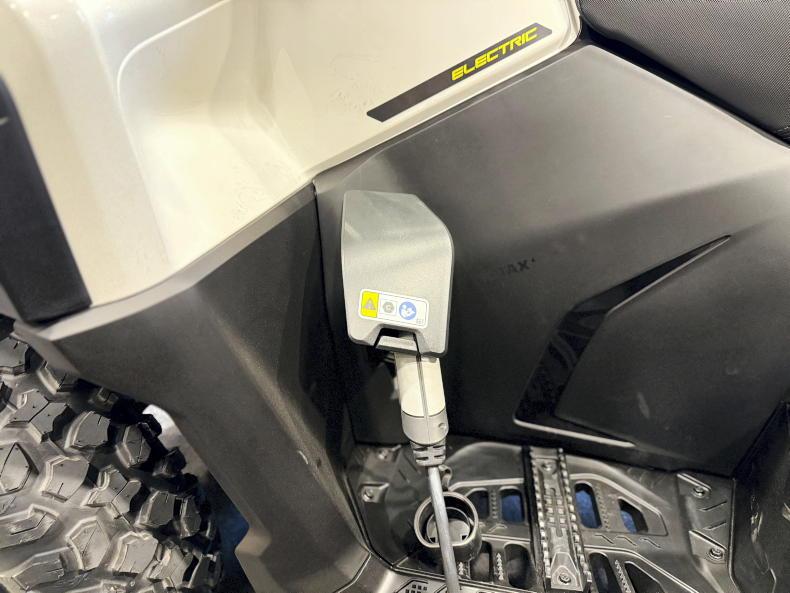
Using a Level 2 charging system, the battery can be charged from 20% to 80% in 50 minutes.
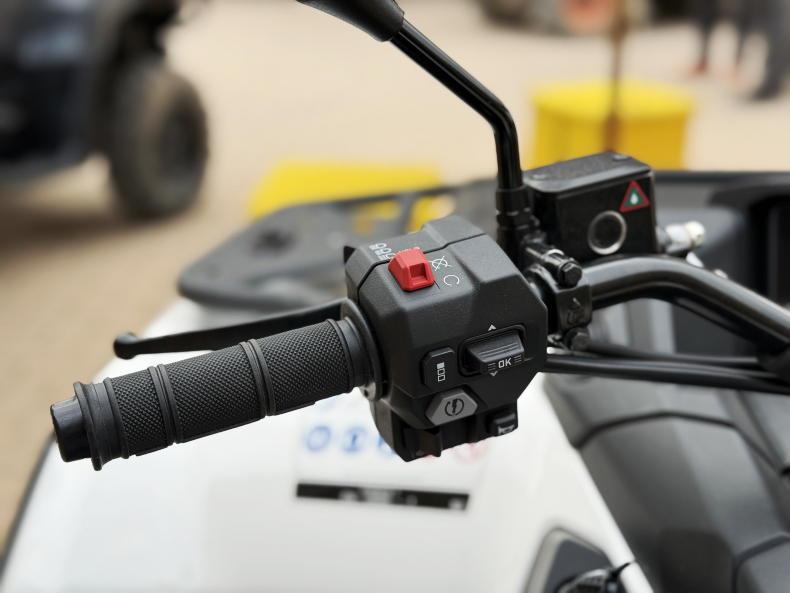
The left handlebar control cluster features two new buttons to navigate through the LCD screen as well as engage reverse.
Powertrain
Can-Am had the advantage of being able to draw on previous experience of electric powertrains from within the wider BRP group. Namely, powertrain specialists Rotax and Can-Am’s on-road division which has been building electric motorcycles for some time now.
The Outlander Electric uses the same modular E-Power system, albeit tailored for off-road use. The E-Power system comprises a 47hp (72Nm) liquid-cooled motor, direct drive transmission and an 8.9kWh lithium-ion battery which offers a theoretical range of up to 80km. However, given the often-challenging terrain faced by an ATV, Can-Am, from its 104,000km of testing, believes 50km to be more of an accurate average range. As expected, there is regenerative braking with three severity presets which help reenergise the battery.
Using a Level 2 charging system, the battery can be reenergised from 20% to 80% in just 50 minutes, or 0% to 100% in just one hour thirty minutes. This compares to respective times of three hours and 10 minutes or five hours and 15 minutes to reach the same capacities using a Level one charging system. Fully confident in its battery technology, Can-Am offers a five-year warranty on the 8.9kWh unit.
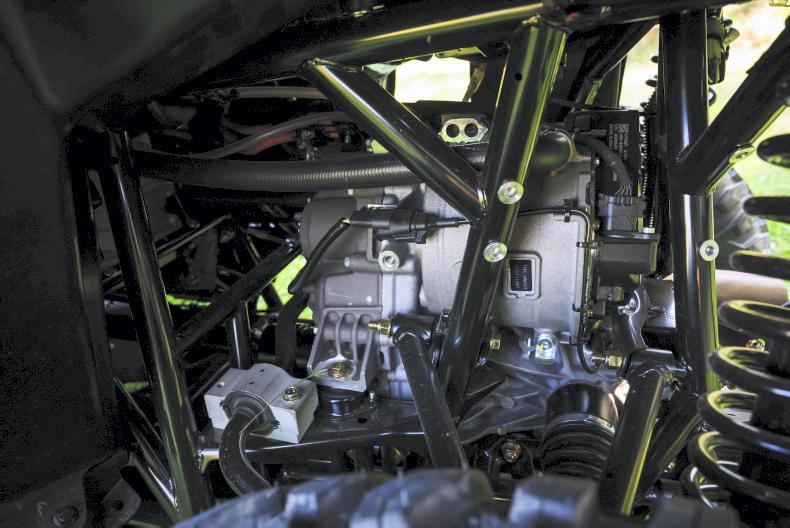
The 47hp electric motor powers a direct drive transmission.
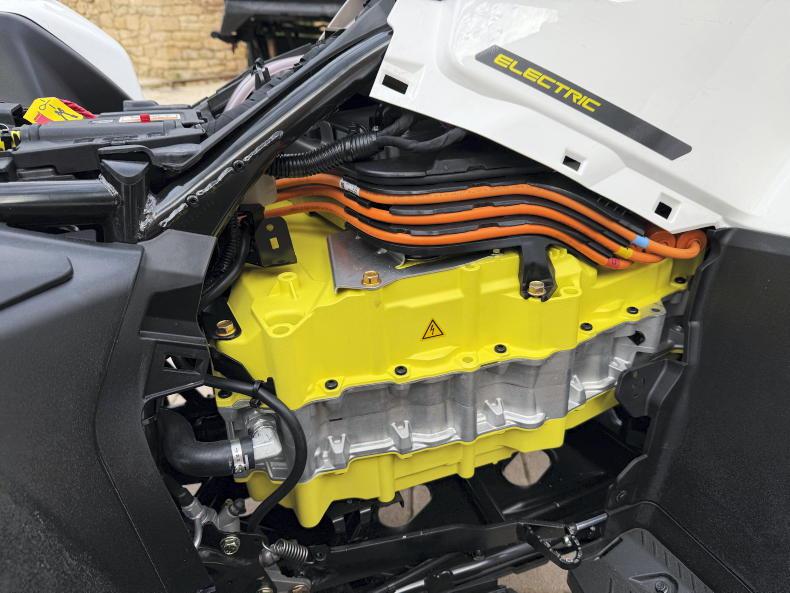
Once the seat and side panel is removed the 8.9kWh battery is easy accessed.
The new direct drive transmission means fewer moving parts and reduced power losses. Aside from preset Work, Standard and Sport modes, there is still a high and low range, high offering speeds of up to 80km/h (60km/h on T homologated units) and low, suited to towing and hard-to-navigate terrains. In 4WD, power is transferred to the front Visco-Lok front locking differential via driveshaft.
During development, the absence of engine noise naturally challenged the engineers to achieve a fully silent riding experience. This resulted in the fitment of a quieter cooling fan, new double-bonded bushing and new XPS Recon Force tyres, all designed for reduced noise and vibrations.
Having spent a number of hours behind the handlebars, the only major change to how the transmission operates is in the way that reverse is selected. The right-hand gated lever no longer has an ‘R’ position for reverse. Instead reverse is selected by pressing and holding (for two second) the ‘start’ button on the left-hand control cluster which effectively reverses the polarity of the electric motor. The same is done to disengage reverse and continue travelling forward. This was an approach that took a few minutes to become familiar with, initially.
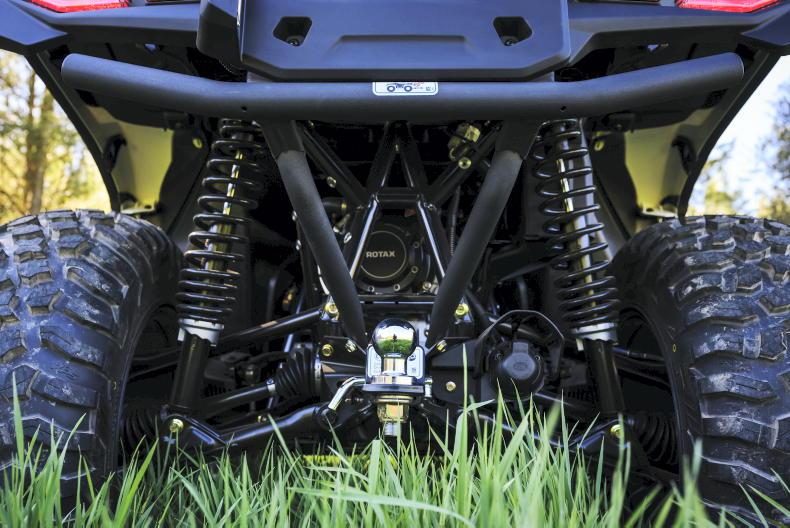
The direct drive transmission is tucked well in behind the rear shocks and swing arms.
Build and controls
Build-wise, the Outlander Electric is based on the same platform as the Outlander 700. Therefore, it shares the same chassis and suspension components. The engine and CVT have been swapped out in favour of the battery and E-Power unit.
Build quality is top-notch and on par with anything that has come before it from Can-Am. There are no electric cables or components exposed, yet at the same time the battery pack is easily accessed once the seat and right-hand side panel have been removed.
The controls differ slightly in the sense that the Electric is equipped with a clean 5in colour display, which through clear screens shows all the expected information including battery range, battery voltage, speed limiter settings, drive mode, electric power steering sensitivity, etc.
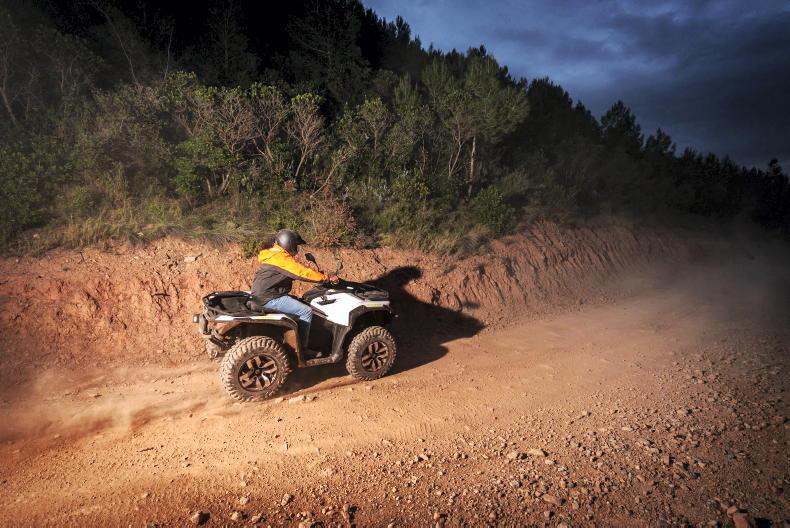
The Outlander Electric handled just as well as its equivalent petrol model.
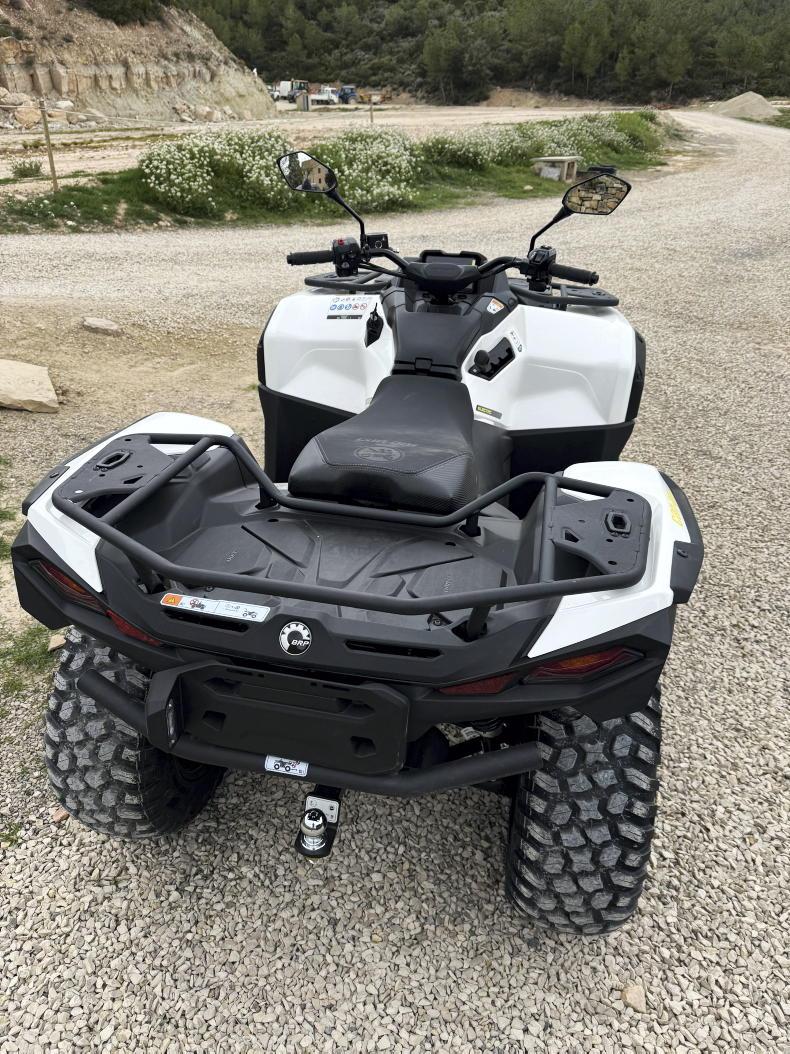
The Outlander Electric features all the normal storage compartments and LinQ quick attach possibilities that the ICE models do.
The screen is navigated through using the buttons positioned on the left-hand cluster. As expected, all lights are LED and there is now a signature LED strip wrapped around the back of the dash area.
The Outlander Electric is compatible with all Can-Am’s LinQ quick attach accessories of which there are over 120 attachments offered.
Capacities match that of the Outlander 700. The unit has a dry weight of 402kg and a towing capacity of 830kg, along with 54.4kg and 109kg front and rear rack capacities.
Performance
The enthusiast within for all things engines, left me feeling a little sceptical about how the Outlander Electric would compare against its impressive petrol counterparts. But, to say I was impressed by the Outlander Electric would be an understatement, on multiple fronts.
Having spent time behind the handlebars of some more budget brand and crude alternatives, the premium finish of the Outlander E-ATV was welcomed, right from build quality through to the integration of the E-Power powertrain.
Regardless of the drive mode selected, the throttle response and torque really is something to behold, and takes a few minutes to become acclimatised to for smooth manoeuvres.
Our first ride involved a mix of dusty Spanish mountain trails with some steep inclines and equally steep descents. While trying to get a feel for its capabilities we didn’t focus too much on preserving battery range which was evident based on the remaining range after travelling 8km.
That said, the regenerative braking impressed, reenergising the battery more than I expected it would.
From riding position to handling, Can-Am has nailed it, feeling just like the Outlander 700 ICE model, as we hoped it would.
With a weight increase of 54kg, I think Can-Am have struck the right balance between weight and range. Although we’d always like to see more range, as is the case with any EV, it would come with the cost of a larger, heavier battery pack which would inevitably take away from what makes the Outlander Electric so impressive.
The Outlander Electric features all the normal storage compartments and LinQ quick attach possibilities that the ICE models do.
On the typical Irish farm, an ATV tends to be a workhorse that is heavily relied on but not necessarily used for hours on end. Therefore, an honest 50km battery range should prove sufficient for general duties such as herding cattle, moving strip wires and light towing etc.
At the moment, the only downside we can see is pricing, which we always expected would be higher than the petrol equivalent, but not by as much.
The Outlander Electric T has a starting price of €14,789 vs €9,755 for the Outlander 700 T ABS. Although petrol prices are at an all-time high, this difference of €5,034 would buy a considerable amount of petrol, before even taking charging costs into account.
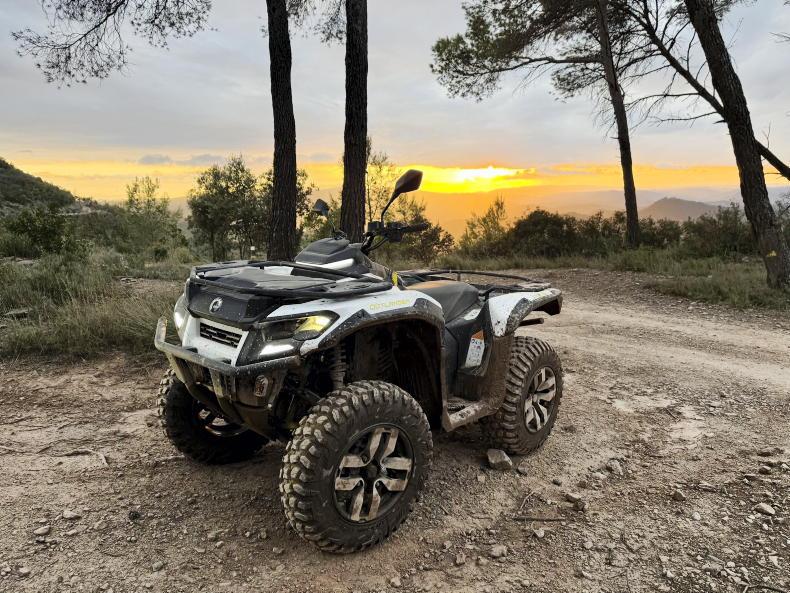
Overall, we were very impressed with the build and performance of the Outlander Electric.
Leaving cost aside, we’re well impressed after a spending a few hours behind the handlebars. However, we hope to review a unit on an Irish farm later this year for a longer period in order to see how it really performs.
Unlike other industries, none of the perceived premium ATV brands have come to market with an electric battery powered solution. Well, that has changed with the arrival of the Can-Am Outlander Electric, claiming to be the world’s first mass-produced electric battery powered ATV (E-ATV).
Credit where credit is due, whether it’s unique features like the LinQ quick attach accessories or frequent model updates, Can-Am is one of the most active and innovative brands in the market.
Keen to show off the capabilities of the Outlander Electric as well as experience its other product updates for the 2026 model year, the Canadian company invited us out to the famous Le Commes off-road facility located just one hour north of Barcelona. Other updates, which we expect to cover in detail over the coming weeks include the new Outlander 6x6 ATV and Traxter HD11 UTV.
Who is Can-Am?
While the Can-Am brand continues to gain traction here in Ireland and across Europe, it remains a household name closer to home on Canadian and North American markets, accounting for a large share of what are massive ATV and UTV markets.
Can-Am forms the larger subsidiary of Bombardier Recreational Products (BRP), based in Quebec, Canada. BRP is the parent company of the well-known Sea-Doo, Rotax, Ski-Doo and Lynx brands. The BRP group had total annual sales of $7.8 billion for the 2025 fiscal year.
All Can-Am ATVs and UTVs are designed and engineered at its headquarters in Valcourt in Quebec and then manufactured in Juarez, Mexico.
The Outlander Electric uses the same E-Power drive system as the firm uses in its electric motorcycles.
The 5in LCD colour display is very cleanly laid out.
Closer to home, Can-Am continues to build its Irish dealer network with the recent appointment of Paudy Buckley Tractors in Co Cork, who joins existing dealers Kilkenny Quads (Kilkenny), McGinty Tractors (Donegal), Pro Trailers & Machinery (Roscommon) and Cowan Bros (Co Antrim and Derry) who cover the northern counties.
Outlander Electric
News broke last August that Can-Am was on the cusp of launching its first E-ATV, first seen by ourselves at Agritechnica in November.
Since engine capacity in cc is the terminology we all use as a reference point for internal combustion engine (ICE) ATVs, Can-Am says that the 700cc Outlander 700 DPS is the closest petrol counterpart in which it shares a lot of its structural components.
Can-Am has worked hard to retain as many characteristics as possible with its Petrol-ICE range, both in terms of looks, rider experience and performance. However, the Outlander Electric does feature some changes, particularly to better suit its electric powertrain which we will come to shortly. The Outlander Electric differentiates itself with its white body colour and diamond cut wheel rims which come as standard.
Using a Level 2 charging system, the battery can be charged from 20% to 80% in 50 minutes.
The left handlebar control cluster features two new buttons to navigate through the LCD screen as well as engage reverse.
Powertrain
Can-Am had the advantage of being able to draw on previous experience of electric powertrains from within the wider BRP group. Namely, powertrain specialists Rotax and Can-Am’s on-road division which has been building electric motorcycles for some time now.
The Outlander Electric uses the same modular E-Power system, albeit tailored for off-road use. The E-Power system comprises a 47hp (72Nm) liquid-cooled motor, direct drive transmission and an 8.9kWh lithium-ion battery which offers a theoretical range of up to 80km. However, given the often-challenging terrain faced by an ATV, Can-Am, from its 104,000km of testing, believes 50km to be more of an accurate average range. As expected, there is regenerative braking with three severity presets which help reenergise the battery.
Using a Level 2 charging system, the battery can be reenergised from 20% to 80% in just 50 minutes, or 0% to 100% in just one hour thirty minutes. This compares to respective times of three hours and 10 minutes or five hours and 15 minutes to reach the same capacities using a Level one charging system. Fully confident in its battery technology, Can-Am offers a five-year warranty on the 8.9kWh unit.
The 47hp electric motor powers a direct drive transmission.
Once the seat and side panel is removed the 8.9kWh battery is easy accessed.
The new direct drive transmission means fewer moving parts and reduced power losses. Aside from preset Work, Standard and Sport modes, there is still a high and low range, high offering speeds of up to 80km/h (60km/h on T homologated units) and low, suited to towing and hard-to-navigate terrains. In 4WD, power is transferred to the front Visco-Lok front locking differential via driveshaft.
During development, the absence of engine noise naturally challenged the engineers to achieve a fully silent riding experience. This resulted in the fitment of a quieter cooling fan, new double-bonded bushing and new XPS Recon Force tyres, all designed for reduced noise and vibrations.
Having spent a number of hours behind the handlebars, the only major change to how the transmission operates is in the way that reverse is selected. The right-hand gated lever no longer has an ‘R’ position for reverse. Instead reverse is selected by pressing and holding (for two second) the ‘start’ button on the left-hand control cluster which effectively reverses the polarity of the electric motor. The same is done to disengage reverse and continue travelling forward. This was an approach that took a few minutes to become familiar with, initially.
The direct drive transmission is tucked well in behind the rear shocks and swing arms.
Build and controls
Build-wise, the Outlander Electric is based on the same platform as the Outlander 700. Therefore, it shares the same chassis and suspension components. The engine and CVT have been swapped out in favour of the battery and E-Power unit.
Build quality is top-notch and on par with anything that has come before it from Can-Am. There are no electric cables or components exposed, yet at the same time the battery pack is easily accessed once the seat and right-hand side panel have been removed.
The controls differ slightly in the sense that the Electric is equipped with a clean 5in colour display, which through clear screens shows all the expected information including battery range, battery voltage, speed limiter settings, drive mode, electric power steering sensitivity, etc.
The Outlander Electric handled just as well as its equivalent petrol model.
The Outlander Electric features all the normal storage compartments and LinQ quick attach possibilities that the ICE models do.
The screen is navigated through using the buttons positioned on the left-hand cluster. As expected, all lights are LED and there is now a signature LED strip wrapped around the back of the dash area.
The Outlander Electric is compatible with all Can-Am’s LinQ quick attach accessories of which there are over 120 attachments offered.
Capacities match that of the Outlander 700. The unit has a dry weight of 402kg and a towing capacity of 830kg, along with 54.4kg and 109kg front and rear rack capacities.
Performance
The enthusiast within for all things engines, left me feeling a little sceptical about how the Outlander Electric would compare against its impressive petrol counterparts. But, to say I was impressed by the Outlander Electric would be an understatement, on multiple fronts.
Having spent time behind the handlebars of some more budget brand and crude alternatives, the premium finish of the Outlander E-ATV was welcomed, right from build quality through to the integration of the E-Power powertrain.
Regardless of the drive mode selected, the throttle response and torque really is something to behold, and takes a few minutes to become acclimatised to for smooth manoeuvres.
Our first ride involved a mix of dusty Spanish mountain trails with some steep inclines and equally steep descents. While trying to get a feel for its capabilities we didn’t focus too much on preserving battery range which was evident based on the remaining range after travelling 8km.
That said, the regenerative braking impressed, reenergising the battery more than I expected it would.
From riding position to handling, Can-Am has nailed it, feeling just like the Outlander 700 ICE model, as we hoped it would.
With a weight increase of 54kg, I think Can-Am have struck the right balance between weight and range. Although we’d always like to see more range, as is the case with any EV, it would come with the cost of a larger, heavier battery pack which would inevitably take away from what makes the Outlander Electric so impressive.
The Outlander Electric features all the normal storage compartments and LinQ quick attach possibilities that the ICE models do.
On the typical Irish farm, an ATV tends to be a workhorse that is heavily relied on but not necessarily used for hours on end. Therefore, an honest 50km battery range should prove sufficient for general duties such as herding cattle, moving strip wires and light towing etc.
At the moment, the only downside we can see is pricing, which we always expected would be higher than the petrol equivalent, but not by as much.
The Outlander Electric T has a starting price of €14,789 vs €9,755 for the Outlander 700 T ABS. Although petrol prices are at an all-time high, this difference of €5,034 would buy a considerable amount of petrol, before even taking charging costs into account.
Overall, we were very impressed with the build and performance of the Outlander Electric.
Leaving cost aside, we’re well impressed after a spending a few hours behind the handlebars. However, we hope to review a unit on an Irish farm later this year for a longer period in order to see how it really performs.






SHARING OPTIONS