Based close to Ballina in Co Mayo, Des Langan set up his own forestry harvesting business back in 2002. After leaving school, Des spent a few a few years driving diggers, before helping out a local contractor with some forestry works. He explained that he just took to it and enjoyed the work. Before long, he purchased himself a Komatsu excavator with a forestry head, and began his own business.
Today, Des’s business is contracted by Coillte, Ireland’s state-owned commercial forestry business which is responsible for 440,000 hectares of forests and lands. It is estimated that Coillte manages approximately 7% of the country’s land.
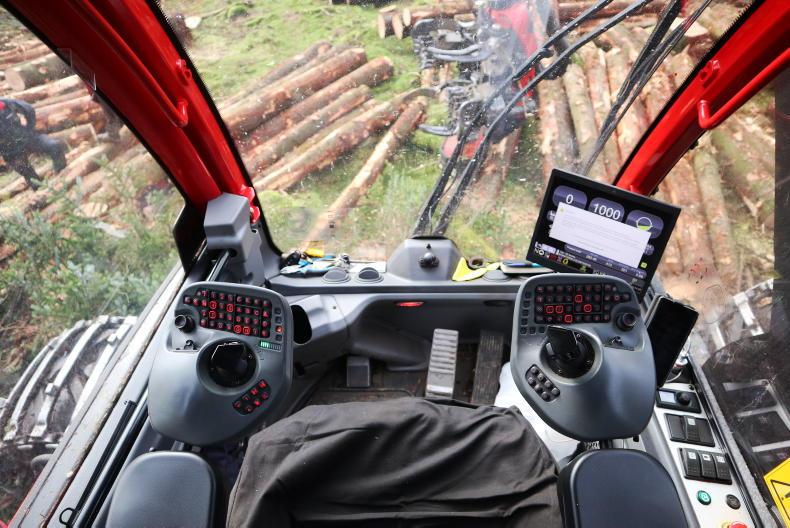
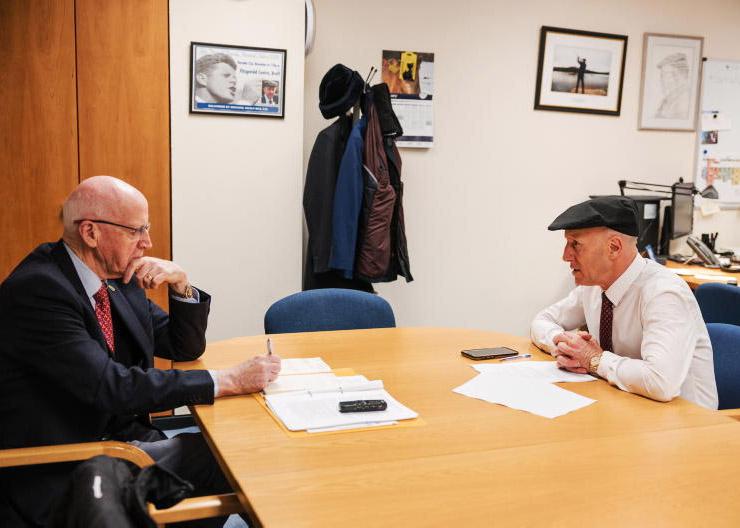
Des Langan explained that Coillte sends foresters a computer file, and it brings up a map of the entire forest on screen.
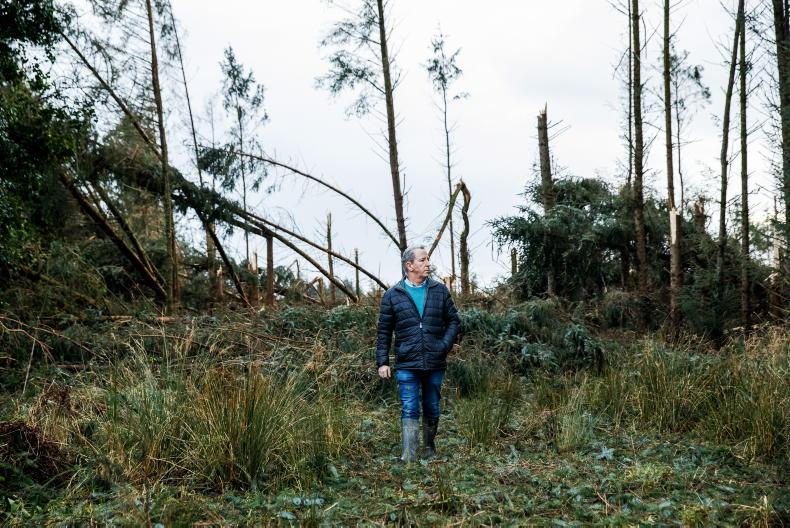
When the Irish Farmers Journal caught up with Des, he was busy tackling windblown forests. Storm Éowyn, which hit in January this year, was the most powerful storm to hit Ireland since hurricane Debbie in 1961. It caused untold damage to thousands of acres of Irish forestry, particularly across the western seaboard.
Speaking about the storm, Des explained that it literally wiped out entire forests near him, including one 300-acre forest near Foxford, which he has just completed harvesting.
“Storm Éowyn caused serious damage to forests in many parts of Ireland, particularly in Mayo,” he said. “There are lots of woods around here lying over. Once the trees aren’t snapped, and the root blades are still in some contact with the soil, this timber should be OK for another three to five years, depending.

The harvester is equipped with a S132 head made by Logmax, which is now a Komatsu subsidiary.
“We have roughly three more years of windblown work ahead of us, with two harvesting outfits, all of which is storm damage. This timber is destined for mills for pallet board, pulp wood, some will go to Bord na Móna as chips for the power station and the remainder will be used for firewood,” Des explained.
Supply v demand
He added: “The storm has had a huge knock-on effect on timber prices. It’s like any business; it all comes down to supply versus demand. After the storm, Coillte and private forestry companies decided to bring in foreign forestry contractors from countries such as Germany, Estonia and Finland, to help clear the damaged forests. They were afraid that the Irish contractors wouldn’t be able to get through the heavy workload.
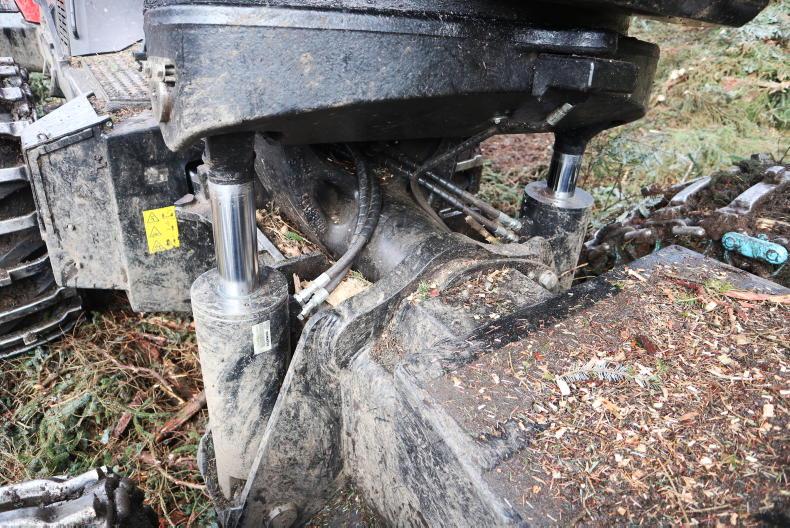
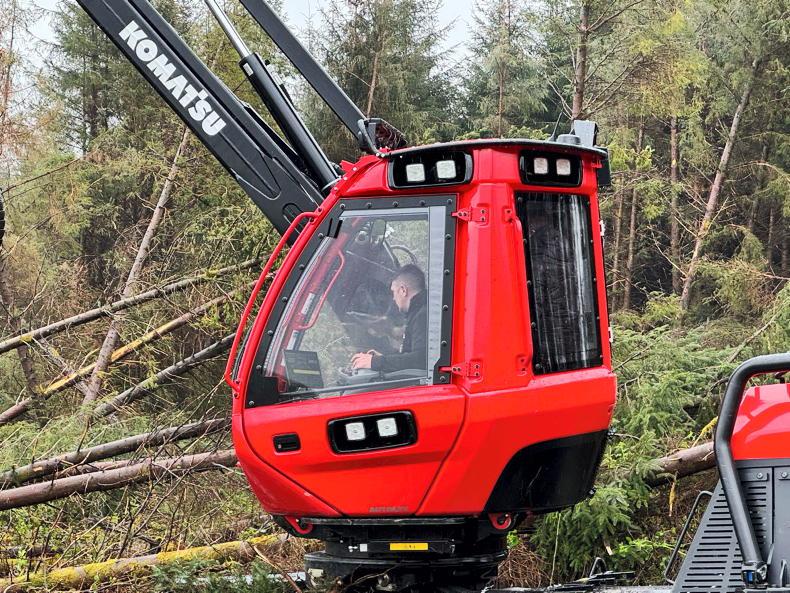
The cab has a self-levelling function that allows the operator to be always seated in a level position.
“Coillte should have given the Irish contractors a few months to see how we were progressing through the workload,” Des continued. “This would also have given them some time to try and open new markets and build more infrastructure for all the excess timber they would be bringing on stream. However, instead, the excess product has tipped the scales, and we now have a situation in Ireland where timber prices are probably down in price by 20%. I don’t do any private forestry work, but I know for a fact that private landowners will be lucky to cover their costs of replanting a forest with the money they are getting for selling the crop off it.”
Des spoke about meeting some of international contractors that were hired.
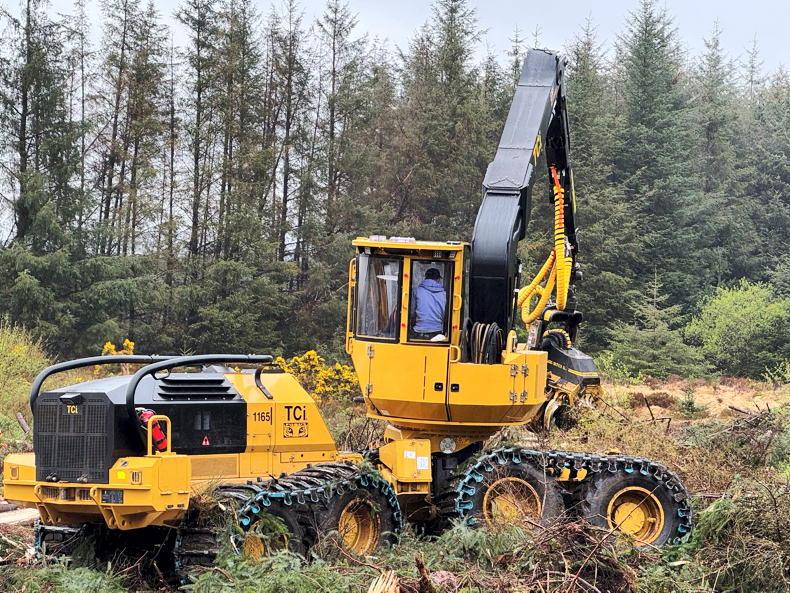
Des purchased a new Ecolog harvester in 2021, which is fitted with a Logmax twin head.
“I’m not sure how many overseas contractors Coillte brought into Ireland. There is one Finnish guy working near me with two harvesters and two forwarders. He’s a nice man and we have helped him get up and running. He was working in Germany, before coming to Ireland. I think he got a big shock when he came to Mayo with his machinery, and realised the ground conditions we work in.
“He is used to working on dry land, and never had to use tracks before. In Finland, the ground is predominately very good, and the contractors can get through work much more easily.
“In Ireland, and especially around here, we need to use the brash off the trees to pad the ground, for traction. It cost that contractor €40,000 on haulage to get here, and he had to spend an extra €70,000 on tracks, so I think the overseas contractors will really struggle in Ireland.”
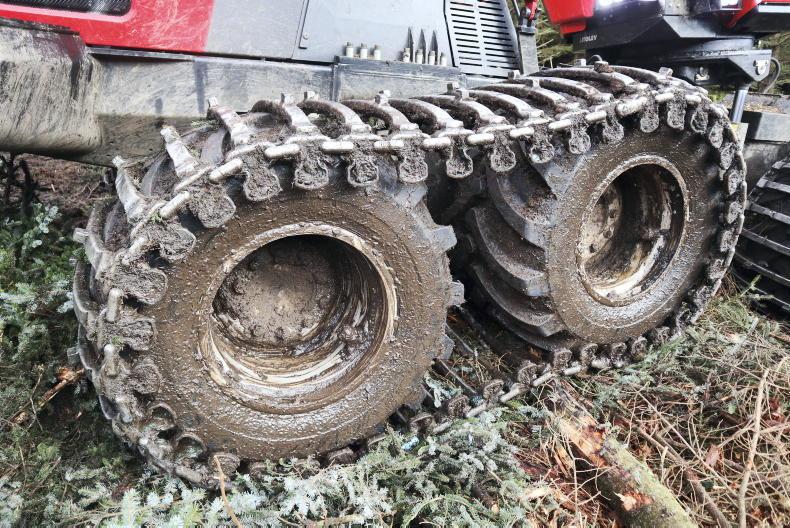
Des runs the harvesters and forwarders on 800mm tyres, kitted out with tracks.
The machinery fleet
For close to two decades, Des operated two excavators with forestry heads and a Valmet 8090 forwarder up until 2021, when he purchased a new Ecolog harvester with a Logmax twin head. In 2024, a new Komatsu 855 forwarder was added. After 10,000 hours of use, Des decided it was time to upgrade the Ecolog harvester and took delivery of a new Komatsu 931xc harvester, trading in his old machine.
“I started the business off from nothing, so buying an excavator and kitting it out was the cheapest way to get into the business day one,” he explained.
“These machines did the job, but it was hard on man and machine. For a start, they weren’t comfortable, they weren’t designed to be tracked across forests. It was also hard on the diggers – the heavy load on the hydraulic system posed a challenge to keep the machines cool.
“In 2021, I moved to a self-propelled machine, which brought about huge benefits. One harvester had one-and-a -half times the output of one excavator, while burning less fuel. Each excavator was probably using 23-24l/h, while the harvester was using 17-18l/h.”
Although a lot of users run the C series four-wheel drive head, Des opted to fit the harvester with a S132 head, which is two-wheel drive head. The S Series is made by Logmax, which is now a Komatsu subsidiary, and make heads for all harvester brands, which are badged S series in Komatsu colours. Des went this route as he was used to the Logmax head on the excavators, and found it to be very reliable. The two-wheel drive head is popular in the west, especially in pine and where the timber isn’t as straight, and it also works well in windblow.

The machine features a hydrostatic-mechanical transmission with two modes: 0-7km/h and 6-20 km/h.
After the storm, Des was offered more work, and decided to buy back his old Ecolog harvester, and a John Deere 1210G forwarder, to put a second outfit on the road. Des added that he couldn’t do this without the help of Alan Jordan.
Komatsu harvester
The 931xc is powered by a 7.4l AGCO Power engine. This six-pot unit has a power output of 255hp (190kW) at 1,850rpm. Des explained that the engine has an abundance of power. He said: “The machine operates at 1,650rpm and typically burns 17-18l/h. The Komatsu burns in the region of five litres of AdBlue in a typical 10-hour working day.”
The machine features a hydrostatic-mechanical transmission with two modes: 0-7km/h and 6-20km/h.
Des explained that he is hugely impressed with the cab. He added: “The machines comfort, control layout, LED lighting and visibility is second to none.
“The computer system is very easy to navigate through. It’s fully automated to cut to the required length and diameters,” he said. “When we go into a forest, Coillte give us a file, which we upload to the machines computer system. This brings up a map of the entire forest on the screen, and flags our live location where we are in the forest, the watercourses and any other areas of interest within the forest.

The head has a 3t feeding force at 5m per second, with +/- 2cm accuracy.
“Through this system, Coillte can see where we are working at all times, and can see exactly what our productivity levels are, and the work we are doing. It’s very transparent.”
The cab has a self-levelling function that allows the operator to be always seated in a level position. The machine comes with a keyless system that can control both the heating and main circuit breaker/lighting remotely. The machine can be set up to run the heaters for the cab and the oil, which clears the windows and warms up the water temperature, meaning the machine is ready to get straight to work once the operator arrives.
Hydraulics
As mentioned, the harvester is equipped with a S132 head made by Logmax, who are now a Komatsu subsidiary. It has a 3t feeding force at 5m per second, with ±2cm accuracy. The harvester is equipped with Komatsu’s three-pump hydraulic system. It has a significant 528l/min (139gal/min) on tap at 1,600rpm. Des has been very impressed with the hydraulic system, and the overall capacity of the machine. The cab and the crane can be rotated 360°. Overall, Des said he is very happy with the machine and the backup.

The harvester is equipped with Komatsu’s three-pump hydraulic system.
Spec
Model: 931XC.Engine: Six-cylinder 7.4l AGCO Power. Horsepower: 255hp (190 kW) at 1,850 rpm. Torque: 1,130 Nm at 1,500 rpm. Transmission: hydrostatic-mechanical with two modes. Hydraulics: 528l/min (139 gal/min) on tap at 1,600 rpm. Kerb weight: From 21,700kg. Fuel tank: 480 litres. List price: up to €680,000 plus VAT.
Des Langan explained that Coillte sends foresters a computer file, and it brings up a map of the entire forest on screen.
The cab and the crane can be rotated 360°.
Based close to Ballina in Co Mayo, Des Langan set up his own forestry harvesting business back in 2002. After leaving school, Des spent a few a few years driving diggers, before helping out a local contractor with some forestry works. He explained that he just took to it and enjoyed the work. Before long, he purchased himself a Komatsu excavator with a forestry head, and began his own business.
Today, Des’s business is contracted by Coillte, Ireland’s state-owned commercial forestry business which is responsible for 440,000 hectares of forests and lands. It is estimated that Coillte manages approximately 7% of the country’s land.
Des Langan explained that Coillte sends foresters a computer file, and it brings up a map of the entire forest on screen.
When the Irish Farmers Journal caught up with Des, he was busy tackling windblown forests. Storm Éowyn, which hit in January this year, was the most powerful storm to hit Ireland since hurricane Debbie in 1961. It caused untold damage to thousands of acres of Irish forestry, particularly across the western seaboard.
Speaking about the storm, Des explained that it literally wiped out entire forests near him, including one 300-acre forest near Foxford, which he has just completed harvesting.
“Storm Éowyn caused serious damage to forests in many parts of Ireland, particularly in Mayo,” he said. “There are lots of woods around here lying over. Once the trees aren’t snapped, and the root blades are still in some contact with the soil, this timber should be OK for another three to five years, depending.
The harvester is equipped with a S132 head made by Logmax, which is now a Komatsu subsidiary.
“We have roughly three more years of windblown work ahead of us, with two harvesting outfits, all of which is storm damage. This timber is destined for mills for pallet board, pulp wood, some will go to Bord na Móna as chips for the power station and the remainder will be used for firewood,” Des explained.
Supply v demand
He added: “The storm has had a huge knock-on effect on timber prices. It’s like any business; it all comes down to supply versus demand. After the storm, Coillte and private forestry companies decided to bring in foreign forestry contractors from countries such as Germany, Estonia and Finland, to help clear the damaged forests. They were afraid that the Irish contractors wouldn’t be able to get through the heavy workload.
The cab has a self-levelling function that allows the operator to be always seated in a level position.
“Coillte should have given the Irish contractors a few months to see how we were progressing through the workload,” Des continued. “This would also have given them some time to try and open new markets and build more infrastructure for all the excess timber they would be bringing on stream. However, instead, the excess product has tipped the scales, and we now have a situation in Ireland where timber prices are probably down in price by 20%. I don’t do any private forestry work, but I know for a fact that private landowners will be lucky to cover their costs of replanting a forest with the money they are getting for selling the crop off it.”
Des spoke about meeting some of international contractors that were hired.
Des purchased a new Ecolog harvester in 2021, which is fitted with a Logmax twin head.
“I’m not sure how many overseas contractors Coillte brought into Ireland. There is one Finnish guy working near me with two harvesters and two forwarders. He’s a nice man and we have helped him get up and running. He was working in Germany, before coming to Ireland. I think he got a big shock when he came to Mayo with his machinery, and realised the ground conditions we work in.
“He is used to working on dry land, and never had to use tracks before. In Finland, the ground is predominately very good, and the contractors can get through work much more easily.
“In Ireland, and especially around here, we need to use the brash off the trees to pad the ground, for traction. It cost that contractor €40,000 on haulage to get here, and he had to spend an extra €70,000 on tracks, so I think the overseas contractors will really struggle in Ireland.”
Des runs the harvesters and forwarders on 800mm tyres, kitted out with tracks.
The machinery fleet
For close to two decades, Des operated two excavators with forestry heads and a Valmet 8090 forwarder up until 2021, when he purchased a new Ecolog harvester with a Logmax twin head. In 2024, a new Komatsu 855 forwarder was added. After 10,000 hours of use, Des decided it was time to upgrade the Ecolog harvester and took delivery of a new Komatsu 931xc harvester, trading in his old machine.
“I started the business off from nothing, so buying an excavator and kitting it out was the cheapest way to get into the business day one,” he explained.
“These machines did the job, but it was hard on man and machine. For a start, they weren’t comfortable, they weren’t designed to be tracked across forests. It was also hard on the diggers – the heavy load on the hydraulic system posed a challenge to keep the machines cool.
“In 2021, I moved to a self-propelled machine, which brought about huge benefits. One harvester had one-and-a -half times the output of one excavator, while burning less fuel. Each excavator was probably using 23-24l/h, while the harvester was using 17-18l/h.”
Although a lot of users run the C series four-wheel drive head, Des opted to fit the harvester with a S132 head, which is two-wheel drive head. The S Series is made by Logmax, which is now a Komatsu subsidiary, and make heads for all harvester brands, which are badged S series in Komatsu colours. Des went this route as he was used to the Logmax head on the excavators, and found it to be very reliable. The two-wheel drive head is popular in the west, especially in pine and where the timber isn’t as straight, and it also works well in windblow.
The machine features a hydrostatic-mechanical transmission with two modes: 0-7km/h and 6-20 km/h.
After the storm, Des was offered more work, and decided to buy back his old Ecolog harvester, and a John Deere 1210G forwarder, to put a second outfit on the road. Des added that he couldn’t do this without the help of Alan Jordan.
Komatsu harvester
The 931xc is powered by a 7.4l AGCO Power engine. This six-pot unit has a power output of 255hp (190kW) at 1,850rpm. Des explained that the engine has an abundance of power. He said: “The machine operates at 1,650rpm and typically burns 17-18l/h. The Komatsu burns in the region of five litres of AdBlue in a typical 10-hour working day.”
The machine features a hydrostatic-mechanical transmission with two modes: 0-7km/h and 6-20km/h.
Des explained that he is hugely impressed with the cab. He added: “The machines comfort, control layout, LED lighting and visibility is second to none.
“The computer system is very easy to navigate through. It’s fully automated to cut to the required length and diameters,” he said. “When we go into a forest, Coillte give us a file, which we upload to the machines computer system. This brings up a map of the entire forest on the screen, and flags our live location where we are in the forest, the watercourses and any other areas of interest within the forest.
The head has a 3t feeding force at 5m per second, with +/- 2cm accuracy.
“Through this system, Coillte can see where we are working at all times, and can see exactly what our productivity levels are, and the work we are doing. It’s very transparent.”
The cab has a self-levelling function that allows the operator to be always seated in a level position. The machine comes with a keyless system that can control both the heating and main circuit breaker/lighting remotely. The machine can be set up to run the heaters for the cab and the oil, which clears the windows and warms up the water temperature, meaning the machine is ready to get straight to work once the operator arrives.
Hydraulics
As mentioned, the harvester is equipped with a S132 head made by Logmax, who are now a Komatsu subsidiary. It has a 3t feeding force at 5m per second, with ±2cm accuracy. The harvester is equipped with Komatsu’s three-pump hydraulic system. It has a significant 528l/min (139gal/min) on tap at 1,600rpm. Des has been very impressed with the hydraulic system, and the overall capacity of the machine. The cab and the crane can be rotated 360°. Overall, Des said he is very happy with the machine and the backup.
The harvester is equipped with Komatsu’s three-pump hydraulic system.
Spec
Model: 931XC.Engine: Six-cylinder 7.4l AGCO Power. Horsepower: 255hp (190 kW) at 1,850 rpm. Torque: 1,130 Nm at 1,500 rpm. Transmission: hydrostatic-mechanical with two modes. Hydraulics: 528l/min (139 gal/min) on tap at 1,600 rpm. Kerb weight: From 21,700kg. Fuel tank: 480 litres. List price: up to €680,000 plus VAT.
Des Langan explained that Coillte sends foresters a computer file, and it brings up a map of the entire forest on screen.
The cab and the crane can be rotated 360°.





SHARING OPTIONS