


Careful consideration of tyres is a must when purchasing a new tractor or purchasing replacements for an existing tractor.
When purchasing a new tractor, it is normal to specify a premium tyre brand at the appropriate size for farming application. Tillage applications, in particular, demand as low an operating pressure as possible to minimise ground compaction. A high load-carrying ability is also demanded for mounted equipment or draught operations in conjunction with low tyre pressures.
In high-horsepower applications, this is further complicated by the need to get all of the tractor’s power to the ground with as little wheel slip as possible. At the same time, trim width measurements must be maintained for travelling on the road. Most mainstream tyre manufacturers offer a solution for the high-horsepower sector.
With bigger tyres, there is a much greater replacement cost. In the replacement aftermarket sector, there tends to be a broader range of options to suit different budgets.
Tyres purchased on new tractors are part of the tractor and its finance package. Replacing tyres can be very costly. One tyre manufacturer offering an economy replacement option for high-horsepower tractors is Indian firm BKT, which is handled in Ireland by Cavan firm Agrigear.
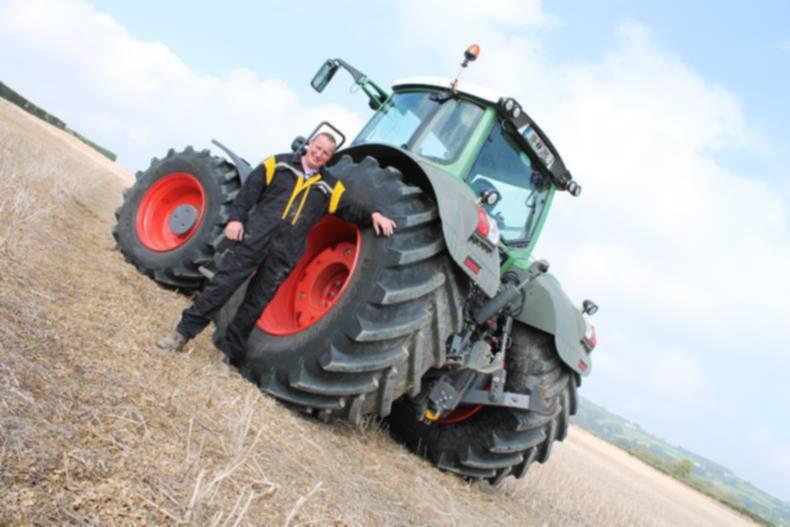
The Irish Farmers Journal spoke to one farmer who opted for replacement BKT tyres on his 2008 Fendt 936. Jonathan Sharpe and his wife, Muriel, are farming and operating a coal retail business just outside Avoca, Co Wicklow.
Their farming operation is mostly tillage but also incorporates some winter beef fattening. Jonathan grows around 220 acres of winter OSR, wheat, oats and barley.
The Fendt 936 does all of the ploughing, cultivation and drilling work. Equipment includes a mounted Kverneland EO six-furrow reversible plough, 5m Simba disc cultivator and Horsch 4m seed and fertilizer drill.
The original tyres on the rear of the Fendt were 710/75R42s. “The Fendt is 360hp and we were not able to effectively transmit all of that power to the ground on the existing tyres.”
Wheel slip was a problem with draught operations. Johnathan says: “If you have 10% wheel slip, then you need 10% more fuel to do 10% more work and so on.
“We could not run them at a low enough pressure and, when drilling, there was too much compaction,” he adds.
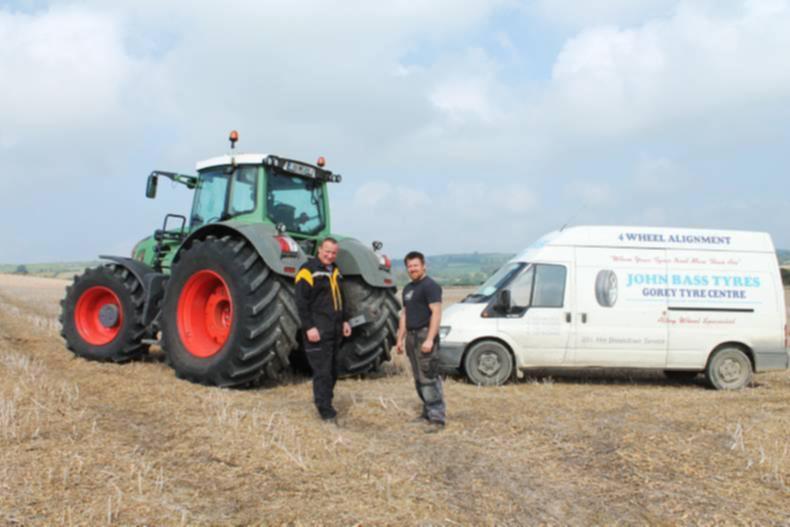
Big tyres have a big price tag. The original tyres were replaced with 900/60R42 BKT Agrimax Force tyres (and wheels) on the rear and 710/60R34s on the front. “These were an economic alternative to more established, premium-branded tyres,” explains Jonathan. The full set was sourced from local tyre centre John Bass Tyres, Gorey, Co Wexford.
According to Agrigear, BKT introduced its top-of-the-range Agrimax radial tyres for high-power tractors with more than 200hp. It adds that the Agrimax Force tyre has been designed and developed based on IF technology, which allows the operator to work at lower inflation pressure with equal loads, so that the tyre has a less aggressive effect on the land.
Agrigear also says that innovations in the tyre design ensure maximum sidewall flexibility and an optimised footprint area during low-pressure use. This allows maximum carrying capacity at a pressure of 1.6 bar, instead of 2.4 bar.
To minimise ground compaction, Jonathan typically runs his new BKT tyres at 0.8 bar. They are even used for ploughing.
“Our Kverneland EO plough allows us to plough on land or in furrow. There is less potential to damage tyres on land and it is more comfortable ploughing on the level,” he says.
One of the main advantages of the Agrimax Force tyre is that once you set the pressure for your load and torque, the tyre can travel at any speed between 0 and 65km/h. This is a feature of the Agrimax Force tyre design that Jonathan likes.



SHARING OPTIONS