With the vast majority of farms now required to spread slurry using Low Emission Slurry Spreading (LESS) techniques in order to comply with regulations, it’s important that a quick calibration procedure is carried out to establish the correct forward speed for the desired application rate.
Since 1 January 2025, rules under the Good Agricultural Practice for Protection of Waters Regulations require all farmers with a grassland stocking rate of over 100kg/ha organic nitrogen to apply all slurry on their holding (produced and imported) using LESS equipment.
This includes pig farmers and slurry applied to arable lands, where incorporation does not take place within 24 hours.
As the threshold narrows requiring the use of LESS on lower stocked farms of 100kg/ha organic nitrogen from the previous threshold of 130kg/ha organic nitrogen, farm size and machinery size reduces too, generally speaking.
These farms were used to spreading with smaller tractors and splash plates, which offered working widths anywhere between 33ft and 44ft (10m-13.5m). Most will have opted for a 7.5m (24.7ft) dribble bar/trailing shoe based on tanker and or tractor restrictions, or maybe even to keep the level of investment required to a minimum.
If this is the case, then the working width has been reduced. So, in order to maintain the same application rate as before, forward speed needs to be increased.
Forward speed is key
However, all farmers and machine drivers relatively new to using LESS applicators such as a dribble bar or a trailing shoe, regardless of their width, should be aware that the forward speed will likely differ in comparison to the splash plate if the same application rate is to be achieved.
When using a LESS applicator for the first time, one thing you will notice is how quick you will empty the tanker in comparison to using the splash plate.
Slurry calibration tool
Teagasc offers a very basic and easy-to-use online slurry spreader calibration calculator to help farmers and agricultural contractors using tankers to set accurate application rates.
The online calibration tool requires four key pieces of information in order to determine the forward speed required to apply the desired rate. The user inputs this information by adjusting a number of sliders on the calculator.
The details required include; size of the tanker used (gallons), working width of the applicator system (metres), the time taken to empty the tanker and the targeted application rate.
The calculator will then indicate the required forward speed in km/h to achieve the desired rate. Not only does it remove the guesswork, but it can be used on a mobile phone and is free to use.
Trial
To prove it works, we used a 2,750-gallon tanker with an 11,000l pump and a 9m trailing shoe. When using the splash plate, the average working width of the application was measured at approximately 13.5m, and the time to empty was approximately six minutes and 25 seconds.
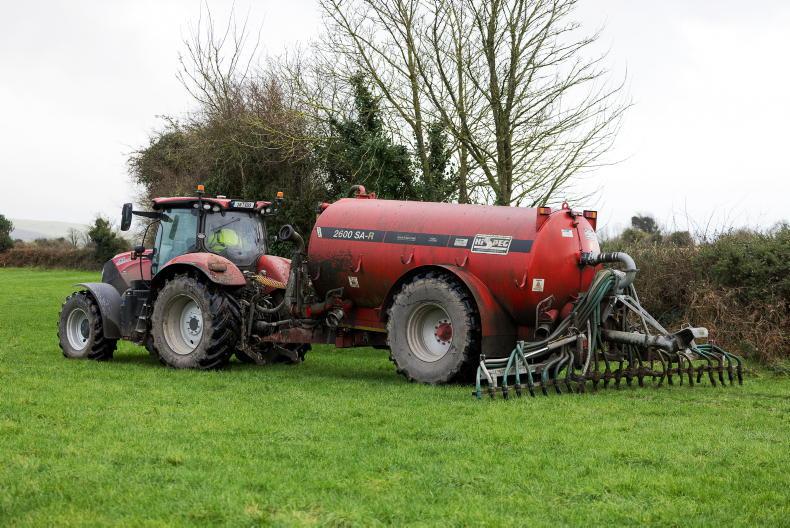
Next, we applied slurry via the trailing shoe, using the same tanker. The nine-metre trailing shoe distributed the slurry through 40 outlets, which were fed by a Vogelsang macerator. The time to empty was approx four minutes and 25 seconds.
Why did the tanker empty quicker?
Slurry being applied through the splash plate had to be fed out through the one narrow gap, measured at approximately 55mm wide. Meanwhile, on the LESS system, the opening feeding the macerator is increased two-fold and in some cases, this goes up three-fold, in addition to far more outlets.
In this situation, the working width is significantly reduced too, while the flow of slurry to feed the large number of outlets is increased, so naturally the tanker will empty far quicker.
The point to note is that when using LESS systems, the tractor’s forward speed needs to be significantly increased to match the splash plate’s application rate. A factor often overlooked by many; forward speed is key to an even application at the correct rate.
Using the calculator
Once we had the information needed, we entered the data into the Teagasc slurry calibration calculator. The calculator advised operating at a forward speed of 3.2km/h when using the splash plate, and over twice that speed of 7km/h when applying slurry with the dribble bar.
Although a 2,750-gallon tanker is larger than what most farmers are running, so too is the 9m trailing shoe.
The most common working width LESS system being sold to farmers in Ireland continues to be 7.5m. Despite this, the concept of the increased forward speed remains the same.
When moving to a new application method, it is important to ensure that you are applying slurry evenly and at the correct rate.
If your land type, tanker and budget allow, we would recommend opting for a wider LESS system in a bid to be able to hit the desired application rates at slower forward speeds. Forward speed is what requires the horsepower. At the same time, weight needs to be kept in mind as the tanker needs to be well balanced.
In brief
When moving to a LESS application method, ensure that you are applying the slurry evenly and at the correct rate. LESS systems (particularly the common 7.5m attachments) require an increased forward speed to maintain the same application rate as a splash plate. Teagasc have a free online calibration calculator which advises users of the correct forward speed to achieve their desired application rate. Tank size, working width, time to empty and the desired application rate are the only required inputs for the Teagasc online calibration tool.
With the vast majority of farms now required to spread slurry using Low Emission Slurry Spreading (LESS) techniques in order to comply with regulations, it’s important that a quick calibration procedure is carried out to establish the correct forward speed for the desired application rate.
Since 1 January 2025, rules under the Good Agricultural Practice for Protection of Waters Regulations require all farmers with a grassland stocking rate of over 100kg/ha organic nitrogen to apply all slurry on their holding (produced and imported) using LESS equipment.
This includes pig farmers and slurry applied to arable lands, where incorporation does not take place within 24 hours.
As the threshold narrows requiring the use of LESS on lower stocked farms of 100kg/ha organic nitrogen from the previous threshold of 130kg/ha organic nitrogen, farm size and machinery size reduces too, generally speaking.
These farms were used to spreading with smaller tractors and splash plates, which offered working widths anywhere between 33ft and 44ft (10m-13.5m). Most will have opted for a 7.5m (24.7ft) dribble bar/trailing shoe based on tanker and or tractor restrictions, or maybe even to keep the level of investment required to a minimum.
If this is the case, then the working width has been reduced. So, in order to maintain the same application rate as before, forward speed needs to be increased.
Forward speed is key
However, all farmers and machine drivers relatively new to using LESS applicators such as a dribble bar or a trailing shoe, regardless of their width, should be aware that the forward speed will likely differ in comparison to the splash plate if the same application rate is to be achieved.
When using a LESS applicator for the first time, one thing you will notice is how quick you will empty the tanker in comparison to using the splash plate.
Slurry calibration tool
Teagasc offers a very basic and easy-to-use online slurry spreader calibration calculator to help farmers and agricultural contractors using tankers to set accurate application rates.
The online calibration tool requires four key pieces of information in order to determine the forward speed required to apply the desired rate. The user inputs this information by adjusting a number of sliders on the calculator.
The details required include; size of the tanker used (gallons), working width of the applicator system (metres), the time taken to empty the tanker and the targeted application rate.
The calculator will then indicate the required forward speed in km/h to achieve the desired rate. Not only does it remove the guesswork, but it can be used on a mobile phone and is free to use.
Trial
To prove it works, we used a 2,750-gallon tanker with an 11,000l pump and a 9m trailing shoe. When using the splash plate, the average working width of the application was measured at approximately 13.5m, and the time to empty was approximately six minutes and 25 seconds.
Next, we applied slurry via the trailing shoe, using the same tanker. The nine-metre trailing shoe distributed the slurry through 40 outlets, which were fed by a Vogelsang macerator. The time to empty was approx four minutes and 25 seconds.
Why did the tanker empty quicker?
Slurry being applied through the splash plate had to be fed out through the one narrow gap, measured at approximately 55mm wide. Meanwhile, on the LESS system, the opening feeding the macerator is increased two-fold and in some cases, this goes up three-fold, in addition to far more outlets.
In this situation, the working width is significantly reduced too, while the flow of slurry to feed the large number of outlets is increased, so naturally the tanker will empty far quicker.
The point to note is that when using LESS systems, the tractor’s forward speed needs to be significantly increased to match the splash plate’s application rate. A factor often overlooked by many; forward speed is key to an even application at the correct rate.
Using the calculator
Once we had the information needed, we entered the data into the Teagasc slurry calibration calculator. The calculator advised operating at a forward speed of 3.2km/h when using the splash plate, and over twice that speed of 7km/h when applying slurry with the dribble bar.
Although a 2,750-gallon tanker is larger than what most farmers are running, so too is the 9m trailing shoe.
The most common working width LESS system being sold to farmers in Ireland continues to be 7.5m. Despite this, the concept of the increased forward speed remains the same.
When moving to a new application method, it is important to ensure that you are applying slurry evenly and at the correct rate.
If your land type, tanker and budget allow, we would recommend opting for a wider LESS system in a bid to be able to hit the desired application rates at slower forward speeds. Forward speed is what requires the horsepower. At the same time, weight needs to be kept in mind as the tanker needs to be well balanced.
In brief
When moving to a LESS application method, ensure that you are applying the slurry evenly and at the correct rate. LESS systems (particularly the common 7.5m attachments) require an increased forward speed to maintain the same application rate as a splash plate. Teagasc have a free online calibration calculator which advises users of the correct forward speed to achieve their desired application rate. Tank size, working width, time to empty and the desired application rate are the only required inputs for the Teagasc online calibration tool. 






SHARING OPTIONS