


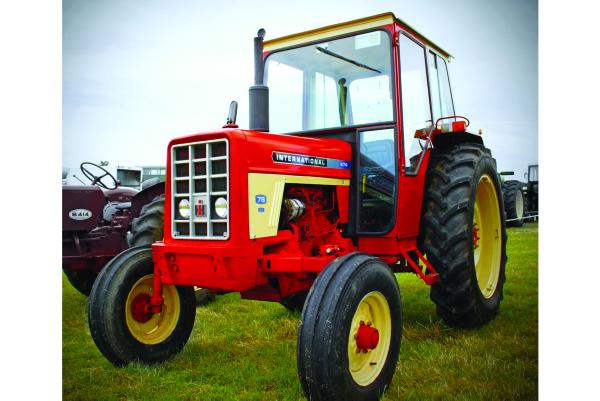
The tractors were assembled in Doncaster, England and exported across the globe.
International Harvester invested heavily in the design, development and factory re-tooling required to manufacture the ‘74 Series’ machines. The new models had simple, modern styling and a cream and red colour scheme.
The first worldwide tractors introduced by International Harvester were the three-cylinder 454 and four-cylinder 574 models. The tractors’ power-plants produced 52hp and 68hp, respectively.
A synchromesh gearbox providing eight forward and four reverse speeds was fitted as standard. The optional ‘Torque Amplifier’ transmission doubled the number of available gears.
However, the real news was that International Harvester was the first tractor manufacturer to introduce a hydrostatic gearbox. This transmission was optional on both the 454 and 574, and proved particularly popular with those who predominantly used their tractors for loader work.
The International Harvester 454 and 574 were joined by the smaller 354, 374 and 444 machines in 1971. The new tractors were rated at 38hp, 41hp and 45hp respectively. The 62hp 474 was added to the range in 1972, and the following year, the 78hp flagship 674 was unveiled.
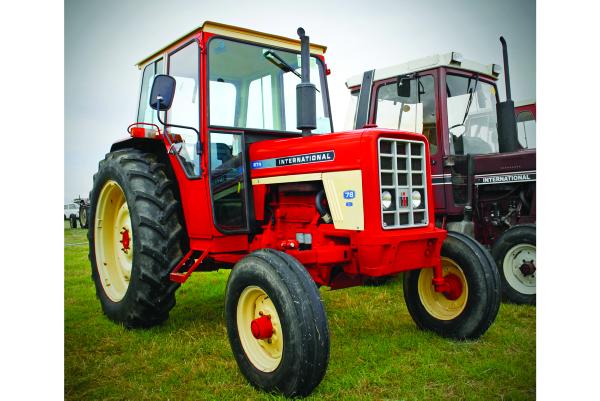
The ‘74 Series’ tractors had many modern features such as oil-immersed self-adjusting disc brakes, pendant style pedals and a user-friendly cab layout with the major controls located on the operator’s right-hand side. Category I and II rear linkage was standard across the range, while optional extras included hydrostatic steering, wheel weights and a pick-up hitch.
The tractors were fitted with a safety frame or Victor cab depending on whether they were being exported or sold domestically. The Victor cab had a removable roof and doors, sliding side windows and an opening rear window. The tractor’s fuel tank was located on top of the rear axle, thereby acting as a useful weight.
||PIC2||
In 1974, the International Harvester 474 was superseded by the 475. Although the new tractor had the same power output as its predecessor, it was fitted with a Perkins power-plant. This was the same engine that powered the Massey Ferguson 165.
Approximately 77,000 International Harvester ‘74 Series’ tractors were produced at Doncaster before the range was superseded by the ‘84 Series’ models in 1977. The most popular model in the range was the versatile 574. The tractors had earned an enviable reputation for reliability among the farming community.
Now is an ideal time to source an example of one of these ‘74 Series’ machines for restoration. Like almost any vintage or classic tractor, the value of International Harvesters is directly correlated with their rarity and desirability which is steadily increasing with every passing year.


SHARING OPTIONS