As grazing begins to get into full steam, farm roadways will come in to frequent use. These roadways are an essential grazing tool for farmers, for animal and machinery access to paddocks and to increase the utilisation of grazed grass.
Maintenance is required to ensure roadways do not fall in to major disrepair, but the most important factor with roadways (especially for dairy cows walking twice daily) is to ensure a firm, smooth surface that will not have a negative impact on hoof health, particularly in the lead up
to breeding.
Repairing an existing roadway
Roadways should be repaired as necessary with maintenance required annually or bi-annually. Particular attention needs to go to the most used areas of the roadway; the first 50-100 metres near the parlour or farmyard. Where it is found that this area is particularly hard to keep clean, then considerations should be given to concreting this area.
Caution needs to be taken when this is done as small stones can be dragged on to the concrete from gravel roads. When a cow steps on a stone sitting on concrete the stone can be driven up in to the cow’s hoof.
Frequent sweeping of the concreted section, or a kerb to force cows to raise their feet before stepping on to the concrete, needs to be completed.
The most common roadway repairs necessary are blinding off rough areas, filling pothole and drainage of roadways. Grass verges along the edge of roads should be cleaned off to allow the road to drain in to the field. Where roadways are lower than the field, then it will have to be raised to allow drainage.
Potholes are caused by sitting water, and while a road may sit higher than the adjacent field, a crossfall from the centre of the road from one side to the other is required to keep water from puddling.
Generally, a thin layer of 8-0-4 type material (small broken stone with ‘’fat’’ running through it) can be used to bring up the road level to height. The road should slope to one or both sides, with a slope of 1:25/ 2.3° recommended and finished off with a suitable surface material and compacted.
Quarry dust should be applied and rolled on to any rougher areas at a thickness of 50-60mm and should not have pebbles larger than 5-6mm in it.
Runoff to streams and channel creation
While livestock prefer a roadway that cambers from the middle, where there is a risk of runoff in to any watercourses, the cambering of slopes from the centre of the road must not be adopted.
As part of changes to the nitrates laws which came in to effect in 2021, roadways running alongside watercourses must ensure that the camber is away from the watercourse with soiled water directed to the field. If you haven’t already completed this action, then it should be carried out immediately.
Roadways on steeply sloping ground tend to suffer badly from rainfall, as streams of water flow downhill, gathering momentum to remove the top layer of finer materials from roadways and exposing the rougher base layers.
Where this occurred, the finer material should be replaced and angled ramps (to prevent build-up of soiled water), shallow channels or cut-off drains installed at intervals across the roadway and in to the field to divert water off the road before it builds up volume and momentum.
Teagasc estimates that a 4m wide roadway, with 0.3m depth of 8-0-4 material off will need one 25 tonne load to cover each 9-11 metres in length. This assumes a density of about two tonnes per m3 for the material used. A similar sized load would cover 60-65 metres with a 50mm surface layer, for example quarry dust for blinding off.
The price of road making material, both crushed stone and dust, for the surface is between €9 and €12 plus VAT/tonne, depending on supplier and now transport distance.
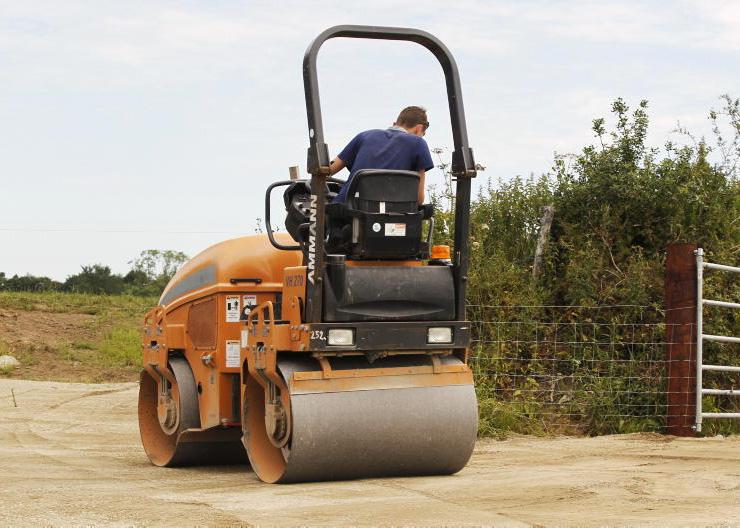
Digger hire for a 13-tonne machine will cost in the region of €40-€50 + VAT per hour, while most farmers will provide their own tractor and a trailer for drawing of materials. A vibrating roller should be used to help seal the quarry dust, and will cost €100-€150 per day depending on size.
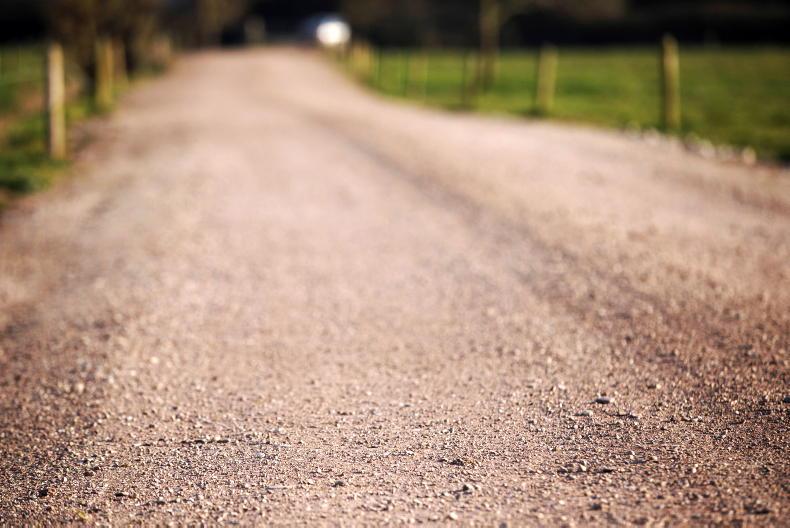
Farm roadways are critical in grazing management, while poor quality roadways can have a seriously negative impact on animal health. \ Donal O' Leary
As grazing begins to get into full steam, farm roadways will come in to frequent use. These roadways are an essential grazing tool for farmers, for animal and machinery access to paddocks and to increase the utilisation of grazed grass.
Maintenance is required to ensure roadways do not fall in to major disrepair, but the most important factor with roadways (especially for dairy cows walking twice daily) is to ensure a firm, smooth surface that will not have a negative impact on hoof health, particularly in the lead up
to breeding.
Repairing an existing roadway
Roadways should be repaired as necessary with maintenance required annually or bi-annually. Particular attention needs to go to the most used areas of the roadway; the first 50-100 metres near the parlour or farmyard. Where it is found that this area is particularly hard to keep clean, then considerations should be given to concreting this area.
Caution needs to be taken when this is done as small stones can be dragged on to the concrete from gravel roads. When a cow steps on a stone sitting on concrete the stone can be driven up in to the cow’s hoof.
Frequent sweeping of the concreted section, or a kerb to force cows to raise their feet before stepping on to the concrete, needs to be completed.
The most common roadway repairs necessary are blinding off rough areas, filling pothole and drainage of roadways. Grass verges along the edge of roads should be cleaned off to allow the road to drain in to the field. Where roadways are lower than the field, then it will have to be raised to allow drainage.
Potholes are caused by sitting water, and while a road may sit higher than the adjacent field, a crossfall from the centre of the road from one side to the other is required to keep water from puddling.
Generally, a thin layer of 8-0-4 type material (small broken stone with ‘’fat’’ running through it) can be used to bring up the road level to height. The road should slope to one or both sides, with a slope of 1:25/ 2.3° recommended and finished off with a suitable surface material and compacted.
Quarry dust should be applied and rolled on to any rougher areas at a thickness of 50-60mm and should not have pebbles larger than 5-6mm in it.
Runoff to streams and channel creation
While livestock prefer a roadway that cambers from the middle, where there is a risk of runoff in to any watercourses, the cambering of slopes from the centre of the road must not be adopted.
As part of changes to the nitrates laws which came in to effect in 2021, roadways running alongside watercourses must ensure that the camber is away from the watercourse with soiled water directed to the field. If you haven’t already completed this action, then it should be carried out immediately.
Roadways on steeply sloping ground tend to suffer badly from rainfall, as streams of water flow downhill, gathering momentum to remove the top layer of finer materials from roadways and exposing the rougher base layers.
Where this occurred, the finer material should be replaced and angled ramps (to prevent build-up of soiled water), shallow channels or cut-off drains installed at intervals across the roadway and in to the field to divert water off the road before it builds up volume and momentum.
Teagasc estimates that a 4m wide roadway, with 0.3m depth of 8-0-4 material off will need one 25 tonne load to cover each 9-11 metres in length. This assumes a density of about two tonnes per m3 for the material used. A similar sized load would cover 60-65 metres with a 50mm surface layer, for example quarry dust for blinding off.
The price of road making material, both crushed stone and dust, for the surface is between €9 and €12 plus VAT/tonne, depending on supplier and now transport distance.
Digger hire for a 13-tonne machine will cost in the region of €40-€50 + VAT per hour, while most farmers will provide their own tractor and a trailer for drawing of materials. A vibrating roller should be used to help seal the quarry dust, and will cost €100-€150 per day depending on size.
Farm roadways are critical in grazing management, while poor quality roadways can have a seriously negative impact on animal health. \ Donal O' Leary






SHARING OPTIONS