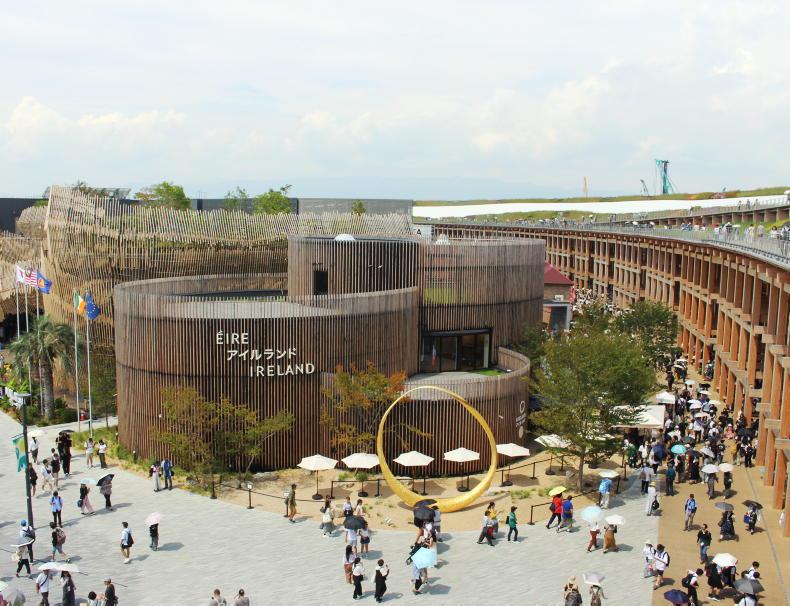
The Ireland Pavilion at Expo 25 was in stark contrast to our first participation at this global event, when Ireland reluctantly entered the Hanover Expo 2000. Ireland has been increasing its wood content at Expo events over the years, especially since the Milan exhibition in 2015. Then, Ciaran O’Connor and his OPW team pushed the boundaries with wood – European larch – in contrast with our first entry which relied heavily on Kilkenny limestone, dry wall stone, glass and galvanised sheeting.
This year, for the first time, Ireland used home-grown timber – Douglas fir – which was sourced, sawn and dried in Ireland before transporting to Osaka as we described in the Irish Farmers Journal (1 November). This was a brave but confident decision, as some countries with long established wood cultures used Japanese sourced wood and international designers. For example, the Nordic countries used Japanese cedar and cypress in their impressive barn structure, designed by Italian architect Michele De Lucchi.
Planning the Irish pavilion began as early as 2022, when the design of both the building, monumental sculpture and garden landscaping was taking shape, but the real action shifted to Co Cork in 2023 and 2024.
Precision sawing and drying of Douglas fir was then taking place in GP Wood sawmill, Enniskeane, while all research, design and preparatory work had been carried out on the sculpture Magnus Rinn in Joseph Walsh Studio, Riverstick.
Joseph Walsh and his team of master craftspeople then moved to Italy where the sculpture featuring bronze and wood, was cast at the Fonderia Artistica Mariani, before it was finally gilded in gold leaf.
Circularity was an inherent theme in the Ireland Pavilion. Walsh chose the word rinn as his inspiration, because “it has meaning in both Gaelic and Japanese that relates to place, circularity and the flow of ideas across cultures”, he explained. Circularity was also the reference point in building the pavilion, which was “constructed in three elliptical areas” to represent an abstracted triskele – the Neolithic spiral motif – as described by Sarah Heery, senior architect with the OPW. The frame of sawn Douglas fir was “designed to allow ease of dismantling and the recycling or re-use of materials”, she said, while “the interior was finished in dark stained timber which evoked the richness of Irish bog oak”.
In Osaka, the actual construction and installation began last year when OPW architects, along with Joseph Walsh, collaborated with the Japanese team to ensure the structure would be built and landscaped in time.
Conscious of how trees are revered in Japan, award-winning landscape architect Hiroyuki Tsujii was chosen to design the pavilion garden along with Oliver Schulman.
In addition to landscape design, Tsujii is the guardian of the Karasaki Pine Tree, a role which includes the passing on of knowledge about this sacred pine in his hometown of Sakamoto.
All three elements – building, sculpture and garden – were in place last December, a major achievement, considering some pavilions struggled to meet the April opening date. The project received significant media exposure in Japan at the time, as it was the first international pavilion to receive a certificate of construction at Expo 25.
The building was booked out every day during Expo 25 from April to October and queues had already formed on the September morning I arrived.
“The objective is to give visitors a sense of Ireland, as our staff outline our history and culture through dance, music and story-telling,” Brian O’Brien, Ireland-Expo 25 commissioner told me during my visit.
“So, the events throughout the seven-month period are aimed to give people a sense of Ireland, as both a trading and tourist destination,” he added. Surprisingly, only 17% of Japan’s 124 million people hold passports.
The end result was a confident and integrated design, featuring sculpture, building and garden, in what was a “team Ireland” approach. The complex created an immediate impact at the popular East Gate section of Expo 25 where most of the average daily attendance – up to 170,000 visitors – from Japan and around the world arrived by Metro. The innovative use of Douglas fir in the pavilion raises the question as to why this species is not planted anymore in Ireland, which we will discuss in the next forestry feature.

Model of Magnus Rinn by Joseph Walsh, one of the exhibits in the interior of the Ireland Pavilion, depicting the materials – oak, bronze and gold – used in the monumental outdoor sculpture. \ Donal Magner
ITGA calls ‘for immediate halt’ to ESB 55m-wide corridors
The Irish Timber Growers Association (ITGA) has called for an immediate halt to the ESB’s proposed removal of 55m-wide corridors of forests under medium-voltage power lines.
“The ITGA has emphasised that full compensation must be provided for the current and future value of all trees cleared, as well as for potential long-term losses to forest viability arising from increased wind exposure and the corresponding reduced economic sustainability of smaller forest blocks,” said Donal Whelan, ITGA technical director.
“Currently, a 20m-wide corridor is retained under such lines. Extending this to 55m would have significant economic and environmental consequences, exposing private timber growers to substantial financial losses from premature harvesting and increasing the risk of windthrow and forest instability in the remaining crop,” he said.
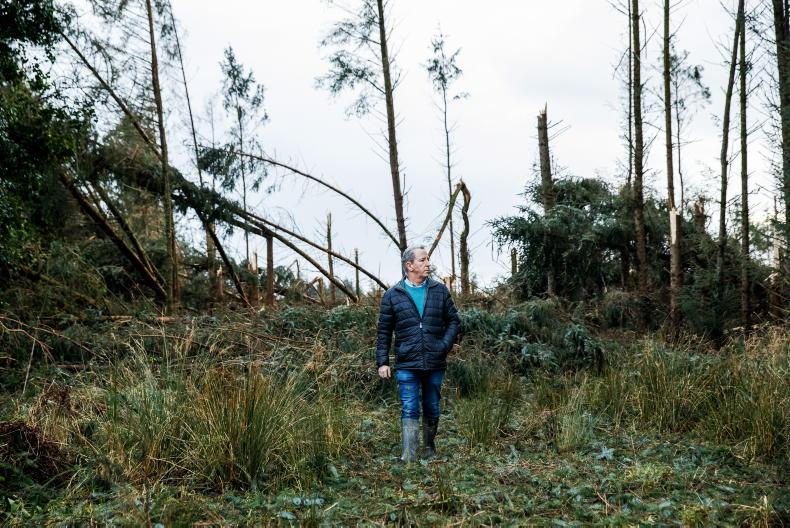
The impact of corridor clearance of this magnitude was illustrated at a recent field day in Coolaney, Co Sligo organised by Western Forestry Co-op and ITGA. Depending on shape, averaged sized forests of 7ha could lose between 20% and 40% of the planted area under the proposals, while smaller plantations could be decimated.
For example, one forest owner present who had a 2.1ha property would lose 1ha if the ESB’s Winter Grid Resilience Plan is implemented. In addition to existing set back losses (housing, road and watercourses) of 1.2ha, the owner’s forest is reduced to 0.3ha of actual planted area. According to ESB data, approximately 710km of medium-voltage lines traverse forest plantations. The additional proposed clearance would result in the loss of 2,485ha (6,140 acres) of forest.
“Within private forests alone, 502km of affected lines would remove 1,757ha — a greater area than Ireland afforested in either of the two past years,” said Whelan.
“Despite repeated efforts at engagement by ITGA, no stakeholder consultation had taken place between the ESB and the association at the time of writing,” according to Whelan.
“The ITGA has called on Minister Michael Healy-Rae TD to intervene before the current draft Bill progresses further,” he said. He acknowledged the need for some tree removal but said: “The proposed clearance scale is unprecedented and would undermine decades of private investment and national afforestation targets.”
The Ireland Pavilion at Expo 25 was in stark contrast to our first participation at this global event, when Ireland reluctantly entered the Hanover Expo 2000. Ireland has been increasing its wood content at Expo events over the years, especially since the Milan exhibition in 2015. Then, Ciaran O’Connor and his OPW team pushed the boundaries with wood – European larch – in contrast with our first entry which relied heavily on Kilkenny limestone, dry wall stone, glass and galvanised sheeting.
This year, for the first time, Ireland used home-grown timber – Douglas fir – which was sourced, sawn and dried in Ireland before transporting to Osaka as we described in the Irish Farmers Journal (1 November). This was a brave but confident decision, as some countries with long established wood cultures used Japanese sourced wood and international designers. For example, the Nordic countries used Japanese cedar and cypress in their impressive barn structure, designed by Italian architect Michele De Lucchi.
Planning the Irish pavilion began as early as 2022, when the design of both the building, monumental sculpture and garden landscaping was taking shape, but the real action shifted to Co Cork in 2023 and 2024.
Precision sawing and drying of Douglas fir was then taking place in GP Wood sawmill, Enniskeane, while all research, design and preparatory work had been carried out on the sculpture Magnus Rinn in Joseph Walsh Studio, Riverstick.
Joseph Walsh and his team of master craftspeople then moved to Italy where the sculpture featuring bronze and wood, was cast at the Fonderia Artistica Mariani, before it was finally gilded in gold leaf.
Circularity was an inherent theme in the Ireland Pavilion. Walsh chose the word rinn as his inspiration, because “it has meaning in both Gaelic and Japanese that relates to place, circularity and the flow of ideas across cultures”, he explained. Circularity was also the reference point in building the pavilion, which was “constructed in three elliptical areas” to represent an abstracted triskele – the Neolithic spiral motif – as described by Sarah Heery, senior architect with the OPW. The frame of sawn Douglas fir was “designed to allow ease of dismantling and the recycling or re-use of materials”, she said, while “the interior was finished in dark stained timber which evoked the richness of Irish bog oak”.
In Osaka, the actual construction and installation began last year when OPW architects, along with Joseph Walsh, collaborated with the Japanese team to ensure the structure would be built and landscaped in time.
Conscious of how trees are revered in Japan, award-winning landscape architect Hiroyuki Tsujii was chosen to design the pavilion garden along with Oliver Schulman.
In addition to landscape design, Tsujii is the guardian of the Karasaki Pine Tree, a role which includes the passing on of knowledge about this sacred pine in his hometown of Sakamoto.
All three elements – building, sculpture and garden – were in place last December, a major achievement, considering some pavilions struggled to meet the April opening date. The project received significant media exposure in Japan at the time, as it was the first international pavilion to receive a certificate of construction at Expo 25.
The building was booked out every day during Expo 25 from April to October and queues had already formed on the September morning I arrived.
“The objective is to give visitors a sense of Ireland, as our staff outline our history and culture through dance, music and story-telling,” Brian O’Brien, Ireland-Expo 25 commissioner told me during my visit.
“So, the events throughout the seven-month period are aimed to give people a sense of Ireland, as both a trading and tourist destination,” he added. Surprisingly, only 17% of Japan’s 124 million people hold passports.
The end result was a confident and integrated design, featuring sculpture, building and garden, in what was a “team Ireland” approach. The complex created an immediate impact at the popular East Gate section of Expo 25 where most of the average daily attendance – up to 170,000 visitors – from Japan and around the world arrived by Metro. The innovative use of Douglas fir in the pavilion raises the question as to why this species is not planted anymore in Ireland, which we will discuss in the next forestry feature.
Model of Magnus Rinn by Joseph Walsh, one of the exhibits in the interior of the Ireland Pavilion, depicting the materials – oak, bronze and gold – used in the monumental outdoor sculpture. \ Donal Magner
ITGA calls ‘for immediate halt’ to ESB 55m-wide corridors
The Irish Timber Growers Association (ITGA) has called for an immediate halt to the ESB’s proposed removal of 55m-wide corridors of forests under medium-voltage power lines.
“The ITGA has emphasised that full compensation must be provided for the current and future value of all trees cleared, as well as for potential long-term losses to forest viability arising from increased wind exposure and the corresponding reduced economic sustainability of smaller forest blocks,” said Donal Whelan, ITGA technical director.
“Currently, a 20m-wide corridor is retained under such lines. Extending this to 55m would have significant economic and environmental consequences, exposing private timber growers to substantial financial losses from premature harvesting and increasing the risk of windthrow and forest instability in the remaining crop,” he said.
The impact of corridor clearance of this magnitude was illustrated at a recent field day in Coolaney, Co Sligo organised by Western Forestry Co-op and ITGA. Depending on shape, averaged sized forests of 7ha could lose between 20% and 40% of the planted area under the proposals, while smaller plantations could be decimated.
For example, one forest owner present who had a 2.1ha property would lose 1ha if the ESB’s Winter Grid Resilience Plan is implemented. In addition to existing set back losses (housing, road and watercourses) of 1.2ha, the owner’s forest is reduced to 0.3ha of actual planted area. According to ESB data, approximately 710km of medium-voltage lines traverse forest plantations. The additional proposed clearance would result in the loss of 2,485ha (6,140 acres) of forest.
“Within private forests alone, 502km of affected lines would remove 1,757ha — a greater area than Ireland afforested in either of the two past years,” said Whelan.
“Despite repeated efforts at engagement by ITGA, no stakeholder consultation had taken place between the ESB and the association at the time of writing,” according to Whelan.
“The ITGA has called on Minister Michael Healy-Rae TD to intervene before the current draft Bill progresses further,” he said. He acknowledged the need for some tree removal but said: “The proposed clearance scale is unprecedented and would undermine decades of private investment and national afforestation targets.”







SHARING OPTIONS