


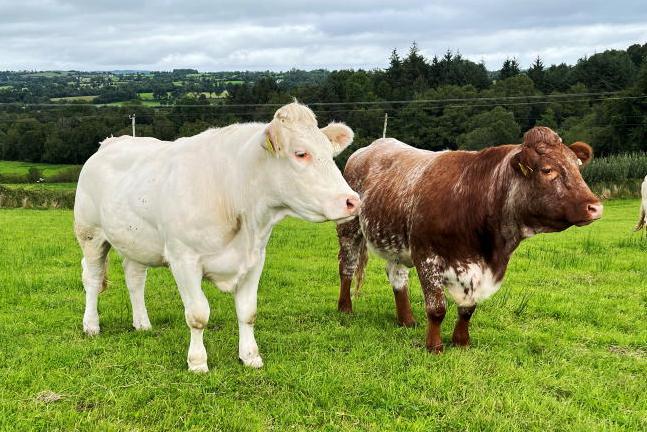
Most characteristics of cattle that we are familiar with - such as growth, fertility and carcase traits - are controlled by many genes.
The myostatin gene is found in all mammals and influences the production of a protein that regulates muscle development.
There are nine known mutations of the myostatin gene in cattle, some of which are breed-specific and others that affect multiple breeds.
This trait is commonly seen in breeds such as Belgian Blue, Charolais and Limousin.
While these mutations can improve carcase yield, conformation and increase kill-out percentages and meat quality, they also introduce management challenges.
Potential drawbacks of some variants - such as Q204, nt821 and E226X - include females with smaller pelvic areas, reduced milk production, delayed onset of puberty and calving difficulties caused by larger calves with higher likelihood of caesarean sections on farm.
Meanwhile, variants such as F94L can increase muscle development without significantly affecting other traits such as calving ability and milk production.
It increases the size of muscle fibres with no associated increase in calving difficulty, reduced fertility or shortened longevity.
Myostatin variations
Myostatin genes are recessive and thus only come into their full expression and effect when an animal carries any two copies.
Every calf inherits one copy of the gene from the sire and one from the dam.
For each myostatin mutation, an animal may have no mutations resulting in normal muscling, one mutation giving intermediate muscling or two mutations producing double muscling.
Animals carrying one copy of a mutation have a 50% chance of passing it to their calves, while those with two copies will always transmit one mutated copy.
This is why understanding the genetics of breeding stock is essential when planning matings.
Importance of genotyping commercial suckler females
Farmers already have access to the myostatin status of pedigree stock bulls and AI sires, but this only provides half the picture.
To make informed breeding decisions, it is crucial to know the genetic status of females in the herd. Visual assessment alone cannot reveal which variants a female carries - therefore, genotyping is essential.
For NI suckler breeders, myostatin status of females will become available through DAERA’s new genotyping programme under the Sustainable Agriculture Programme (Bovine Genetics Genotyping Scheme).
This will allow farmers to develop breeding plans that maximise benefits and minimise disadvantages.
Knowing the myostatin status of weanling heifers is also advantageous when selecting replacements, as issues such as delayed puberty and reduced milk ability can affect herd efficiency and profitability.
There is a place for myostatin within the suckler herd - provided farmers have the knowledge to make informed breeding decisions, aiming for heterozygous animals (one copy of a mutation) to balance muscling with calving ease.


SHARING OPTIONS