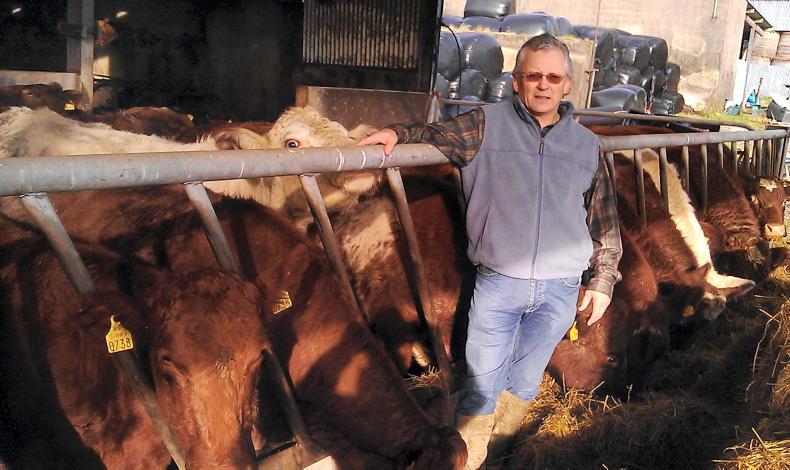
Richard Lee from Mitchelstown in Co Cork wasn’t born a farmer, instead his father was an artificial insemination (AI) technician when Richard was growing up.
However, after inheriting a farm in the early 1980s, a small milking herd was established in 1983, and he began registering Shorthorns in 1984 from stock purchased from the purebred herd at Ballinagrane Estate near Clonmel, Co Tipperary.
“It was their docility, colour variation and the fact that they were dual purpose and easy to maintain which made them particularly suited to the farm,” Richard said.
It was around this time that Richard began collecting old breed herd books, journals, and anything connected to the breed and its history going back to the early 1800s.
Knockagarry herd
Having ceased milking cows in 2000, Richard’s own herd today comprises of over 40 registered beef Shorthorn cows, most of which descend from the original dual-purpose types.
“We converted to organics in 2016 and the vast majority of the herd are now naturally polled – mainly due to animal welfare issues, and of course it’s a matter of tag-and-go, as all cows calve outside in April and May.”
There is a newfound interest in the breed from organic farmers
All of the females born on the farm are pedigree registered, together with a select number of males. Surplus bulls are castrated and sold for beef production. The heifers are usually sold to repeat pedigree customers.
“There is a newfound interest in the breed from organic farmers. Some white or light roan bulls are sold to dairy farmers to breed the sought after blue roan calves,” he said.
History of the breed in Ireland
Reportedly, Shorthorn cattle were first developed in the northeast of England in the late 1700s, from a cross of Teeswater and Durham cattle. They were developed by breeders Charles and Robert Colling, John Booth and Thomas Bates – men who would become legends of cattle breeding, foreseeing a breed of cattle which would last over two centuries.
“At the time there were Longhorns, so that’s where Shorthorns got their name,” added Richard.
According to Richard: “Shorthorns were documented as being in Ireland well before the first breed herdbook was published in 1822 by George Coates. They were certainly in Antrim in the first decade of the century, as in 1812, 10 Shorthorns were exhibited at an early livestock show in Ballinasloe under the auspices of the Farming Society of Ireland.”
Dual-purpose breed
Over the next 100 years, Shorthorn would become the predominant breed of cattle in Ireland, mainly because of their dual-purpose attributes.
“They were self-sufficient, produced good-quality milk for cheese and butter, and at the same time bred a good calf for beef,” said Richard. In 1874, the Shorthorn Society of Great Britain and Ireland was formed with the purchase of Coates’ herdbook from Henry Strafford who had taken ownership of the herdbook.
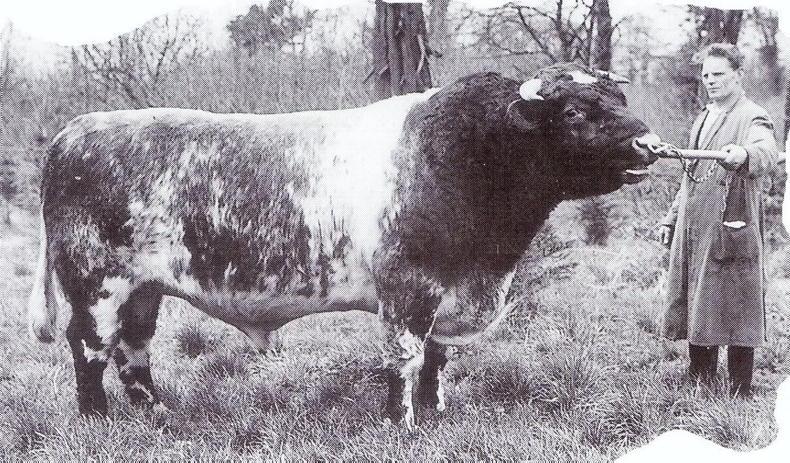
Diamond Strike, a dual-purpose Shorthorn bull bred by W Hall in 1956.
In the 1930s, 40s and 50s Shorthorns really took over from some of the existing cows in Ireland.
Shorthorns crossed really well with some of the other traditional British breeds, such as the Aberdeen Angus, Galloway and Hereford. Many will recall the beautiful Blue Grey cattle which resulted from the cross of a Shorthorn with the Galloway, and of course the wonderful Murray Grey which came from the Angus crossed with the Shorthorn.
But in the 1960s, things would change considerably for the Shorthorn breed in Ireland.
AI influence
“It was around this time AI was first introduced to Ireland. In the mid-1960s, a lot of breeders crossed British Friesian with their Shorthorn cows.
“I suppose you could say this was the start of the demise of the Shorthorns reign as Ireland’s number one breed,” said Richard.
The cross of the British Friesian on the Shorthorn cow produced a good animal with lots of milk and, in most cases, the British Friesian got the credit. Dairy cows changed from Shorthorn to British Friesian within years. But – mainly in the west of the country – some farmers were not happy with the influence of the British Friesian on the Shorthorn. This led to a Department of Agriculture-led survey conducted in association with the Shorthorn society.
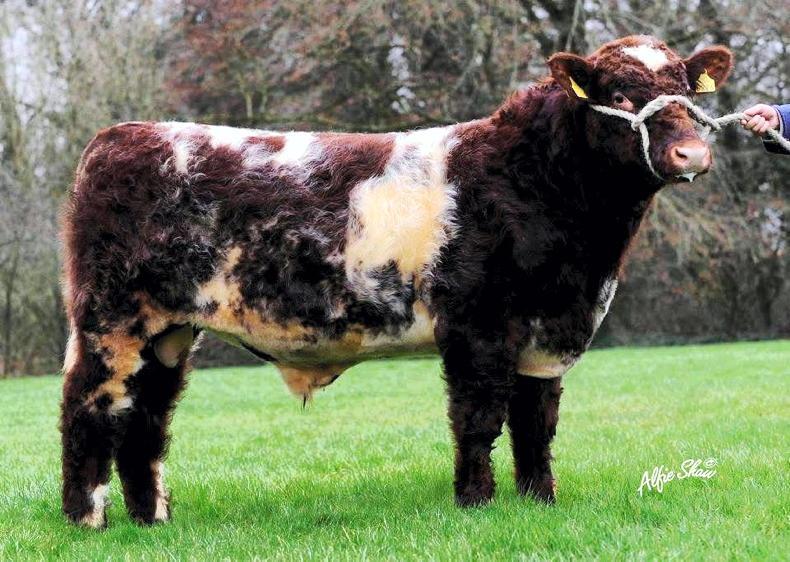
The highly successful AI bull Creaga Dice bred by Noel and Lisa Dowd has had a big impact on the breed. \ Alfie Shaw
It involved Department officials inspecting Shorthorn cattle on farms in an effort to preserve the breeds dual-purpose characteristics.
Exports to the US
“Things took a turn around the 1970s when Dermott Cahill from Dovea Genetics brought a US buyer to the Deerpark Shorthorn herd owned by the Quane family in Co Limerick.
“He was so impressed with what he saw, he purchased a number of cattle for direct export to the US,” Richard explained.
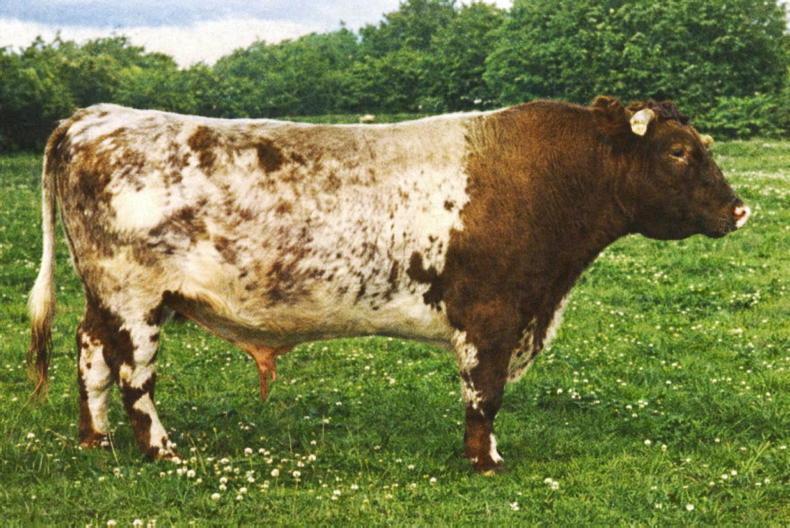
The famous Shorthorn bull Deerpark Leader.
This created a massive outlet for Irish Shorthorns to the US at the time, with bulls selling for up to $24,000.
“It was quite remarkable what happened around then, the Shorthorn bulls Deerpark Guinness and Deerpark Dividend were airlifted out of Shannon to the US, along with females and other bulls,” added Richard.
The Quanes became a household name in the breed, producing many famous bulls, including the great Deerpark Leader.
It was also around this time some of the main continental breeds came into Ireland, such as the Charolais and Limousin. These breeds changed the course of suckling farming in Ireland, adding more size, weight, conformation and growth. To counteract this, a number of breeders in the UK introduced a new breed of cattle to the Shorthorn breed.
Maine-Anjou
In the 1980s, a French breed of cattle called Maine-Anjou was crossed into the Shorthorn breed, having been first imported into the UK.
“Some of the British Shorthorn breeders crossed Maine-Anjou into the breed to add more size and beef into the cattle and at the same time they didn’t interfere with colour.
“Many the beef Shorthorn today have some Maine-Anjou in them, although I prefer to maintain the more moderate 100% type,” Richard explained.
The introduction of the French breed would lead to the dual-purpose breed being split into two different breeds, dairy Shorthorns and beef Shorthorns. For years, all Shorthorns were registered in the one herdbook, until the establishment of the Irish Shorthorn Cattle Society herdbook in 2004.
“Today, beef and dairy shorthorns are recognised as two different breeds. Both can be registered in the Irish herdbook, but they are classified as two separate breeds of cattle,” said Richard.
Success of the breed
Since the formation of the Irish herdbook in 2004, the breed in Ireland has gone from strength to strength.
Dairy and beef Shorthorns are shown in separate rings at summer shows up and down the country. In 2024, there were 1,517 pedigree Shorthorn calves registered in the herdbook, up over 150 calves on the previous year.
The breed has really come back into fashion in recent years, with suckler farmers looking to add colour to their replacement females, especially in the top-end commercial breeding heifer market.
There is also an increase in dairy farmers using Shorthorn bulls to produce replacement heifers for use in the suckler herd.
The influx of farmers into organic farming has also seen an increased demand for Shorthorn cattle.
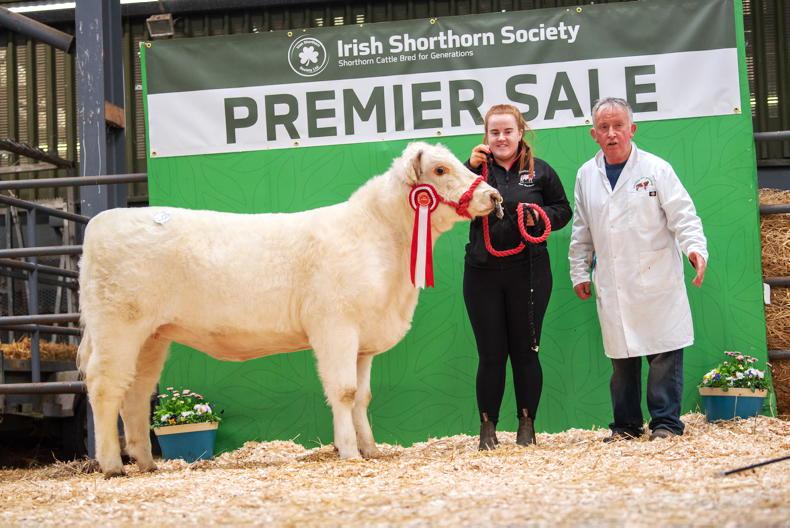
Bushypark Roisin 4th that sold for a breed record price of €8,000 in 2024, exhibited by Roisin and John Keane. \ Swarber Photography
In 2024, a white Shorthorn heifer sold for a breed record of €8,000 at the society’s premier sale in Carrick-on-Shannon. At the same venue in 2025, a Shorthorn bull broke the male breed record price when he sold for €7,100.
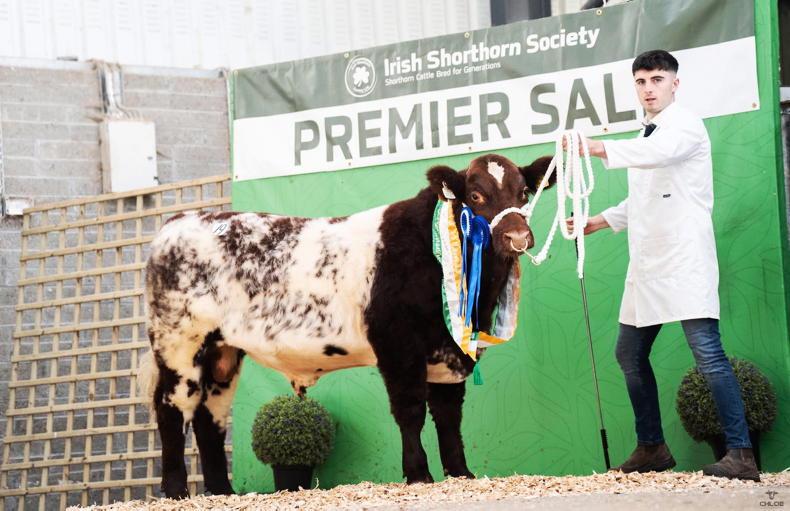
Rockville Ramsey shown by Aaron Dockery that sold for an Irish male record price of €7,100 in 2025. \ Chloe Goggins
Richard believes the future has never been better for the Shorthorn breed in Ireland.
“Shorthorn never got a chance to be good cattle in good times, now they have that chance. We now have Shorthorns which are suited to the showring, dairy shorthorns which can be utilised within dairy herds and Shorthorns which can be used within a commercial enterprise,” he said.
There are so many tools breeders have today that previous generations didn’t have all those years ago, such as DNA, genomics, myostatin and AI.
Richard also believes the Irish Cattle Breeding Federation (ICBF) has a role to play in the future of the breed. “I do believe in the ICBF system, it provides us with a vast amount of valuable information. Although there are issues and anomalies, I think we need to work with them.”
Whatever the future holds for Shorthorn in Ireland, it’s remarkable that the dual-purpose traits such as their great colour variation, docility and honesty which attracted farmers to them over 200 years ago is still what attracts farmers to Shorthorn today.
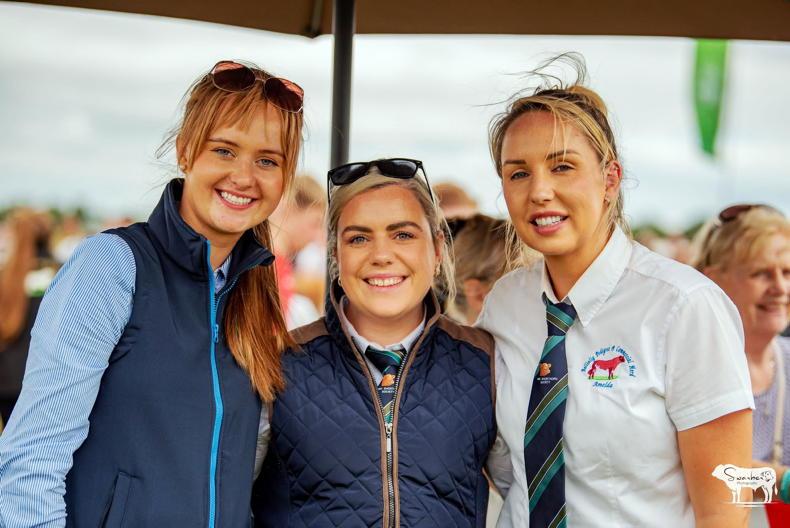
Society secretary Shauna Mulhall, PRO Áine O'Donovan and president of the society Amelda Middleton Leonard. \ Swarber Photography
In 2024, Amelda Middleton Leonard from Co Westmeath made history when she was elected president of the Irish Shorthorn Cattle Society, the first time a female held the position since its establishment.
A few months later, Longford native Shauna Mulhall was appointed Secretary of the Society, taking over from Joanne Bowers. Both Amelda and Shauna are supported by PRO Áine O’Donovan, making for a formidable team and a bright future for the breed in Ireland.
Richard Lee from Mitchelstown in Co Cork wasn’t born a farmer, instead his father was an artificial insemination (AI) technician when Richard was growing up.
However, after inheriting a farm in the early 1980s, a small milking herd was established in 1983, and he began registering Shorthorns in 1984 from stock purchased from the purebred herd at Ballinagrane Estate near Clonmel, Co Tipperary.
“It was their docility, colour variation and the fact that they were dual purpose and easy to maintain which made them particularly suited to the farm,” Richard said.
It was around this time that Richard began collecting old breed herd books, journals, and anything connected to the breed and its history going back to the early 1800s.
Knockagarry herd
Having ceased milking cows in 2000, Richard’s own herd today comprises of over 40 registered beef Shorthorn cows, most of which descend from the original dual-purpose types.
“We converted to organics in 2016 and the vast majority of the herd are now naturally polled – mainly due to animal welfare issues, and of course it’s a matter of tag-and-go, as all cows calve outside in April and May.”
There is a newfound interest in the breed from organic farmers
All of the females born on the farm are pedigree registered, together with a select number of males. Surplus bulls are castrated and sold for beef production. The heifers are usually sold to repeat pedigree customers.
“There is a newfound interest in the breed from organic farmers. Some white or light roan bulls are sold to dairy farmers to breed the sought after blue roan calves,” he said.
History of the breed in Ireland
Reportedly, Shorthorn cattle were first developed in the northeast of England in the late 1700s, from a cross of Teeswater and Durham cattle. They were developed by breeders Charles and Robert Colling, John Booth and Thomas Bates – men who would become legends of cattle breeding, foreseeing a breed of cattle which would last over two centuries.
“At the time there were Longhorns, so that’s where Shorthorns got their name,” added Richard.
According to Richard: “Shorthorns were documented as being in Ireland well before the first breed herdbook was published in 1822 by George Coates. They were certainly in Antrim in the first decade of the century, as in 1812, 10 Shorthorns were exhibited at an early livestock show in Ballinasloe under the auspices of the Farming Society of Ireland.”
Dual-purpose breed
Over the next 100 years, Shorthorn would become the predominant breed of cattle in Ireland, mainly because of their dual-purpose attributes.
“They were self-sufficient, produced good-quality milk for cheese and butter, and at the same time bred a good calf for beef,” said Richard. In 1874, the Shorthorn Society of Great Britain and Ireland was formed with the purchase of Coates’ herdbook from Henry Strafford who had taken ownership of the herdbook.
Diamond Strike, a dual-purpose Shorthorn bull bred by W Hall in 1956.
In the 1930s, 40s and 50s Shorthorns really took over from some of the existing cows in Ireland.
Shorthorns crossed really well with some of the other traditional British breeds, such as the Aberdeen Angus, Galloway and Hereford. Many will recall the beautiful Blue Grey cattle which resulted from the cross of a Shorthorn with the Galloway, and of course the wonderful Murray Grey which came from the Angus crossed with the Shorthorn.
But in the 1960s, things would change considerably for the Shorthorn breed in Ireland.
AI influence
“It was around this time AI was first introduced to Ireland. In the mid-1960s, a lot of breeders crossed British Friesian with their Shorthorn cows.
“I suppose you could say this was the start of the demise of the Shorthorns reign as Ireland’s number one breed,” said Richard.
The cross of the British Friesian on the Shorthorn cow produced a good animal with lots of milk and, in most cases, the British Friesian got the credit. Dairy cows changed from Shorthorn to British Friesian within years. But – mainly in the west of the country – some farmers were not happy with the influence of the British Friesian on the Shorthorn. This led to a Department of Agriculture-led survey conducted in association with the Shorthorn society.
The highly successful AI bull Creaga Dice bred by Noel and Lisa Dowd has had a big impact on the breed. \ Alfie Shaw
It involved Department officials inspecting Shorthorn cattle on farms in an effort to preserve the breeds dual-purpose characteristics.
Exports to the US
“Things took a turn around the 1970s when Dermott Cahill from Dovea Genetics brought a US buyer to the Deerpark Shorthorn herd owned by the Quane family in Co Limerick.
“He was so impressed with what he saw, he purchased a number of cattle for direct export to the US,” Richard explained.
The famous Shorthorn bull Deerpark Leader.
This created a massive outlet for Irish Shorthorns to the US at the time, with bulls selling for up to $24,000.
“It was quite remarkable what happened around then, the Shorthorn bulls Deerpark Guinness and Deerpark Dividend were airlifted out of Shannon to the US, along with females and other bulls,” added Richard.
The Quanes became a household name in the breed, producing many famous bulls, including the great Deerpark Leader.
It was also around this time some of the main continental breeds came into Ireland, such as the Charolais and Limousin. These breeds changed the course of suckling farming in Ireland, adding more size, weight, conformation and growth. To counteract this, a number of breeders in the UK introduced a new breed of cattle to the Shorthorn breed.
Maine-Anjou
In the 1980s, a French breed of cattle called Maine-Anjou was crossed into the Shorthorn breed, having been first imported into the UK.
“Some of the British Shorthorn breeders crossed Maine-Anjou into the breed to add more size and beef into the cattle and at the same time they didn’t interfere with colour.
“Many the beef Shorthorn today have some Maine-Anjou in them, although I prefer to maintain the more moderate 100% type,” Richard explained.
The introduction of the French breed would lead to the dual-purpose breed being split into two different breeds, dairy Shorthorns and beef Shorthorns. For years, all Shorthorns were registered in the one herdbook, until the establishment of the Irish Shorthorn Cattle Society herdbook in 2004.
“Today, beef and dairy shorthorns are recognised as two different breeds. Both can be registered in the Irish herdbook, but they are classified as two separate breeds of cattle,” said Richard.
Success of the breed
Since the formation of the Irish herdbook in 2004, the breed in Ireland has gone from strength to strength.
Dairy and beef Shorthorns are shown in separate rings at summer shows up and down the country. In 2024, there were 1,517 pedigree Shorthorn calves registered in the herdbook, up over 150 calves on the previous year.
The breed has really come back into fashion in recent years, with suckler farmers looking to add colour to their replacement females, especially in the top-end commercial breeding heifer market.
There is also an increase in dairy farmers using Shorthorn bulls to produce replacement heifers for use in the suckler herd.
The influx of farmers into organic farming has also seen an increased demand for Shorthorn cattle.
Bushypark Roisin 4th that sold for a breed record price of €8,000 in 2024, exhibited by Roisin and John Keane. \ Swarber Photography
In 2024, a white Shorthorn heifer sold for a breed record of €8,000 at the society’s premier sale in Carrick-on-Shannon. At the same venue in 2025, a Shorthorn bull broke the male breed record price when he sold for €7,100.
Rockville Ramsey shown by Aaron Dockery that sold for an Irish male record price of €7,100 in 2025. \ Chloe Goggins
Richard believes the future has never been better for the Shorthorn breed in Ireland.
“Shorthorn never got a chance to be good cattle in good times, now they have that chance. We now have Shorthorns which are suited to the showring, dairy shorthorns which can be utilised within dairy herds and Shorthorns which can be used within a commercial enterprise,” he said.
There are so many tools breeders have today that previous generations didn’t have all those years ago, such as DNA, genomics, myostatin and AI.
Richard also believes the Irish Cattle Breeding Federation (ICBF) has a role to play in the future of the breed. “I do believe in the ICBF system, it provides us with a vast amount of valuable information. Although there are issues and anomalies, I think we need to work with them.”
Whatever the future holds for Shorthorn in Ireland, it’s remarkable that the dual-purpose traits such as their great colour variation, docility and honesty which attracted farmers to them over 200 years ago is still what attracts farmers to Shorthorn today.
Society secretary Shauna Mulhall, PRO Áine O'Donovan and president of the society Amelda Middleton Leonard. \ Swarber Photography
In 2024, Amelda Middleton Leonard from Co Westmeath made history when she was elected president of the Irish Shorthorn Cattle Society, the first time a female held the position since its establishment.
A few months later, Longford native Shauna Mulhall was appointed Secretary of the Society, taking over from Joanne Bowers. Both Amelda and Shauna are supported by PRO Áine O’Donovan, making for a formidable team and a bright future for the breed in Ireland.





SHARING OPTIONS