


There are lots of potential benefits to be had by growing cover crops, but good practice must be followed if suitable yields are to be achieved and negative impacts on the next crop are to be avoided, a leading agronomist has said.
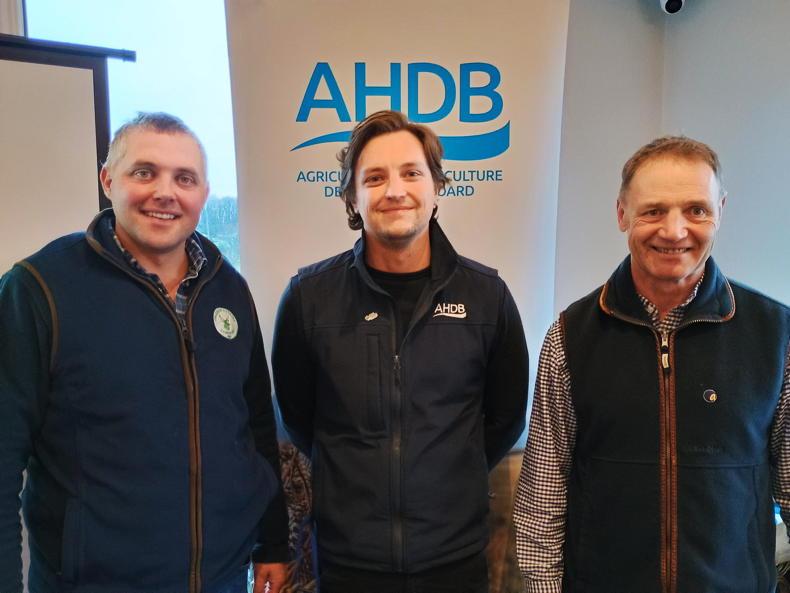
Addressing growers in Armagh at the latest monitor farm meeting organised by the Agriculture and Horticulture Development Board (AHDB), Chris Martin from Agrovista said the timing of establishment and destruction of the crop are both key.
His preference is that cover crops are sown out by mid-August and no later than mid-September.
He quoted trials which showed 10t of dry matter per hectare (DM/ha) can be grown from a mid-August sowing date.
By the end of August, this potential output is halved, and from a mid-September sowing date it drops to just 1t/ha.
“The earlier the better. A day in August is like a week in September and like a month in October,” he said.
Destruction
When it comes to the date of destruction, it is dictated by the carbon to nitrogen ratio of each crop.
Plants such as vetches or phacelia have a lower ratio, so can be left to a couple of weeks pre-sowing. However, the likes of black oats or rye have a higher carbon to nitrogen ratio so they need to be destroyed at least six weeks before sowing.
“Destroy around now in January or February at the latest. You will get a yield drag in the next crop if you don’t. Start the decomposition process earlier, get the earthworms going and the soil biology working,” said Martin.
His comments back up those of many local growers who have suggested DAERA needs to look again at the rules around cover crops in the new Farming With Nature (FwN) scheme.
In the FwN transition scheme which opened in 2025, planting a winter cover crop was one of five total options that were available to be chosen by farmers, with a payment of £225/ha available.
However, given the scheme closed in early August 2025, it was into September before applicants knew if they were successful, so there was limited opportunity to get crops planted.
The rules require that the crops must be retained until 15 February 2025, which is not in line with the expert view of Chris Martin.
Simple
His advice to growers on Tuesday is not to go for complicated mixes, but instead to keep it simple and rely on plants that we know will grow in NI.
In general, he said where cereals are in the rotation, to avoid the likes of rye. Where oilseed rape is grown, avoid brassicas, and if peas and beans are in the rotation, avoid having legumes in cover crop mixes.
“Whatever you do, make sure the cover crop never goes to seed – one years’ seed, is 10 years weed,” he added.
In England, he maintained a situation has developed where there are now a lot of cheap cover crop seed mixes on the market from other parts of Europe.
“It is a race to the bottom – we are getting things never seen before,” said Martin.
Many advantages due to cover crops
During his presentation on Tuesday, Chris Martin listed out numerous advantages from growing cover crops.
They include capturing nutrients such as nitrogen and phosphorus, which otherwise would be lost to the environment, with the trapped nutrients then released to the next crop in the spring.
He said in England the likes of brown mustard and rocket are being widely grown before potatoes, as they help destroy potato cyst nematodes (PCN), while crops such as black oats are very good at drying out soil in early spring.
There is also data coming through which shows significant increases in carbon captured in soils when cover crops are grown.
However, he maintained that the biggest benefit of all relates to improved soil structure, with root systems helping porosity and encouraging bacteria and fungi to grow.
“It is really important to have living roots in the soil at all times – that’s why cover crops are so vital.
“We usually get a lot of sunlight in August and September – that sunlight is wasted if there are no cover crops,” said Martin.
Run-off from bare soils after maize
There has been a significant increase in the maize area in NI over recent years, but in most situations, it is impossible to get another crop established post-harvest, so farmers are tending to leave fields to lie bare all winter.
According to Chris Martin, there is already legislation in place in England to ban the growing of maize on steep slopes near watercourses, and he expects government will eventually introduce legislation that will effectively require crops such as maize to be undersown.
He said in trials where maize was undersown with different grass varieties, the likes of Italian Ryegrass had been “a disaster” as it negatively impacted maize yields.
Slow growing perennial ryegrasses had performed relatively well, although the “real deal” seems to be festulonium, which is a hybrid of ryegrass and fescue species.
The grass must be direct drilled in rows, with a gap of at least 15cm to the maize plants. Drilling should be done at around six weeks post maize planting, when any plastic is well degraded and the maize is at the five to six leaf stage.
“There are lots of machines in the west of England now that can drill grass into maize,” said Martin.
Slurry solids displace crops in AD diet
The AHDB event on Tuesday also heard from Christopher Gill, the farm manager at the 2,500-acre Caledon Estate in Co Tyrone.
The farm has around 1,000 acres of forestry as well as a historic herd of red deer kept on a 250-acre paddock.
Some land not suited to cropping is let out in conacre, with the remainder used to grow crops for a 500kW anaerobic digestor (AD) commissioned 10 years ago.
Currently the feedstock for the AD plant includes 12t of grass silage, 7t of wholecrop, 7t of chopped beet and 10t of separated slurry solids from surrounding farms. Other crops grown as part of the rotation include oilseed rape and maize.
Gill said his preference is to get another winter crop established after harvest, although he has also grown some cover crops, to include redstart, which was then grazed by sheep.
He reckons in three out of every five years, he is able to get a crop in after maize, although he is considering dropping maize from his rotation because of the negative impact on land.
“It is the same with beet. We have 30 acres in and getting it harvested this winter is a nightmare. I probably would cut it out too,” he said.
One option is to displace both crops in the AD feedstock with more separated slurry solids.
“We have fed 3,000t of separated solids in 2025. It is a good feedstock for us,” said Gill.
To date, Caledon Estate has utilised local contractors to separate slurry on farms. However, a machine has been acquired and should be operational by April 2026.
In line with other AD plant operators, Caledon Estate stands the cost of slurry separation so long as it can take away the solids.





SHARING OPTIONS