


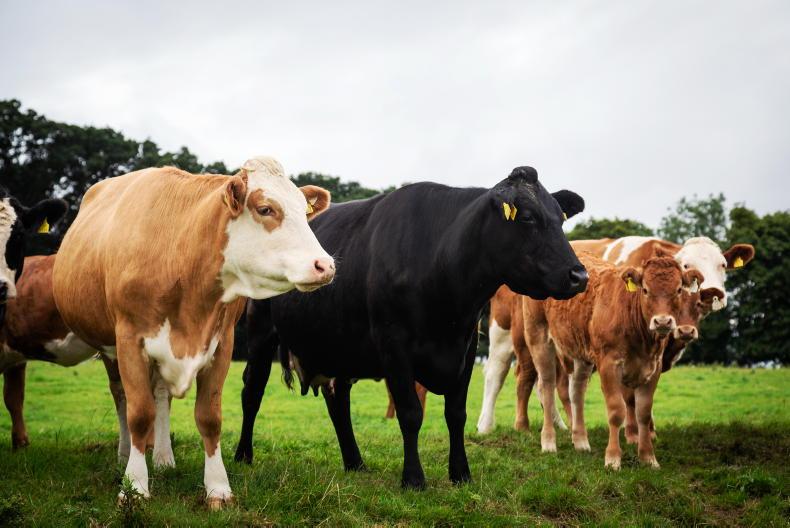
The latest census figures published by DAERA show suckler cow numbers in June 2025 fell by another 5%, taking the total to just 213,774 head.
That total is the lowest since 1969 when there were 190,800 sucklers recorded in NI and in the period since then, the high point was during the time of headage based payments in 1998, when numbers peaked at 344,704.
Exactly half of all NI farms still have suckler cows, although that figure is also in decline, with the number of suckler farms down 4% from 13,475 to 12,939 in the last 12 months.
Average herd size is 16.5 cows, with only 689 farms keeping over 50 suckler cows.
By contrast, dairy numbers continue to rise, with the cow herd at a new record high of 330,673 in June 2025, up 2% on the previous year.
However, there are fewer dairy farms in NI, with the number dropping 83 to 3,050 in 2025.
That means the average herd is now 108 cows compared to 104 cows in 2024. Nearly 40% of herds have over 100 cows.
Heifers
The switch to sexed semen in recent years, means there continues to be no shortage of dairy heifers in NI. In June 2025, ‘other dairy females’ stood at 155,590, which is marginally up on 2024, but 20% ahead of the total in June 2020.
Overall, the increase in dairy is generally cancelling out the reduction in sucklers. In June 2025, total cattle numbers were actually down 2% at 1.647m, although it is worth noting that total NI cattle numbers have been remarkably consistent at around the 1.6m mark for most of the last 50 years.
Sheep
The same cannot be said of sheep and at June 2025, total ewe numbers dropped back 7% to 864,522 head, their lowest since 1984. Like sucklers, peak ewe numbers came during the time of headage based payments in 1998, when there were 1.45m on farms.
The latest figures show there are 8,999 farms with ewes, leaving average flock size at 96 head.
However, in June 2024, there were 9,719 farms keeping ewes, so the number of farms involved in the sector has dropped by over 7% in just one year.
That compares to a much smaller drop of 1.7% in the number of farms with cattle (19,893).
Poultry
The only sector seeing increased numbers of farms is poultry, with the total rising from 957 to 1,006 in the last year.
That rise is mainly on the back of the sustained increase in the laying hen flock. Since 2021 the number of laying hens in NI has increased 82% to 7.86m. Over the same period broiler numbers have dropped 15% to 13.61m.
Pigs
The pig sector has also seen growth, with the number of sows and gilts in pig up 14% in June 2025 to an eight-year high of 45,449.
While there are 263 farms with sows, the sector is very consolidated – there are 51 farms with at least 200 sows – these farms keep over 80% of the sow herd.
Cereals
In the cereal sector, there was little change in the figures year-on-year, with 1,957 farms in June 2025 growing 30,170ha, which works out at an average of 15.4ha per farm. Just 129 farms grow over 50ha, which compares to 125 farms in June 2024.
Spring barley remains the most popular cereal (12,064ha), followed by winter wheat (8,761ha) and winter barley (7,417ha).



SHARING OPTIONS