


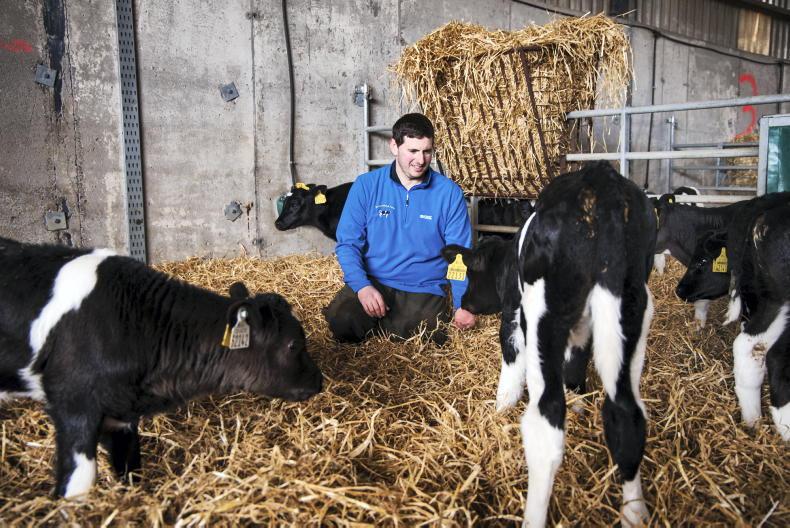
Calving is progressing well here in Abbeyleix and we’re now over the halfway mark, which always feels like a turning point in spring. There’s great momentum around the yard at the minute. To date we’ve had five sets of twins. Only two of those were picked up at scanning, so they were well flagged in advance and I was keeping a very close eye on those cows as they came close to calving. Both of them had calves coming backwards, but because we were prepared and watching carefully, everything went smoothly.
The other three sets of twins were a surprise – all twin heifers – and, to be fair, they calved themselves without any assistance.
We were lucky with those. Twin calvings can so easily go wrong, so to have them arrive unassisted and lively was a real bonus. All cows that have twins get two bottles of calcium and 30l of Reviva. Any older or higher-yielding cows get the Reviva too.
It hasn’t all been straightforward though. We’ve had a few challenges along the way, particularly with milk fever and a couple of sick cows. We had three cases of milk fever in total, but thanks to the collars we were able to pick them up early.
Only one cow actually went down, and that was in the middle of calving, which complicated matters as she couldn’t get the calf out herself. After giving a few bottles of calcium and giving her a few lifts over the following days, she made a full recovery. Catching her early made all the difference.
In hindsight, I think some of the issue may have stemmed from me using up a few leftover bags of magnesium chloride flakes from last year.
Since switching to this year’s supply, we haven’t had another case – touch wood it stays that way. It’s a reminder that small changes in minerals can have a big impact at calving time.
We’ve also had two cases of E. coli mastitis in freshly calved cows, along with one cow that picked up a viral infection. Thankfully, all responded well to treatment and are back thriving in the herd.
One addition to the toolkit this spring has been a stomach pump I invested in last year. I’ve been using it on any cow that’s off form, particularly milk fever cases or cows slow to bounce back after calving, to try and give them a boost. Through it, I give a rumen stimulant and a dietetic supplement. I find it helps to get the rumen working again quickly and gives them the push they need to get back eating and milking.
Unfortunately, we did lose one cow, a month away from calving, due to a twisted calf bed. It’s always a blow to lose an animal, especially in the middle of a busy spring, but as the saying goes, “when you have livestock, you will have dead stock”. It’s never easy, but it’s part and parcel of farming.
On the grazing front, we’ve been making steady progress, considering the horrendous weather we are having. We’ve managed to get cows out to grass every day and haven’t missed a grazing yet, which is no small achievement for this time of year. We are using spur roads and back fencing and obviously going to our driest fields.
Ground conditions have held up reasonably well, considering we have had 230mm of rain in January and February so far. There is some marking in paddocks, but nothing too severe and I’d be confident it will disappear once growth kicks in properly. In a month’s time, I doubt we’ll even notice it.
Cows are going out for about three hours after each milking and then returning to the cubicles for silage.
The odd dry day we do have, they actually stay out longer even though the gap opens after three hours. At the moment, we have 13% of the farm grazed. The target in the spring rotation planner is 16%, so we’re doing well.



SHARING OPTIONS