


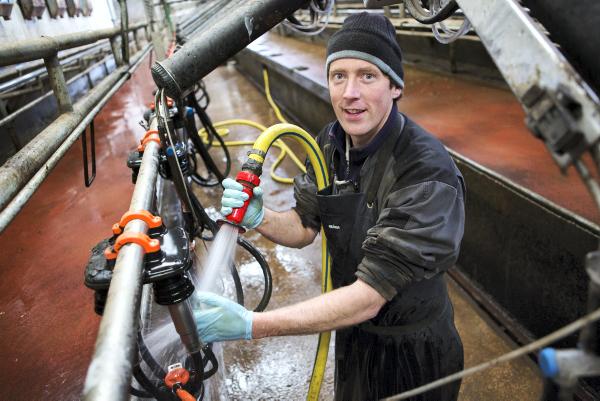
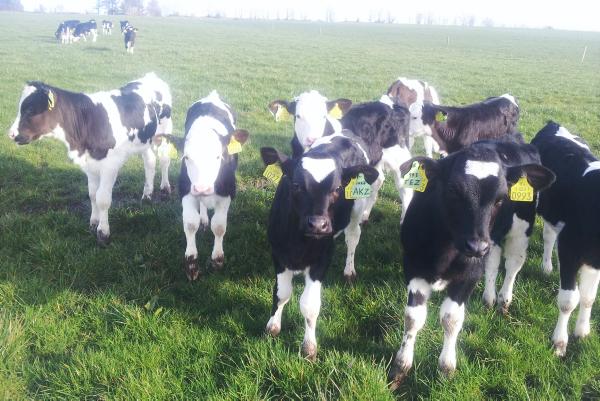
I farm: “160 acres in Ballynoe, Co. Cork. We milk 100 Mountbeliarde cross dairy cows on the farm. I farm full time with my wife Norma.”
This week: We have just 10 cows left to calve. Overall the calving has gone very well to date. With the recent bout of good weather it means that we are able to let the cattle out to grass, taking the pressure off the stretched winter feed supplies."
Dairy: “I’ve always had a keen interest in dairy, farming in partnership with my father until 2009. We have 62 Mountbeliarde heifers to go in calf this time round. Calving started on 28 January and is expected to be finished over a 10 week period, by the end of March. Well that’s the plan anyway! All cattle are vaccinated for BVD, Lepto, Salmonella and IBR. We have an average EBI of 176, milk sub index 48 and fertility sub index 94."
Monitor farm: "Our farm is a Teagasc Glanbia monitor farm. It’s very helpful in terms of bringing in fresh ideas and better farming practises."
Market: “We sell all the bull calves immediately off the farm and keep all heifer calves as replacements."
Feed/Tillage: “We don’t carry out any tillage operations on the farm. We get in a contractor to make the silage. We make all our own pit silage and make round bales from any surplus grass that we have.”
Family: “Wife Norma, daughters Maeve (2) and Áine (1). My wife works as an electrical engineer and gives a hand on the farm whenever she has a minute to spare. Hopefully they’ll have a big interest in the farm when they are a bit older.”
Quotable quote: “With the removal of milk quotas, price is definitely going to be more volatile. I feel it is more about being efficient than increasing cow numbers. If you can keep costs at a minimum, you have a good chance of surviving and doing well in this system of farming. If you can turn a profit then you know you’re doing something right.”
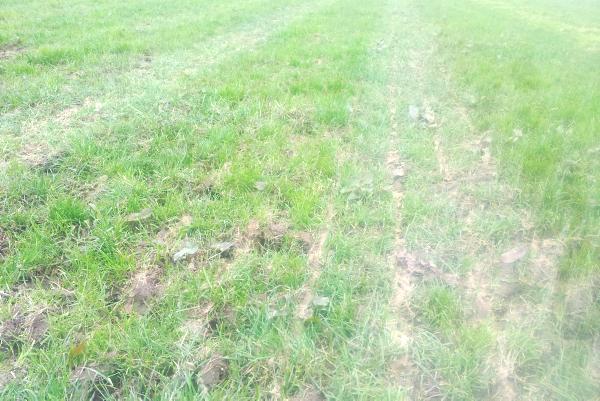
I walked the farm on Monday morning as one of the first jobs of the week is to measure the grass. The place is looking much greener and I am satisfied with a daily growth of 17kg. However, almost all the cows are now calved, as a result demand is quite high at 30 and with the poor February growth my grass budget is not looking the best.
While the weather is good, as are the ground conditions, I decided to keep grazing full time on the wettest and hardest to reach paddocks. Once these are gone I will supplement with good bale silage made from surplus grass last summer. If it stays dry I will be able to spread a bale around the paddock before the cows go in, however if it gets wet I will feed indoors before the evening milking.
The planned diet will be 10kg grass, 3kg meal and 3kg silage. I have 55% of the farm grazed which is slightly ahead of target. The silage will help stretch out the first rotation until the 5th-10th April. Cows are milking well now at around 20 litres, with 4.09% fat and 3.22% protein. My SCC has never been so good at 49,000.
One of the most important jobs of the year was completed yesterday - I have ordered my AI straws for the coming year. I use the ICBF website sire advice section and manually pick bulls for my criteria as follows: over 160 fertility EBI & 30 kg solids with an eye on protein percentage and less than 300kgs of milk. I also flick through all the AI catalogues; it is great to see so many Irish bred bulls to choose from.
Breeding is still five weeks away, so I plan to order up supplies of BVD and Lepto vaccine and I like to get the annual TB test done and out of the way at this time of the year.



SHARING OPTIONS