


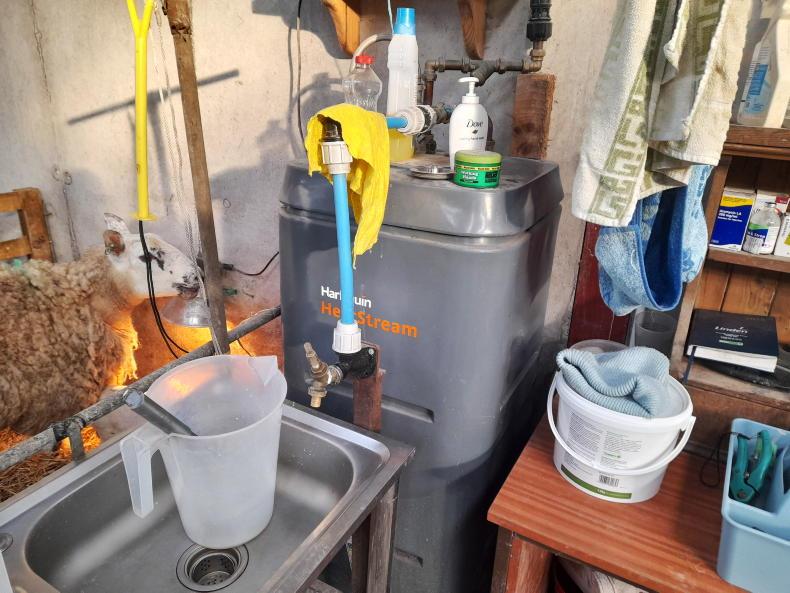
About six years ago we built a new general-purpose shed.
There was a strong leaning towards lambing in its design, and sure enough it is now referred to as ‘the lambing shed’.
During the initial years I reckoned it was state of the art, due mainly to the step-up from my previous system which involved utilising ancient sheds, stone barns, open fields and sheltered corners.
Moving to an area where ewes could give birth under one roof was a luxury I had previously only dreamt about, and then came further refinements: walk-in feed barriers, a proper designated work station, constant hot water, four cameras linked to both the television screen and my phone, and a bale unroller for the feed passage – it all contributed to me having a slightly false sense of my own magnificence.
There were also no more 100-watt bulbs dangling precariously from a distant corner – no, this place was lit up like Old Trafford on a Wednesday evening cup game. Small tweaks then occurred and hurdles tied with baler twine were upgraded and replaced with steel rods running through eye bolts. As I strutted up and down the rows of individual lambing pens, I felt as proud as a peacock.
But this year has thrown up a few problems, and I realise that there is maybe no such thing as the perfect shed.
Timings
Firstly, I got my timings a bit wrong in the autumn. Just when the main batch were about to start their second cycle, I introduced another flock to ensure continuity.
My exceptional wisdom and experience told me the first ones would all take to the ram, and the second lot would just be cycling ten days or so later.
Except this didn’t happen, or anything like it. Instead, in some sort of oestrogen/testosterone explosion, the rams managed to serve three quarters of the ewes in three days.
Therefore, when it came to lambing there wasn’t enough room for all the red-marked rumps from tupping time in the shed.
This in turn meant that some had to be housed in a poultry shed with no cameras. As it turned out, this wasn’t so important, because the intensive nature of the lambing pattern meant I was up several times per night anyway.
This concentration of nocturnal labour is all well and good if there is a team of people involved, but around here when you ask for some volunteers to do the overnight shift you are met with complete silence (I can’t say I blame them).
So, for 10 days or so it was up to me to attend to my sheep, and I gradually realised my shed design wasn’t ideal for concentrated lambing.
Maternal
I have 24 ewes in each pen and a very high percentage of my ewes are overly maternal, so that chances of them stealing someone else’s lamb is huge. I reckon about 10 ewes in a pen would be plenty.
To stop the mismothering occurring, I had to check the cameras every two hours and be there to move one away as soon as possible.
The next problem with so many ewes birthing in a short period was an outbreak of E coli which, on straw bedding, wasn’t entirely unexpected.
What exacerbated this issue was the number of triplet births, with almost one in three sheep having trebles. I dislike sets of three, especially when tiredness is beginning to overwhelm me.
Weather
The poor weather back in January also played a negative role, because stock were housed much earlier than normal.
The knock-on effect meant straw bedding built up against the bottom of the feed barrier and with the extra height, lively lambs often fell over the barrier and couldn’t scramble back in to their mother.
I doubt if there is anything more frustrating than returning a yapping lamb to its rightful mother, only for her to knock it into the middle of next week because they were separated for too long.
Mood
I have often stated how much I enjoy the lambing season, especially now that Susan is retired and available as a full-time midwife and bottler of weak lambs. However, for that busy spell this year, pleasure was nowhere to be found.
Things are back to normal now, and the easing of the workload has seen my mood improving steadily.
But during that period in early March, I honestly began to question how many more years I wanted to put myself through this mild form of slavery.


SHARING OPTIONS