I’ve been writing news and opinion pieces for almost 30 years and I’ve never had to wrestle with any other issue quite as much as I have with the fuel protests that have been ongoing since last Tuesday.
There are times when battle lines are drawn so decisively that you have to ask yourself the old question Woodie Guthrie posed, “Which side are you on?”
This has begun to feel like one of those moments. And I cannot side with the protesters, although I understand their frustration with Government inaction.
The protest on Tuesday was hardly without precedent. Dublin is regularly visited by protesting groups and sometimes there is disruption. Mostly, that disruption is targeted and temporary.
However, on this occasion, the Irish Haulage Farming Construction Contractors Amalgamation (IHFCCA) leaders quickly made it clear that they intended to create widespread disruption and they would continue to do so until their demands had been met.
Fast forward to Saturday evening and it emerged that ministers have put together a package of measures relating to fuel prices for the worst affected sectors.
Measures
I have no idea what these measures are, but cabinet will be meeting online to approve them on Sunday, so we won’t have long to wait for them to be revealed.
Will the leaders of the protests see whatever emerges as enough? Only time will tell.
And if they do, at that point, we will discover if the words of James Geoghegan to the Irish Times on Friday are to come true.
The Westmeath farmer and agricultural contractor, who has emerged as one of the leading organisers of the protest, was quoted as follows: “I would be one of the leaders” …. “It’s in our hands, we call the shots. Whatever we decide to do is what everyone else will do.”
Previous experience would suggest Mr Geoghegan is being optimistic in that opinion. We only have to look back to that fraught period of 2019 for an example of where one group after another was supplanted.
On the August bank holiday of 2019, following months of campaigning over beef prices by the Beef Plan Movement, members were communicating through Whatsapp groups.
A few weeks in, the processors started injuncting people they saw as leaders at the different protests.
In the face of extreme legal and financial pressure, the Beef Plan began to implode into two separate groups, one of which is still Beef Plan, the other became the Irish Beef and Lamb Association.
As Beef Plan’s leadership stood away from the gates, farmers identifying as the Independent Farmers of Ireland emerged as spokespersons on the factory blockades. This group also quickly schismed into two.
In late November, a new group emerged. Calling themselves the Individual Farmers, they organised a tractorcade to Dublin.
They received a lot of coverage in the national media and people such as James Geoghegan, Christopher Duffy and John Dallon were first heard on the airwaves.
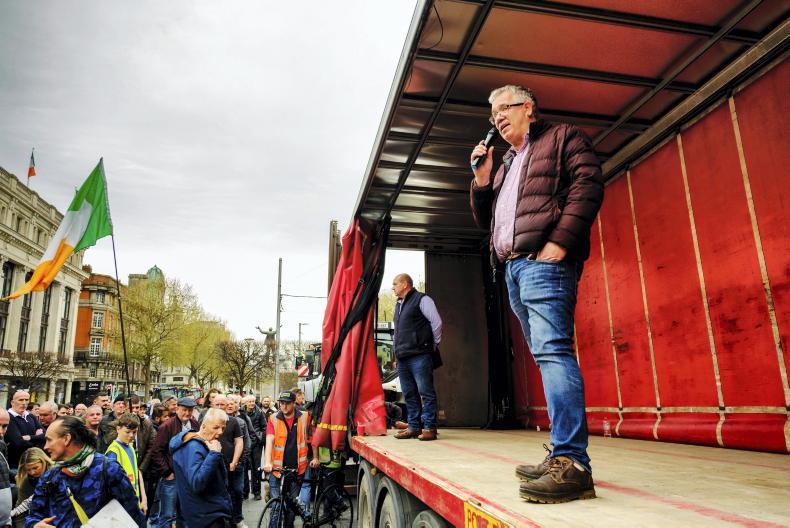
James Geoghegan addresses the fuel protest in Dublin. \ Philip Doyle
The protest was initially about the lack of progress made by the beef stakeholder group set up in the wake of the factory protests.
However, a number of issues, including the climate agenda (the Climate Action Plan had been launched that June) and the carbon tax on fuel were namechecked by protesters.
Disruption
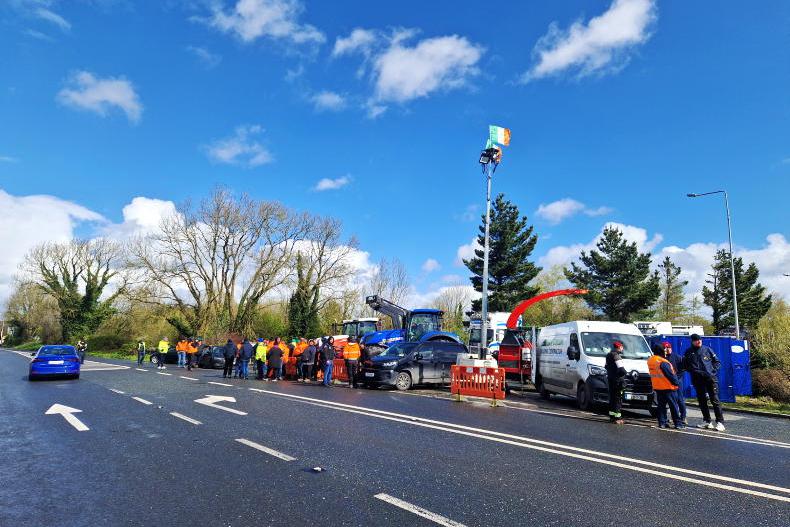
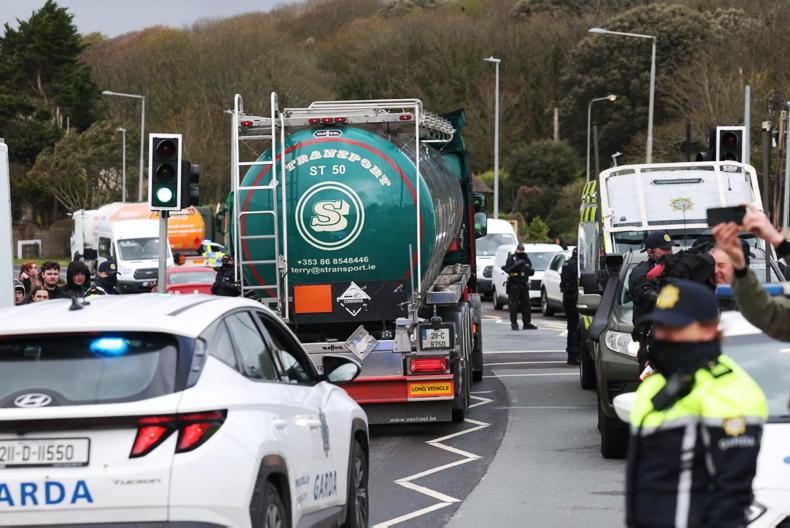
There was some traffic disruption across the entire city, even though the protesters had confined themselves to a small section of the city centre.
That is an indication in part of the failure of Dublin’s traffic planners. The exchanges with protesters were mostly good-natured; they were even invited free into Coppers!
The same group of people, more or less, returned the following January and again disrupted traffic in Dublin.
There was less public sympathy this time, with much anger expressed at a slow drive along the M50 that completely paralysed the city.
As the protesters left, they were promising to return unless their concerns were met.
And then, less than two months later, the country went into lockdown as coronavirus swept across the world. The events of 2019 were more or less consigned to the history books.
The various organisations all still exist, but none have really had national prominence since.
Other groups, such as the Irish Rural Association, have also emerged. Most, if not all, of these groups recently got a platform at the Independent Ireland anti-Mercosur rally in Athlone.
Easier to start a protest than end it
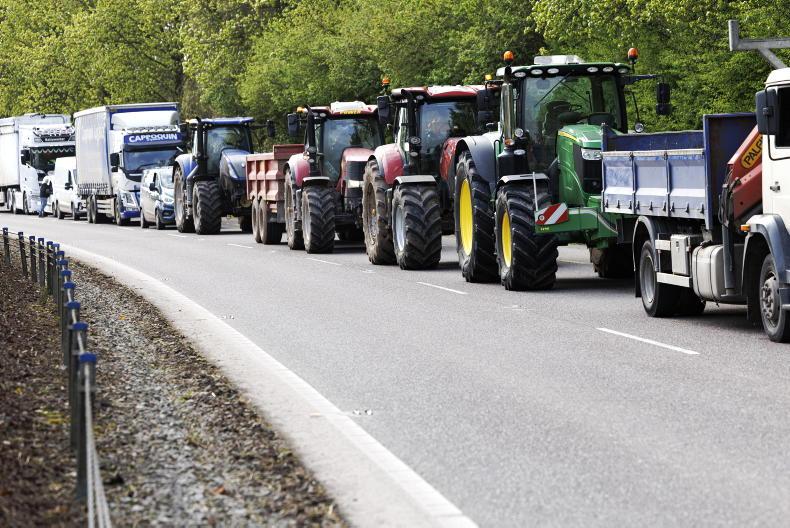
The fuel crisis has now seen this group back on the streets, but with an escalation of their strategy. Of course, they are not alone. Agricultural contractors and farmers have been joined by hauliers and transport companies.
All are reeling at the impact of fuel prices on their livelihoods. No-one can doubt that. And there seems to be a significant level of public sympathy for them and for the action they have taken.
This Government is not popular and the majority of people across the country are dissatisfied with its approach to a whole range of issues.
The ever-rising cost of living, housing, immigration and health are the “big four”. It could be that the fuel protest is seen as a strong rejection of the Government and many people are identifying with the simmering frustration, bordering on desperation, of the protesters.
But that support could evaporate in a heartbeat if stories emerge of people losing their lives in the back of an ambulance or on the way to a maternity hospital while stuck in a traffic jam.
In a way, it’s a miracle that five days of disruption hasn’t seen such narratives emerge.
Next week, when the schools are scheduled to reopen, the scale of disruption will be of a higher magnitude if the protests continue.
The news emerging of a teenager being pepper-sprayed mean a de-escalation is unlikely unless the package the Government seems set to approve is seen as acceptable by the protest leaders.
And then we will find out if James Geoghegan is correct - that everyone else will do what he and the rest of the ad-hoc protest committee decide to do.
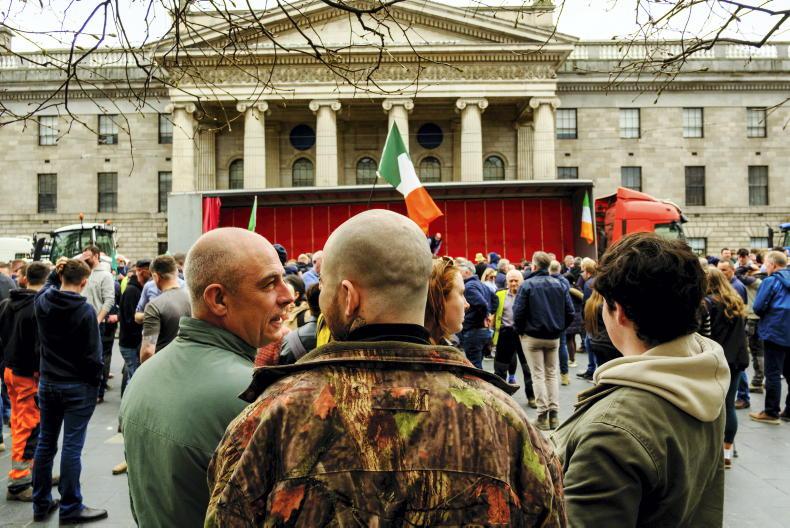
Protesters in Dublin's O'Connell Street on Tuesday. \ Philip Doyle
A separate question remains. Is this action, irrespective of the final outcome, morally acceptable. The protesters are effectively holding the country to ransom in pursuit of their demands.
And when they do that, it isn’t in my name. I don’t believe that any group has the right to hold the country to ransom.
Let’s hark back to those early days of lockdown in March 2020. Farmer leaders were among the first to go public with the needs of their sector.
Livestock marts and processors would have to be allowed to continue to operate. Supplies of feed, fertiliser and fuel must continue to flow to farms and milk must be collected.
All of that happened. Workers in the meat factories suffered elevated levels of COVID, but continued to slaughter our cattle, lambs, pigs and poultry.
Mart sales transitioned to online auctions and inputs and farm produce were collected and delivered.
If fuel shortages were occurring as a result of the war in Iran, farmers would be saying they and ancillary businesses would need priority access. Instead, we are seeing shortages caused to the general public by the actions of the protesters.
Over the last 24 hours, stories have been emerging of dairy processors telling us they will have no fuel to collect milk from early next week. Feed deliveries to pig farms have been compromised.
I’m sure these issues can be ironed out by negotiation with the protesters, but, frankly, special accommodation for farming by protesters who are mostly farmers and agricultural contractors smacks of hypocrisy.
If dockers were blocking the ports and restricting the flow of feed, fertiliser and fuel, it’s quite likely that many farmers would be calling for the Government to send in the army to resume the flow of essential supplies.
Hardest of professions
We completed our spring planting early on Friday morning. The weather in Wexford has been better than in most other places over the last couple of weeks and it’s always a relief when a block of work is completed.
We had to put in a few late nights, being part-timers, but it was only for a short period.
I have so much respect for agricultural contractors, for whom the planting, silage and harvest seasons go on for weeks and months. They work very long hours, from dawn until midnight, fighting the weather, managing staff, minding machinery.
They provide an essential service to farmers, surviving on tight margins.
Contractors felt unseen when the carbon tax rebate facility extended to farmers was denied them. They felt ignored when they were excluded from TAMS support for machinery that is more used by contractors than farmers, in particular low emissions slurry equipment.
And, as fuel prices escalated, they felt that the few cent removed from agri-diesel excise duty was an insult.
I sympathise with them, genuinely. But I don’t believe they and their fellow protesters should hold the public as hostages in pursuit of their aims.
And holding the infrastructure of the country in a chokehold for five days is doing that in my opinion.
A precedent has been set - and I don’t mean that in a good way. I remember (barely) the dark days of the 1970s, when industrial action was rife.
Bank worker strikes, postal strikes, massive PAYE protests - I can’t remember any section of society taking direct action like this in my lifetime.
The end does not justify the means in this instance.
Government’s sluggish response
It is fair to say the Government has not handled this situation well. Everyone now expects a package to be signed off by cabinet on Sunday.
I don’t have any insight as to the extent of the package, but it should have been delivered no later than Friday.
I fully understand the Government’s reluctance to negotiate with the protesters directly, although some engagement might have been possible.
But the recognised representatives of farmers, agricultural contractors, hauliers and transport companies have been calling for better supports for weeks and the Government went into Friday’s meeting with them without with a package of proposals.
It seems a discussion as to what was wanted was their agenda, when that had been clearly articulated by the likes of the Irish Road Hauliers Association, the Farm and Forestry Contractors of Ireland, plus the IFA, ICMSA and the other farm organisations long before.
One didn’t sense an urgency to present a package that would de-escalate the situation.
A lot of people on the protest are contrasting the tepid and slow Government effort with the decisiveness shown when COVID struck and the extent of the temporary measures put in place to support the economy.
Is this Government getting tired? They have been running the country for a decade now and Fine Gael has been in government for over 15 years. They need to demonstrate a sure-footedness over the coming days.
My fervent hope is that the next 24 hours sees the protests stood down, with the Government proposals being accepted.
I’ve been writing news and opinion pieces for almost 30 years and I’ve never had to wrestle with any other issue quite as much as I have with the fuel protests that have been ongoing since last Tuesday.
There are times when battle lines are drawn so decisively that you have to ask yourself the old question Woodie Guthrie posed, “Which side are you on?”
This has begun to feel like one of those moments. And I cannot side with the protesters, although I understand their frustration with Government inaction.
The protest on Tuesday was hardly without precedent. Dublin is regularly visited by protesting groups and sometimes there is disruption. Mostly, that disruption is targeted and temporary.
However, on this occasion, the Irish Haulage Farming Construction Contractors Amalgamation (IHFCCA) leaders quickly made it clear that they intended to create widespread disruption and they would continue to do so until their demands had been met.
Fast forward to Saturday evening and it emerged that ministers have put together a package of measures relating to fuel prices for the worst affected sectors.
Measures
I have no idea what these measures are, but cabinet will be meeting online to approve them on Sunday, so we won’t have long to wait for them to be revealed.
Will the leaders of the protests see whatever emerges as enough? Only time will tell.
And if they do, at that point, we will discover if the words of James Geoghegan to the Irish Times on Friday are to come true.
The Westmeath farmer and agricultural contractor, who has emerged as one of the leading organisers of the protest, was quoted as follows: “I would be one of the leaders” …. “It’s in our hands, we call the shots. Whatever we decide to do is what everyone else will do.”
Previous experience would suggest Mr Geoghegan is being optimistic in that opinion. We only have to look back to that fraught period of 2019 for an example of where one group after another was supplanted.
On the August bank holiday of 2019, following months of campaigning over beef prices by the Beef Plan Movement, members were communicating through Whatsapp groups.
A few weeks in, the processors started injuncting people they saw as leaders at the different protests.
In the face of extreme legal and financial pressure, the Beef Plan began to implode into two separate groups, one of which is still Beef Plan, the other became the Irish Beef and Lamb Association.
As Beef Plan’s leadership stood away from the gates, farmers identifying as the Independent Farmers of Ireland emerged as spokespersons on the factory blockades. This group also quickly schismed into two.
In late November, a new group emerged. Calling themselves the Individual Farmers, they organised a tractorcade to Dublin.
They received a lot of coverage in the national media and people such as James Geoghegan, Christopher Duffy and John Dallon were first heard on the airwaves.
James Geoghegan addresses the fuel protest in Dublin. \ Philip Doyle
The protest was initially about the lack of progress made by the beef stakeholder group set up in the wake of the factory protests.
However, a number of issues, including the climate agenda (the Climate Action Plan had been launched that June) and the carbon tax on fuel were namechecked by protesters.
Disruption
There was some traffic disruption across the entire city, even though the protesters had confined themselves to a small section of the city centre.
That is an indication in part of the failure of Dublin’s traffic planners. The exchanges with protesters were mostly good-natured; they were even invited free into Coppers!
The same group of people, more or less, returned the following January and again disrupted traffic in Dublin.
There was less public sympathy this time, with much anger expressed at a slow drive along the M50 that completely paralysed the city.
As the protesters left, they were promising to return unless their concerns were met.
And then, less than two months later, the country went into lockdown as coronavirus swept across the world. The events of 2019 were more or less consigned to the history books.
The various organisations all still exist, but none have really had national prominence since.
Other groups, such as the Irish Rural Association, have also emerged. Most, if not all, of these groups recently got a platform at the Independent Ireland anti-Mercosur rally in Athlone.
Easier to start a protest than end it
The fuel crisis has now seen this group back on the streets, but with an escalation of their strategy. Of course, they are not alone. Agricultural contractors and farmers have been joined by hauliers and transport companies.
All are reeling at the impact of fuel prices on their livelihoods. No-one can doubt that. And there seems to be a significant level of public sympathy for them and for the action they have taken.
This Government is not popular and the majority of people across the country are dissatisfied with its approach to a whole range of issues.
The ever-rising cost of living, housing, immigration and health are the “big four”. It could be that the fuel protest is seen as a strong rejection of the Government and many people are identifying with the simmering frustration, bordering on desperation, of the protesters.
But that support could evaporate in a heartbeat if stories emerge of people losing their lives in the back of an ambulance or on the way to a maternity hospital while stuck in a traffic jam.
In a way, it’s a miracle that five days of disruption hasn’t seen such narratives emerge.
Next week, when the schools are scheduled to reopen, the scale of disruption will be of a higher magnitude if the protests continue.
The news emerging of a teenager being pepper-sprayed mean a de-escalation is unlikely unless the package the Government seems set to approve is seen as acceptable by the protest leaders.
And then we will find out if James Geoghegan is correct - that everyone else will do what he and the rest of the ad-hoc protest committee decide to do.
Protesters in Dublin's O'Connell Street on Tuesday. \ Philip Doyle
A separate question remains. Is this action, irrespective of the final outcome, morally acceptable. The protesters are effectively holding the country to ransom in pursuit of their demands.
And when they do that, it isn’t in my name. I don’t believe that any group has the right to hold the country to ransom.
Let’s hark back to those early days of lockdown in March 2020. Farmer leaders were among the first to go public with the needs of their sector.
Livestock marts and processors would have to be allowed to continue to operate. Supplies of feed, fertiliser and fuel must continue to flow to farms and milk must be collected.
All of that happened. Workers in the meat factories suffered elevated levels of COVID, but continued to slaughter our cattle, lambs, pigs and poultry.
Mart sales transitioned to online auctions and inputs and farm produce were collected and delivered.
If fuel shortages were occurring as a result of the war in Iran, farmers would be saying they and ancillary businesses would need priority access. Instead, we are seeing shortages caused to the general public by the actions of the protesters.
Over the last 24 hours, stories have been emerging of dairy processors telling us they will have no fuel to collect milk from early next week. Feed deliveries to pig farms have been compromised.
I’m sure these issues can be ironed out by negotiation with the protesters, but, frankly, special accommodation for farming by protesters who are mostly farmers and agricultural contractors smacks of hypocrisy.
If dockers were blocking the ports and restricting the flow of feed, fertiliser and fuel, it’s quite likely that many farmers would be calling for the Government to send in the army to resume the flow of essential supplies.
Hardest of professions
We completed our spring planting early on Friday morning. The weather in Wexford has been better than in most other places over the last couple of weeks and it’s always a relief when a block of work is completed.
We had to put in a few late nights, being part-timers, but it was only for a short period.
I have so much respect for agricultural contractors, for whom the planting, silage and harvest seasons go on for weeks and months. They work very long hours, from dawn until midnight, fighting the weather, managing staff, minding machinery.
They provide an essential service to farmers, surviving on tight margins.
Contractors felt unseen when the carbon tax rebate facility extended to farmers was denied them. They felt ignored when they were excluded from TAMS support for machinery that is more used by contractors than farmers, in particular low emissions slurry equipment.
And, as fuel prices escalated, they felt that the few cent removed from agri-diesel excise duty was an insult.
I sympathise with them, genuinely. But I don’t believe they and their fellow protesters should hold the public as hostages in pursuit of their aims.
And holding the infrastructure of the country in a chokehold for five days is doing that in my opinion.
A precedent has been set - and I don’t mean that in a good way. I remember (barely) the dark days of the 1970s, when industrial action was rife.
Bank worker strikes, postal strikes, massive PAYE protests - I can’t remember any section of society taking direct action like this in my lifetime.
The end does not justify the means in this instance.
Government’s sluggish response
It is fair to say the Government has not handled this situation well. Everyone now expects a package to be signed off by cabinet on Sunday.
I don’t have any insight as to the extent of the package, but it should have been delivered no later than Friday.
I fully understand the Government’s reluctance to negotiate with the protesters directly, although some engagement might have been possible.
But the recognised representatives of farmers, agricultural contractors, hauliers and transport companies have been calling for better supports for weeks and the Government went into Friday’s meeting with them without with a package of proposals.
It seems a discussion as to what was wanted was their agenda, when that had been clearly articulated by the likes of the Irish Road Hauliers Association, the Farm and Forestry Contractors of Ireland, plus the IFA, ICMSA and the other farm organisations long before.
One didn’t sense an urgency to present a package that would de-escalate the situation.
A lot of people on the protest are contrasting the tepid and slow Government effort with the decisiveness shown when COVID struck and the extent of the temporary measures put in place to support the economy.
Is this Government getting tired? They have been running the country for a decade now and Fine Gael has been in government for over 15 years. They need to demonstrate a sure-footedness over the coming days.
My fervent hope is that the next 24 hours sees the protests stood down, with the Government proposals being accepted.





SHARING OPTIONS