


There is huge potential on beef, sheep and suckler farms to increase the volume of grass grown annually.
The average annual grass production on drystock farms ranges from as low as 4t dry matter per hectare (DM/ha) to 5t DM/ha, but the potential exists to push grass output to in excess of 10t DM/ha through the adoption of improved grassland management practices.
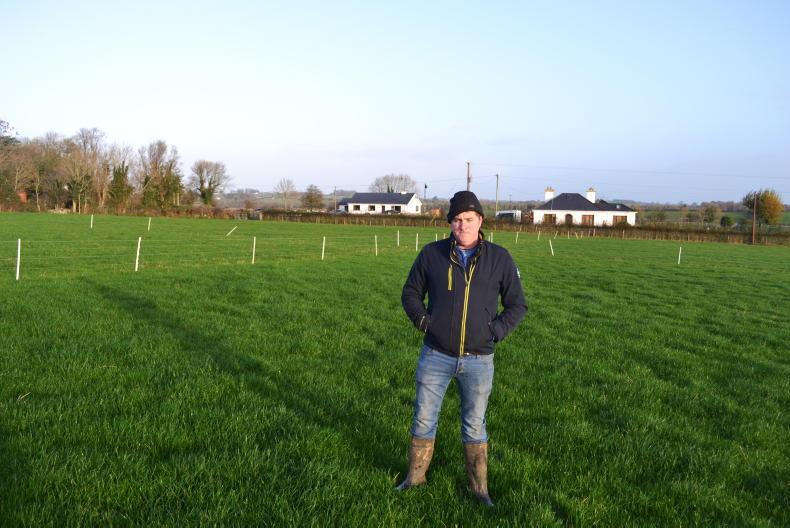
Farmers attending a farm walk held last week on the farm of Shane Moore, located a short distance outside Athleague in Co Roscommon, were shown first-hand how grass production can be transformed over a number of years.
In the space of four years grass production has increased from an estimated 6-7t DM/ha to in excess of 10t DM/ha in 2021, and is on target to potentially reach 12-13t/ha in 2022.
This achievement was marked by the farm being selected as a drystock finalist in the 2021 Grassland Farmer of the Year competition run through the Grass 10 programme.
The farm joined the Teagasc BETTER Farm sheep programme in 2018 and recently also joined the Teagasc Signpost Programme.
Farm plan focus
Shane attributes much of the increase in grass production to putting a defined farm plan in place outlining a path for progress.
This focused on three key areas on the grassland front – improving grazing infrastructure, addressing soil fertility deficits and grassland measuring and budgeting.
The farm extends to 30ha including a 13ha turlough area, of which 8ha are grazeable. It is split in to three main divisions – the home block comprising 7ha good lands, an owned outfarm block of 8ha and two rented parcels also totaling 8ha.
Excluding the turlough area, the land type can be described as predominately good free-draining soil.
There are now 25 ‘permanent’ grazing divisions in place with an average size of 0.91ha. This compares to less than 10 grazing divisions at the outset.
The home farm block was used at the farm walk to show the changes made in grazing infrastructure.
Increased grazing divisions
This section of ground is laid out in three fields. One of the first actions taken after joining the BETTER Farm programme was to increase the number of grazing divisions.
Shane decided to use electric fencing set up in a semi-permanent manner to split the grazing block into eight divisions.
There were a number of reasons why five strands of electric wire were used as opposed to erecting sheep wire.
The cost is one obvious factor, but the main reasoning was to see how these grazing divisions worked in terms of moving animals around the area and also to be able to alter the size of grazing divisions if desired, depending on stock numbers.
These fences have stood the test of time and are working adequately. Temporary electric fencing is used to subdivide each of these areas again, with Shane explaining that it is not uncommon during the main grazing season for there to be at least 16 grazing divisions present.
Soil fertility
The farm is located in an area of high rainfall and as such there is always a threat of the soil pH being eroded. An annual soil sampling programme is in place and in recent years a liming programme has helped lift soil pH to target levels of over 6.3.
This has been credited with providing the potential for higher grass production. Soil phosphorus (P) and potassium (K) levels are also under the spotlight.
Initially compound fertilisers were applied where necessary and since building a new sheep shed this is balanced with applying organic fertilisers to low P and K soils and any areas where there has been P and K removed through harvesting silage.
Measure to manage
Shane is also measuring grass using the Teagasc PastureBase programme since 2018. While it was hard to envisage the value of measuring at the outset it is a process that has become an integral part of the day-to-day management on the farm.
“It is no big job and when doing the herding it is only a matter of carrying the platemeter and plugging in the information on the app as you go. It gives you the confidence to make big decisions and its value was even greater this year in helping to make decisions on spreading fertiliser”.
Shane says that for most of the year he carries out a grass walk on a weekly basis, but that during peak grass growth this can be reduced to every four days given how quick things can change.
A spring and autumn grazing plan are also put in place and this is viewed as vital in setting the farm up to capitalise on the savings and gains that can be best achieved by utilising spring grass. This is detailed on the adjacent page.
Animal output
The increase in grass output is delivering considerably on two fronts in terms of kilos of lamb sold off the farm. The increase in grass growth is sustaining a higher stocking rate, while improved grazing management is sustaining higher performance in each individual animal.
This is reflected in Table 1, with ewe numbers set to take another jump in the coming season and 200 ewes plus replacements joining with rams for breeding. A 25-head weanling to store cattle enterprise is also run alongside the sheep enterprise.
The breeding policy on the farm in recent years has also changed from terminal breeding to a mixture of terminal and maternal breeding.
Charollais rams are mated with ewe lambs and younger ewes, while Belclare and New Zealand Suffolk genetics have been used to breed replacements.
The young age profile in the flock is likely to bring about a gradual improvement as ewes mature and maternal genetics feed through the entire flock.
Shane is happy with the current level of prolificacy and does not want to push it upwards of two lambs per ewe joined as, with working full-time off farm, he does not want to enter a scenario of dealing with a high number of triplet litters.
As such, he plans to limit the level of Belclare genetics in the flock. His target is to wean in excess of 1.6 lambs per ewe joined to mature ewes.
2021 lamb performance
The performance of lambs from birth to weaning is detailed in Table 2. The performance of lambs in the final weeks pre-weaning was below target and this curtailed strong performance in early lactation.
Teagasc sheep specialist Damian Costello highlighted that this was a common issue raised by producers this year.
Shane was happy with post-weaning performance, with lambs averaging 190g per day during July and August. All male lambs are left entire and concentrates are used strategically to aid performance as the season progresses.
Ram lambs weighing 38kg to 40kg upwards are joined to a finishing group which receives 0.5kg concentrates daily.
As lambs are drafted for slaughter they are replaced with lambs from the grazing group. Shane is satisfied with how lambs have performed during September, with 70% of the lambs drafted by 1 October.
Ewe lambs do not receive concentrate feeding until deemed necessary. It is likely that concentrates will now be introduced to compensate for a drop in grass dry matter.
Autumn closing plan
Ewes lamb in a tight timeframe over three weeks from 1 March, with ewes and lambs going to grass as soon as possible and usually within 24 to 36 hours of lambing.
Shane explains that time is seriously limited at this stage of the year and in this regard he says that it is essential that sufficient grass is available to sustain ewes and lambs without any concentrate feeding.
The secret to this is closing paddocks in adequate time to deliver a rest period of 120 days. “If there is one small thing to take home tonight it is that I can’t say enough about the value of having early grass.
"Start with closing 20% or 40% of your grazing area at the recommended time (late October and mid-November, respectively) and I guarantee you won’t go back. The biggest problem I had this year was going out and bringing in ewes with big bags of milk”
Shane says that his autumn grazing planner started in September through setting up the farm for grazing in October. The home farm block is the first utilised after lambing and as such is where the greatest demand is.
There is a higher cover of grass present on this area than usual, with grass growth of over 40kg DM/ha and demand of 25kg DM/ha continuing to see autumn grass covers build. As such Shane is tweaking breeding plans to ensure closing is not delayed.
Open to change
Ewes are usually split up across the home and outfarm blocks for breeding and single sire mating. In recent weeks two large grazing groups have been focused on grazing ground on the home block.
Small grazing divisions are in place to reduce the length of time any batch of sheep has to graze out paddocks.
The majority of ewes will remain on this area during breeding to ensure these paddocks are grazed out first and the closing date is not delayed.
“There will be a nice cover of grass on these areas in November and December but the temptation must be avoided to re-graze these areas. The small reprieve now will be a very costly mistake next spring”.
The erection of a new sheep shed in recent years has also helped to facilitate improved grassland management. Shane recalls that he housed ewes a couple of weeks earlier than expected in 2021 at the start of December.
“Ewes were housed on 12 December and we were initially worried we had them in too early but if you ask me now it was the best decision. Ewes were in great form come scanning and I wouldn’t be one bit worried to have to do it again.”
Having an ample supply of good-quality silage available makes this decision much easier.
“I was always a man to cut silage in June, but with improved grassland management I’m now cutting in mid-May. It has greatly reduced my meal bill and this has never been more important with rising input costs.”
Next steps
Frank Campion, Teagasc researcher and BETTER farm programme adviser says that reseeding was pushed well down the line of priorities before now as there was much lower hanging fruit to address.
A reseeding programme will allow the farm to take the next step forward to achieving Shane’s aim of reaching a stocking rate of 12 ewes/ha, while the incorporation of clover is a vital step to reduce the farm’s reliance on chemical nitrogen and optimise input costs.




SHARING OPTIONS