


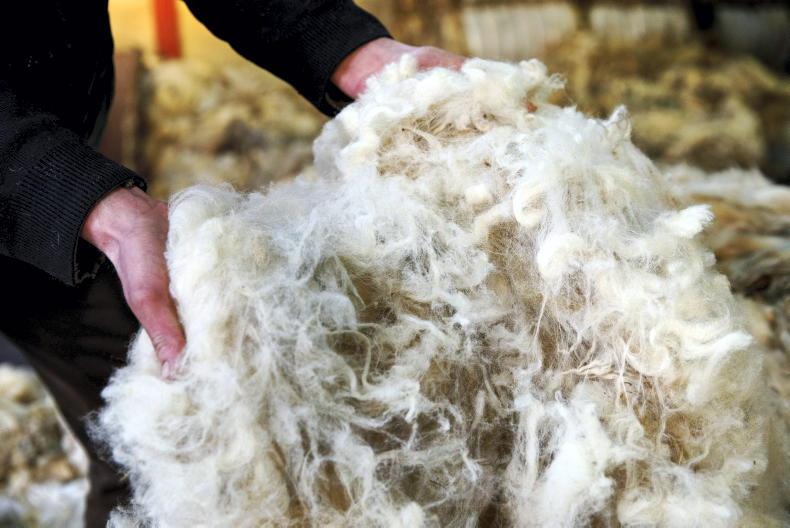
The final British Wool auction for 2025, held on 2 December, has set a positive tone for the trade resuming on a strong footing in 2026.
The average greasy wool price, which is wool which has been sorted and graded but not washed, was recorded at £1.21/kg (€1.38/kg) with a 100% clearance rate of the 1,071t offered.
This is not the price that producers receive for their wool with the farmgate price based on the average greasy price minus a cost for handling, processing, bringing wool to auction etc.
This cost was approximately 60p/kg (69c/kg) for the 2024 clip year with the average greasy price at £1/kg (€1.14/kg).
It is not predicted that wool prices will weaken in the New Year with global supplies tightening.
British Wool have traded 50% of the available wool clip and throughput is down around 4% year-on-year continuing the negative volume trend over the last decade.
As such producers who marketed their wool through the co-operative this year could see their final return increase by about 20p/kg (23c/kg) on average.
There is variation between the value of different wool types with fine wool types, Mules, Cheviots for example securing a significantly higher price than Swaledale, Welsh or Scottish Blackface wool.
Andrew Hogley, CEO at British Wool commented: “With prices having shown a further improvement over recent weeks, we encourage any members who still have wool on farm to send it in.”
Irish returns
The upward movement in the trade has not been replicated in the Irish market. Wool prices have increased by 5c/kg but still remain at a low level. The general run of prices on offer from merchants is averaging in the region of 30c/kg for lowland types and 15c/kg to 20c/kg for white hill wool and back to 10c/kg for grey / black Scotch-type wool.
There are deals being completed for wool well-presented and packed for 5c/kg to 10c/kg above the going rate for large volumes of guaranteed high-quality.
There are some predictions of demand for wool firming in the first quarter of 2026 but what effect this has on price remains to be seen.
There was a similarly positive outlook for wool at the start of 2025 but the introduction of US tariffs quelled Chinese appetite for wool and it took months for the market to realise any real upward momentum. The wool industry’s benchmark Eastern Market Indicator has increased for the longest period since 1987 and this is mainly due to renewed demand from China which is the world’s largest processor of wool.
The latest industry statistics report that China imported 13% to 15% more wool in September and October 2025 with this trend following through to November.
Premium quality
At the top end of the quality spectrum Australian Wool Innovation Limited is reporting the value of luxury-quality wool of 16 to 18 microns selling upwards of $20/kg (€11.47/kg) in last week’s wool auctions.
The more typical 20 micron wool is trading in the region of $18/kg to $19/kg (€10.16/kg to €10.72/kg), with such prices 35% to 40% higher year-on-year.
Despite this relatively high price, an increasing number of Australian sheep farmers running sheep for the production of wool continue to convert to meat breeds.
This is being fuelled in recent years by higher lamb prices and major volatility in wool prices.
This switch is further limiting production and reducing global supplies of wool with some industry commentators forecasting that Australian wool supplies are set to fall to their lowest level in over 100 years over the next 12 months.
Higher micron wool such as crossbred wool is trading in the region of $6 to $8/kg (€3.39/kg to €4.61/kg).
Farmers in New Zealand are also witnessing keener demand for wool amid lower production volumes.
The average wool price is running 35% or $4/kg higher than 12 months ago with the current price averaging at over NZ$15.5/kg (€7.63/kg).
Again big variation exists between the higher-quality Merino wool clip and crossbred/lowland breed types.




SHARING OPTIONS