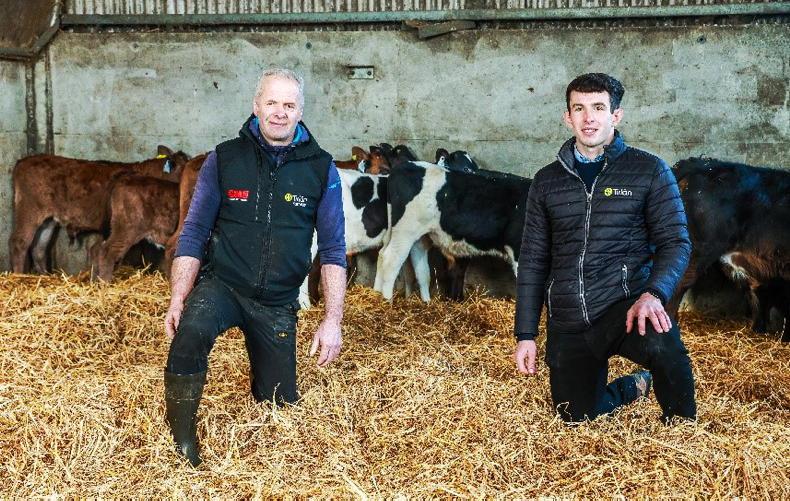
Seán (left) works closely with his Tirlán FarmLife business manager Eoin Regan, who is always on hand to provide technical support.
ADVERTISEMENT
Seán Miller runs a progressive dairy and calf-to-beef enterprise just outside Abbeyleix, Co Laois, supplying milk to Tirlán.
Seán farms alongside his brother Joe and wife Helen, with their five children also lending a hand during the busiest periods.
“When calving starts, everyone plays their part,” Seán explains.
ADVERTISEMENT
The Millers operate a busy family-run farm where careful preparation and strong calf management protocols are central to long-term herd performance.
Depending on the time of year, the farm keeps between 700 and 800 animals in total. Around 200 cows are milked annually, while approximately 40 to 50 surplus heifers and cows are sold each year.
The remaining stock is carried through the system, with around 160 cattle finished annually at two years of age, all of which are slaughtered through the Twenty20 Beef Club.
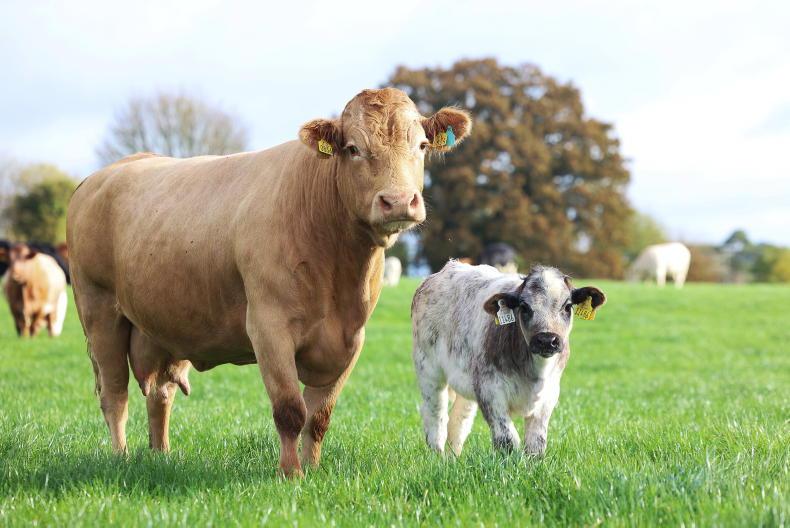
The herd was traditionally British Friesian, but Seán now uses Angus, Aubrac and some Limousin genetics within the system.
“My focus is on breeding a cow that works for the system - good fertility, strength and solids, but also easy calving and healthy calves from day one,” he explains.
Calving system and dry cow management
The Millers operate a split calving system, with autumn and spring calving. Approximately 35 to 40 cows calve in October and November, while the main spring-calving period begins around 7 February.
Cows are dried off for an eight-week period, during which time nutrition and health are carefully managed.
Dry cow minerals are introduced eight weeks pre-calving, alongside straw and small amounts of meal, with feeding levels adjusted as cows approach calving.
All cows are dosed for liver fluke, lice and worms and vaccinated for IBR and leptospirosis.
Scan results have been strong, with an empty rate of less than 5%, and calving difficulty is minimal thanks to careful sire selection, with Angus used on heifers and Aubrac on cows.
In relation to drying off, Seán states that: “Even though we milk all year round, giving cows their full dry period pays dividends when calving starts.”
Preparation and calf management
Ahead of calving, all pens, calf sheds and equipment are power-washed and disinfected. The farm has three calf sheds and two automatic feeders, which are serviced and prepared well in advance of calving.
Once born, calves are cleaned, navels treated and fed a full feed of warm colostrum as soon as possible, with most drinking naturally.
“It’s easier on the calf and helps them settle,” Seán notes.
Calves receive colostrum twice a day, for five to seven days before transitioning on to milk replacer. Calf jackets are fitted immediately and left on for three to four weeks to conserve heat.
A strict vaccination programme is followed, including pneumonia vaccination and dosing for coccidiosis.
Fresh bedding, clean water, good ventilation and early introduction of concentrates and roughage support rumen development.
“Keeping calves warm is critical. Cold calves are more likely to get scour or pneumonia,” Seán adds.
Watch: business manager Kevin Maher discusses the GAIN Calf Milk Replacer range
Feeding Gain Easi-mix Calf Milk Replacer
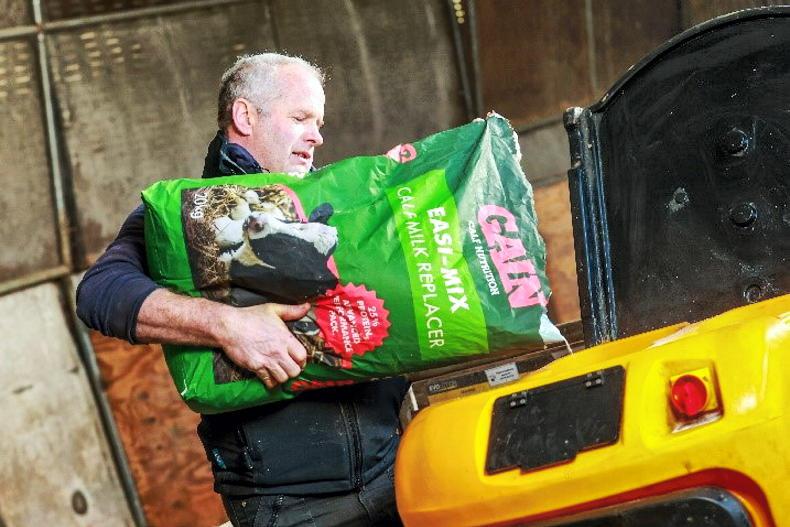
Seán has fed GAIN Easi-Mix Calf Milk Replacer for almost 10 years and credits it with delivering consistent calf performance while improving labour efficiency.
Once calves move on to the automatic feeder, intakes are gradually increased and delivered in three smaller, more frequent feeds to support digestion and overall calf health.
"Calves remain on milk replacer until around 60 days of age, after which intakes are gradually reduced, with weaning completed at approximately 80 days once calves are consuming around 1.5kg of concentrate daily,” Seán explains.
Seán stresses that “the automatic feeders are a huge labour saver. Calves are fed little and often, which is much easier on their stomachs and takes pressure off us during a very busy time.”
From a biosecurity perspective, milk replacer reduces disease transmission compared with whole or transition milk, particularly for infections such as Johne’s disease.
Consistency of composition avoids nutritional upsets often associated with milk from cows at varying stages of lactation.
“Calf health is definitely better - there’s very little scour, and calves are thriving. They’re hitting their target weights - around 140kg at weaning - and the transition on to milk replacer is seamless,” Seán explains.
Its ease of mixing, compatibility with automatic feeders and flexibility across feeding systems ensure reliability even during peak calving.
Seán has fed GAIN Easi-Mix Calf Milk Replacer for almost 10 years, and credits it with delivering consistent calf performance while improving labour efficiency.
Technical support and confidence for calving
Seán works closely with his Tirlán business manager Eoin Regan, who provides ongoing technical advice and support.
“It’s important to have someone at the end of the phone,” Seán says. “If there’s ever an issue, Eoin is there to give advice or arrange support and that gives real confidence during a busy calving season.”
GAIN Easi-Mix calf milk replacer is a 25% protein premium milk replacer for home-reared replacement dairy heifers and general calf rearing.
It promotes trouble-free performance through consistent composition and high digestibility, with BioMos prebiotic to support immunity, Gardion garlic oil to aid calf health, and Digest VO to help protect against coccidiosis and cryptosporidium.
Looking ahead to the coming calving season, Seán is confident in the system in place.
“When everything is prepared, calves are warm and feeding is consistent, calving becomes far more manageable. From a labour, efficiency and biosecurity point of view, GAIN Easi-Mix plays a big role in keeping everything running smoothly.”
For more information on GAIN Easi-Mix, please contact your local branch, business manager or visit tirlánfarmlife.com.
Register for free to read this story and our free stories.
This content is available to digital subscribers and loyalty code users only. Sign in to your account, use the code or subscribe to get unlimited access.
The reader loyalty code gives you full access to the site from when you enter it until the following Wednesday at 9pm. Find your unique code on the back page of Irish Country Living every week.
CODE ACCEPTED
You have full access to the site until next Wednesday at 9pm.
CODE NOT VALID
Please try again or contact support.
Seán Miller runs a progressive dairy and calf-to-beef enterprise just outside Abbeyleix, Co Laois, supplying milk to Tirlán.
Seán farms alongside his brother Joe and wife Helen, with their five children also lending a hand during the busiest periods.
“When calving starts, everyone plays their part,” Seán explains.
The Millers operate a busy family-run farm where careful preparation and strong calf management protocols are central to long-term herd performance.
Depending on the time of year, the farm keeps between 700 and 800 animals in total. Around 200 cows are milked annually, while approximately 40 to 50 surplus heifers and cows are sold each year.
The remaining stock is carried through the system, with around 160 cattle finished annually at two years of age, all of which are slaughtered through the Twenty20 Beef Club.
The herd was traditionally British Friesian, but Seán now uses Angus, Aubrac and some Limousin genetics within the system.
“My focus is on breeding a cow that works for the system - good fertility, strength and solids, but also easy calving and healthy calves from day one,” he explains.
Calving system and dry cow management
The Millers operate a split calving system, with autumn and spring calving. Approximately 35 to 40 cows calve in October and November, while the main spring-calving period begins around 7 February.
Cows are dried off for an eight-week period, during which time nutrition and health are carefully managed.
Dry cow minerals are introduced eight weeks pre-calving, alongside straw and small amounts of meal, with feeding levels adjusted as cows approach calving.
All cows are dosed for liver fluke, lice and worms and vaccinated for IBR and leptospirosis.
Scan results have been strong, with an empty rate of less than 5%, and calving difficulty is minimal thanks to careful sire selection, with Angus used on heifers and Aubrac on cows.
In relation to drying off, Seán states that: “Even though we milk all year round, giving cows their full dry period pays dividends when calving starts.”
Preparation and calf management
Ahead of calving, all pens, calf sheds and equipment are power-washed and disinfected. The farm has three calf sheds and two automatic feeders, which are serviced and prepared well in advance of calving.
Once born, calves are cleaned, navels treated and fed a full feed of warm colostrum as soon as possible, with most drinking naturally.
“It’s easier on the calf and helps them settle,” Seán notes.
Calves receive colostrum twice a day, for five to seven days before transitioning on to milk replacer. Calf jackets are fitted immediately and left on for three to four weeks to conserve heat.
A strict vaccination programme is followed, including pneumonia vaccination and dosing for coccidiosis.
Fresh bedding, clean water, good ventilation and early introduction of concentrates and roughage support rumen development.
“Keeping calves warm is critical. Cold calves are more likely to get scour or pneumonia,” Seán adds.
Watch: business manager Kevin Maher discusses the GAIN Calf Milk Replacer range
Feeding Gain Easi-mix Calf Milk Replacer
Seán has fed GAIN Easi-Mix Calf Milk Replacer for almost 10 years and credits it with delivering consistent calf performance while improving labour efficiency.
Once calves move on to the automatic feeder, intakes are gradually increased and delivered in three smaller, more frequent feeds to support digestion and overall calf health.
"Calves remain on milk replacer until around 60 days of age, after which intakes are gradually reduced, with weaning completed at approximately 80 days once calves are consuming around 1.5kg of concentrate daily,” Seán explains.
Seán stresses that “the automatic feeders are a huge labour saver. Calves are fed little and often, which is much easier on their stomachs and takes pressure off us during a very busy time.”
From a biosecurity perspective, milk replacer reduces disease transmission compared with whole or transition milk, particularly for infections such as Johne’s disease.
Consistency of composition avoids nutritional upsets often associated with milk from cows at varying stages of lactation.
“Calf health is definitely better - there’s very little scour, and calves are thriving. They’re hitting their target weights - around 140kg at weaning - and the transition on to milk replacer is seamless,” Seán explains.
Its ease of mixing, compatibility with automatic feeders and flexibility across feeding systems ensure reliability even during peak calving.
Seán has fed GAIN Easi-Mix Calf Milk Replacer for almost 10 years, and credits it with delivering consistent calf performance while improving labour efficiency.
Technical support and confidence for calving
Seán works closely with his Tirlán business manager Eoin Regan, who provides ongoing technical advice and support.
“It’s important to have someone at the end of the phone,” Seán says. “If there’s ever an issue, Eoin is there to give advice or arrange support and that gives real confidence during a busy calving season.”
GAIN Easi-Mix calf milk replacer is a 25% protein premium milk replacer for home-reared replacement dairy heifers and general calf rearing.
It promotes trouble-free performance through consistent composition and high digestibility, with BioMos prebiotic to support immunity, Gardion garlic oil to aid calf health, and Digest VO to help protect against coccidiosis and cryptosporidium.
Looking ahead to the coming calving season, Seán is confident in the system in place.
“When everything is prepared, calves are warm and feeding is consistent, calving becomes far more manageable. From a labour, efficiency and biosecurity point of view, GAIN Easi-Mix plays a big role in keeping everything running smoothly.”
For more information on GAIN Easi-Mix, please contact your local branch, business manager or visit tirlánfarmlife.com.
If you would like to speak to a member of our team, please call us on 01-4199525.
Link sent to your email address
We have sent an email to your address. Please click on the link in this email to reset your password. If you can't find it in your inbox, please check your spam folder. If you can't find the email, please call us on 01-4199525.
ENTER YOUR LOYALTY CODE:
The reader loyalty code gives you full access to the site from when you enter it until the following Wednesday at 9pm. Find your unique code on the back page of Irish Country Living every week.






SHARING OPTIONS