Stephen Wallace, Mountrath,
Co Laois
The weather broke at just the wrong time for Stephen as his beans were not ripe enough to cut while the good weather was there.
There were still green pods and stems in the winter beans a couple of weeks ago, but they are now ripe and ready to be harvested whenever the weather allows. The spring beans have caught up and are now ripe too.
Stephen says that the spring beans will have a much higher yield than the winter beans this year. He is not worried about the beans as they will stay standing and won’t lose their pods.
However, Stephen has some May-sown spring oats to harvest too. The crop needs a few dry days before harvesting, but Stephen will be trying to get it done as soon as he can to minimise losses.
When last speaking to Stephen, he still had 10ac of spring barley to harvest, and he expected it to be the best of the barley. This proved to be true, and the crop yielded 3.25t/ac at moisture contents between 15.5 and 17%.
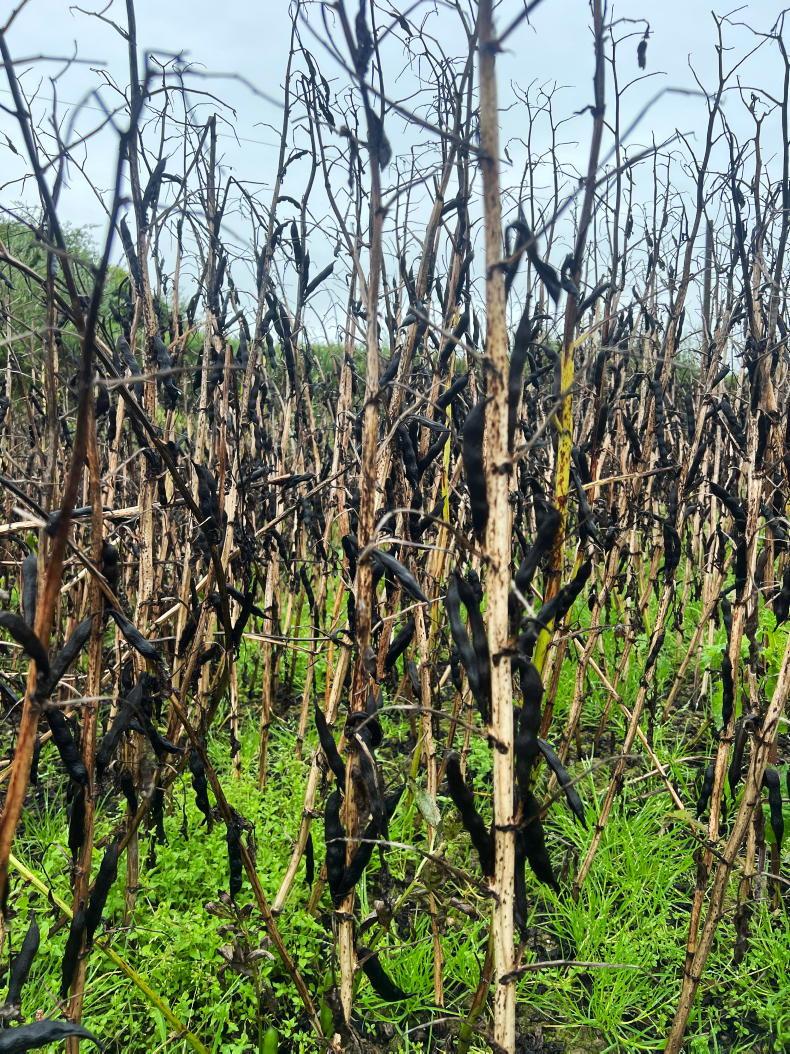
Stephen's beans are ripe and will be cut whenever the weather allows.
In contrast, the winter wheat disappointed. It averaged just over 3t/ac. Stephen says the grains were very small and did not fill very well. The hot, dry weather did not help, but the ground is also of low fertility. Stephen is working on this through the use of organic manures and crop rotation, but he says it will take a number of years to see the benefit. The crop also produced 10 bales/ac.
All of the cover crops in the Farming for Water EIP have been planted. Stephen is also hoping to sow 20ac of LG Armada winter oilseed rape. He had prepared the seedbed and was ready to plant it when a mechanical breakdown prevented him from doing so. The rain arrived the next day. He is hoping to get the crop planted in the next few days, if the weather allows.
Pádraig Connery, Villierstown, Co Waterford
The harvest was finished relatively early for Pádraig, with the spring beans cut on 20 August.
They were disappointing, yielding 1.65t/ac at 18% moisture content. Pádraig thinks that they ripened too early due to the hot and dry weather in July and August.
There was very little rainfall in this period on Pádraig’s farm and the beans lost some of their green leaves quite early. There may have been some chocolate spot in the crop late on, too. The straw was chopped on the crop. One headland was left uncut because the weeds had taken over the crop. Some other areas had some weeds too, but it did not cause any issues as the crop was very dry.
Pádraig has planted 65ha of cover crops this year, 40ha of which is for the Farming for Water EIP. A small area of this is going into winter cereals, and is made up of forage rape and leafy turnip, while the remainder is an eight-way mix. They were planted between 5 and 10 August.
Pádraig says there was huge dust as it was so dry at the time, and he questions the benefits of planting them in arid conditions. Pádraig was considering planting winter oilseed rape this year but he has decided to wait until next year.
Instead, he will plant some winter rye as a local merchant will take it from him and will match the barley grain price.
He aims to plant the crop in about 10 days’ time around the time of the National Ploughing Championships. The ground was sprayed off earlier this week to control grass weeds.
Winter cereal planting is still a bit away, but Pádraig says he will start drilling winter barley in the last days of September in a few fields where a BYDV tolerant variety has been chosen.
David Hobson, Dunsany, Co Meath
As one harvest draws to an end, the beginning of the next crop cycle begins for David. Winter oilseed rape drilling commenced on 22 August, despite the dry soils at the time. Ground conditions are warm, and once the rain arrived, it was not long before the cotyledons emerged above the soil. Once cereal volunteers emerge, a graminicide (Falcon) will be applied at between 0.8 and 1l/ha. Slug pellets (Meterex) were broadcast at 3- 4kg/ha.
The oilseed rape area is up 35% on last year and two varieties were used on the farm – LG Armada and Aurelia. Seed rates ranged from 2.2 to 2.5 kg/ha, depending on the field and thousand seed weight.
The farm has also been busy with drying grain, planting cover crops for the Farming for Water EIP, bagging seed, and carrying out general land work. Sourcing cover crop seed was a struggle for David given the high demand this year. David notes the importance of drilling brassica-free mixes due to the oilseed rape in the rotation. Mixes generally consisted of vetch, clovers, phacelia, and oats.
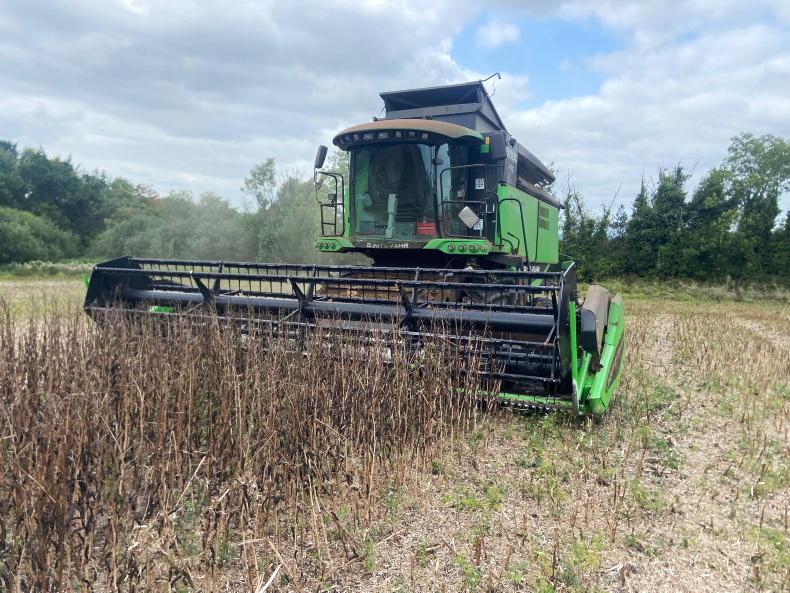
Pádraig finished his harvest on 20 August with the spring beans.
The Lynx spring beans harvest began earlier this week and the results so far have been very good, with yields averaging 5.4t/ha at 20 to 23% moisture. The quality is excellent and David hopes to have the harvest complete by the end of the week.
Before David has had a chance to fully reflect on the 2025 harvest, the farm’s plan for cereal planting in 2026 is nearly finalised.
Despite the positive yields during the harvest, current grain prices do not bode well for margins this year. David says the numbers simply do not stack up given where costs have escalated to in the past four years.
He adds that strong roots weather weak markets, and farmers must continue to diversify their farms and stay resilient in the current economic climate.
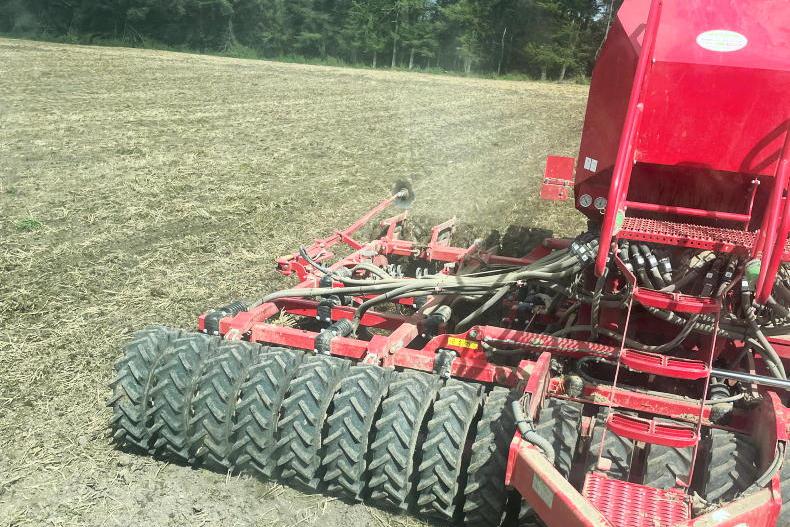
The winter oilseed rape was planted in very dry conditions in Meath.
Stephen Wallace, Mountrath,
Co Laois
The weather broke at just the wrong time for Stephen as his beans were not ripe enough to cut while the good weather was there.
There were still green pods and stems in the winter beans a couple of weeks ago, but they are now ripe and ready to be harvested whenever the weather allows. The spring beans have caught up and are now ripe too.
Stephen says that the spring beans will have a much higher yield than the winter beans this year. He is not worried about the beans as they will stay standing and won’t lose their pods.
However, Stephen has some May-sown spring oats to harvest too. The crop needs a few dry days before harvesting, but Stephen will be trying to get it done as soon as he can to minimise losses.
When last speaking to Stephen, he still had 10ac of spring barley to harvest, and he expected it to be the best of the barley. This proved to be true, and the crop yielded 3.25t/ac at moisture contents between 15.5 and 17%.
Stephen's beans are ripe and will be cut whenever the weather allows.
In contrast, the winter wheat disappointed. It averaged just over 3t/ac. Stephen says the grains were very small and did not fill very well. The hot, dry weather did not help, but the ground is also of low fertility. Stephen is working on this through the use of organic manures and crop rotation, but he says it will take a number of years to see the benefit. The crop also produced 10 bales/ac.
All of the cover crops in the Farming for Water EIP have been planted. Stephen is also hoping to sow 20ac of LG Armada winter oilseed rape. He had prepared the seedbed and was ready to plant it when a mechanical breakdown prevented him from doing so. The rain arrived the next day. He is hoping to get the crop planted in the next few days, if the weather allows.
Pádraig Connery, Villierstown, Co Waterford
The harvest was finished relatively early for Pádraig, with the spring beans cut on 20 August.
They were disappointing, yielding 1.65t/ac at 18% moisture content. Pádraig thinks that they ripened too early due to the hot and dry weather in July and August.
There was very little rainfall in this period on Pádraig’s farm and the beans lost some of their green leaves quite early. There may have been some chocolate spot in the crop late on, too. The straw was chopped on the crop. One headland was left uncut because the weeds had taken over the crop. Some other areas had some weeds too, but it did not cause any issues as the crop was very dry.
Pádraig has planted 65ha of cover crops this year, 40ha of which is for the Farming for Water EIP. A small area of this is going into winter cereals, and is made up of forage rape and leafy turnip, while the remainder is an eight-way mix. They were planted between 5 and 10 August.
Pádraig says there was huge dust as it was so dry at the time, and he questions the benefits of planting them in arid conditions. Pádraig was considering planting winter oilseed rape this year but he has decided to wait until next year.
Instead, he will plant some winter rye as a local merchant will take it from him and will match the barley grain price.
He aims to plant the crop in about 10 days’ time around the time of the National Ploughing Championships. The ground was sprayed off earlier this week to control grass weeds.
Winter cereal planting is still a bit away, but Pádraig says he will start drilling winter barley in the last days of September in a few fields where a BYDV tolerant variety has been chosen.
David Hobson, Dunsany, Co Meath
As one harvest draws to an end, the beginning of the next crop cycle begins for David. Winter oilseed rape drilling commenced on 22 August, despite the dry soils at the time. Ground conditions are warm, and once the rain arrived, it was not long before the cotyledons emerged above the soil. Once cereal volunteers emerge, a graminicide (Falcon) will be applied at between 0.8 and 1l/ha. Slug pellets (Meterex) were broadcast at 3- 4kg/ha.
The oilseed rape area is up 35% on last year and two varieties were used on the farm – LG Armada and Aurelia. Seed rates ranged from 2.2 to 2.5 kg/ha, depending on the field and thousand seed weight.
The farm has also been busy with drying grain, planting cover crops for the Farming for Water EIP, bagging seed, and carrying out general land work. Sourcing cover crop seed was a struggle for David given the high demand this year. David notes the importance of drilling brassica-free mixes due to the oilseed rape in the rotation. Mixes generally consisted of vetch, clovers, phacelia, and oats.
Pádraig finished his harvest on 20 August with the spring beans.
The Lynx spring beans harvest began earlier this week and the results so far have been very good, with yields averaging 5.4t/ha at 20 to 23% moisture. The quality is excellent and David hopes to have the harvest complete by the end of the week.
Before David has had a chance to fully reflect on the 2025 harvest, the farm’s plan for cereal planting in 2026 is nearly finalised.
Despite the positive yields during the harvest, current grain prices do not bode well for margins this year. David says the numbers simply do not stack up given where costs have escalated to in the past four years.
He adds that strong roots weather weak markets, and farmers must continue to diversify their farms and stay resilient in the current economic climate.
The winter oilseed rape was planted in very dry conditions in Meath.






SHARING OPTIONS