


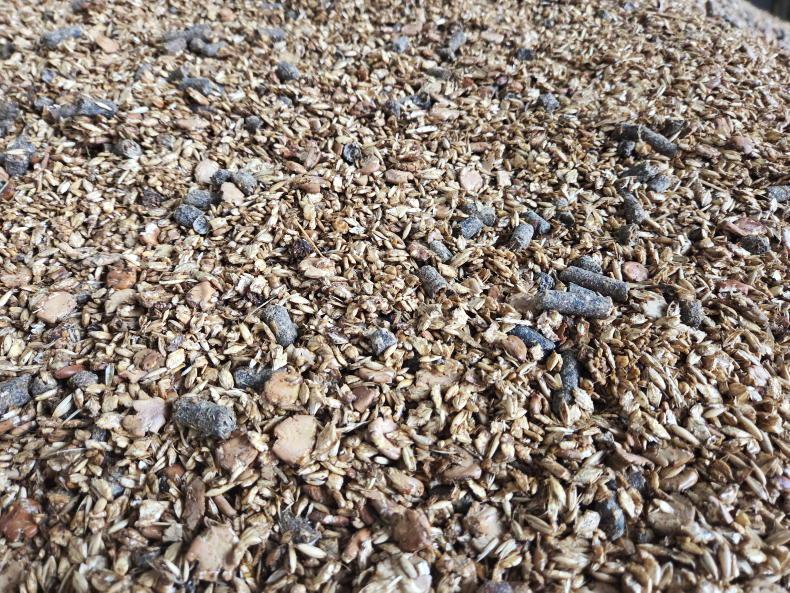
The amount of maize imported into the Republic of Ireland increased by almost 232,000t in 2025, to over 1.7m tonnes. Barley and wheat imports were down, but overall wheat, barley and maize imports were up almost 89,000t, despite the wheat, barley and oat harvest in Ireland being 250-275,000t greater in 2025 than in 2023 or 2024.
In total, approximately 4.37m tonnes of grain, beet and oilseed products were imported into the country. The majority of these products were used for animal feed, while some enters food and drink production. Not all feed is included in the 4.37m figures, but it gives a good indication.
Over 6m tonnes of compound feed are estimated to be produced in Ireland each year. We produce about 2.2m tonnes of grain and about 1.5m tonnes of this goes to animal feed.
The figures used in this article were obtained by the Central Statistics Office (CSO). It is raw data and may be subject to change. We detail some of these imports in the article below.
Barley
Barley imports totalled an estimated 512,198t in 2025. This was down 15,827t from 2024. The majority of barley imports crossed the water from Britain. Those imports came to 226,603t. Some 37,766t came from Northern Ireland, again the majority likely travelling through.
A lot of barley came from Europe – 87,866t from Germany; 51,876t from Poland; 26,151t from Lithuania; 11,557t from France; 9,619t from Denmark; 4,646t from Belgium; 4,175t from Sweden; and 693t from Netherlands.
Ukraine has not been listed as a country of origin, but grain may have travelled through another country and that country may be listed as the country of origin.
Wheat
A total of 400,559t of wheat was reported to be imported into the country in 2025, down significantly on the year before when it was 527,603t.
However, the reduction in wheat and barley imports seems to have been replaced by maize.
The majority of wheat came from France – 151,730t. A total of 71,400t came from Northern Ireland, majority most likely travelling through.
Some 47,906t came from Denmark, while 42,925t came from Britain and 34,840t from Latvia, 25,322t from Sweden, 10,187t from Poland, 7,500t from Estonia and 4,676t from Lithuania.
Soybean meal
Soybean meal is a massive source of protein. We do not produce enough protein crops in Ireland to meet demand; that said, many tonnes of beans that we produced last year sat in sheds after harvest with no market. We imported over 818,000t of soybean meal last year, hulls also came into the country.
The majority, nearly 600,000t of soybean meal, came from Argentina last year. However, once again we see that a large amount came from Northern Ireland – 100,547t.
This was not produced in Northern Ireland and we cannot tell where it came from, similarly amounts came from Britain and Netherlands, neither soybean strongholds.
Oats
Disappointingly, 17,443t of oats were reported to be imported in 2025. Given the level of oats produced in Ireland, the amount that has been in storage with no demand and the low-carbon emissions produced from Irish oats, – aside from the 209t that crossed the border from Northern Ireland – it is extremely disappointing to see the amount imported into the country. A massive 16,153t of oats come from Latvia.
Maize
Maize (grain maize) takes up 39% of the 4,368,900t of total imports. A massive 1,711,660t of maize was imported into the country from January to December inclusive in 2025. The majority of that maize came from Canada – 866,024t. This was followed by the US (335,993t), Brazil (209,972t) and Northern Ireland (183,112t). The maize noted as coming from Northern Ireland would have travelled through Northern Ireland, but was not produced there. This shows that the statistics do not tell the whole story on imports.
Some maize came from France, totalling 89,966t. The amount of maize coming from there has decreased in recent years. French maize has been reported to be used in whiskey production. The lower amount this year may be to do with reduced demand for whiskey, but the figure had been declining previous to that.
Beet pulp
Seeing beet pulp and molasses being imported into the country is a hard one to take for tillage farmers who grew beet before the sugar industry was closed down in 2006.
Approximately 213,752t of beet pulp came into the country in 2025. About half of this came from Egypt (108,964t), 41,091t came from the US, 33,289t from Germany, 14,943t from Russia and smaller amounts from Netherlands, Ukraine, France, Northern Ireland and a tiny amount from Britain.
Molasses
Molasses pulls up many different and interesting countries of origin. Ireland is drawing molasses from many different corners of the world, from Belarus to Belize and Guatemala to Indonesia. Frustrating for most farmers to read again no doubt, given the sugar industry was closed.
Malt
Malt imports have declined significantly. Just 4,418t of malt imports were reported by the CSO in 2025, down from 10,239t in 2024 and 14,376t in 2023.
They mainly came from Britain and Netherlands.
Malt imports are likely down on reduced demand from the distilling sector, but we should also remember that we cannot decipher between grains for food and drink and grain from animal feed.
So, for example, barley could have been imported to be malted, but demand is down.
Mercosur
A massive 816,773t is estimated to have been imported from Mercosur countries. Maize and soybeans were the main products that travelled from Argentina, Brazil and Paraguay.
We will always need to import animal feed products into this country, but little effort is being made to reduce the amount.
If yields of new varieties were not improving, our grain production would be significantly down due to area decline over the past decade.
The increase in maize imports is disappointing. Where we can’t use Irish we should be aiming to use ingredients of similar quality and from neighbouring countries.
It is not right to place strict regulations on Irish and EU growers and now a CBAM tax on fertiliser, while we import grain that is not impacted by either of these things.
How is it fair to have Irish farmers competing against GM crops, treated with pesticides banned in the EU, produced using fertiliser not subject to a carbon tax they pay? Farmers not farming with these factors are able to sell at lower prices.
It is also concerning that we do not know where all the grain is coming from. There are unknown origins and then there is grain that clearly was not produced in the country it came from.
Very little grain seemed to have been reported as coming from Ukraine, but we are likely to have received grain from Ukraine that simply travelled through another country.
We will always import, but our regulations on imports could be better. We should know what country products are coming from.
We should know whether it is being used for food, drink or feed and like-for-like standards should apply.
It goes without saying, the Government should be doing more to reach its target of 400,000ha of tillage in the country by 2030 to increase the level of home-grown feed and grain in the country and to increase the level of grain in animals’ diets that has a low carbon footprint.
More Irish grain could add value to meat and milk products and back up the Irish brand.


SHARING OPTIONS