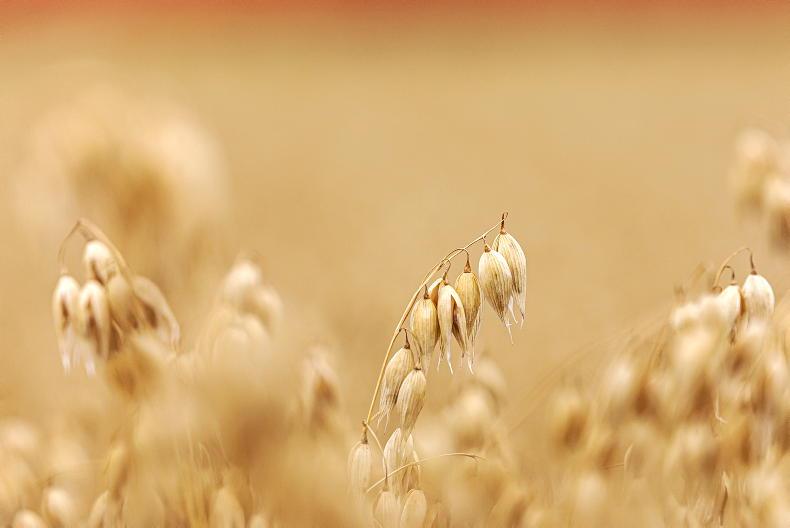
At present, oats sit in sheds across the country, as there seems to be very little demand for the product from the industry.
At the Teagasc beef conference last week, information of trials on oats in animal feeds was shared with farmers.
The information said farmers should not dismiss oats, as the grain “performs just as well as barley for finishing cattle”.
Teagasc stated that “native oats are priced very competitively compared to barley, making them a practical option for reducing winter feed costs without sacrificing performance”.
Unfortunately, oats are very competitive at the minute due to lack of demand, which is disappointing to see, as oats are a crop suited extremely well to Ireland and they are carbon neutral on many farms where straw is chopped.
Research
Teagasc carried out two research trials on finishing beef cattle. Teagasc Grange said that the feeding value of rolled oats was similar to rolled barley when used as a supplement to grass silage.
There was no difference in performance between cattle fed the oats-based concentrate and the barley-based concentrate across grass silage and total DM intake, daily liveweight gain or feed efficiency.
The switch did not impact on slaughter weight, carcase weight, kill-out proportion, estimated carcase gain or carcase conformation and fat scores.
Nutritional value
Oats are naturally high in fibre and fat, lower in starch and has a slightly lower crude protein content than barley, but feeding value proved to be similar according to Teagasc. It concluded:
Rolled oats can directly replace rolled barley.There is no loss in growth rate, feed efficiency or carcase grades from this replacement.Teagasc said the move supports Irish tillage farmers and reduces reliance on imports.Oats use can also improve farm sustainability.It is great to see the use of Irish oats being promoted among beef farmers and more of this work needs to be done across the livestock sectors.
It would be great to see research carried out on the use of oats as a buffer feed to replace palm kernel in the summer, for example.
It is important that oats do not replace Irish barley in rations. That said, the more Irish products we use, the more demand there will be.
Teagasc research has shown that a 64% Irish ration can reduce the carbon footprint of dairy herds by 7.3%, so there are opportunities to produce premium products based on Irish-fed animals and reduced carbon footprints that could add money to tillage and livestock farmers’ incomes.
At present, oats sit in sheds across the country, as there seems to be very little demand for the product from the industry.
At the Teagasc beef conference last week, information of trials on oats in animal feeds was shared with farmers.
The information said farmers should not dismiss oats, as the grain “performs just as well as barley for finishing cattle”.
Teagasc stated that “native oats are priced very competitively compared to barley, making them a practical option for reducing winter feed costs without sacrificing performance”.
Unfortunately, oats are very competitive at the minute due to lack of demand, which is disappointing to see, as oats are a crop suited extremely well to Ireland and they are carbon neutral on many farms where straw is chopped.
Research
Teagasc carried out two research trials on finishing beef cattle. Teagasc Grange said that the feeding value of rolled oats was similar to rolled barley when used as a supplement to grass silage.
There was no difference in performance between cattle fed the oats-based concentrate and the barley-based concentrate across grass silage and total DM intake, daily liveweight gain or feed efficiency.
The switch did not impact on slaughter weight, carcase weight, kill-out proportion, estimated carcase gain or carcase conformation and fat scores.
Nutritional value
Oats are naturally high in fibre and fat, lower in starch and has a slightly lower crude protein content than barley, but feeding value proved to be similar according to Teagasc. It concluded:
Rolled oats can directly replace rolled barley.There is no loss in growth rate, feed efficiency or carcase grades from this replacement.Teagasc said the move supports Irish tillage farmers and reduces reliance on imports.Oats use can also improve farm sustainability.It is great to see the use of Irish oats being promoted among beef farmers and more of this work needs to be done across the livestock sectors.
It would be great to see research carried out on the use of oats as a buffer feed to replace palm kernel in the summer, for example.
It is important that oats do not replace Irish barley in rations. That said, the more Irish products we use, the more demand there will be.
Teagasc research has shown that a 64% Irish ration can reduce the carbon footprint of dairy herds by 7.3%, so there are opportunities to produce premium products based on Irish-fed animals and reduced carbon footprints that could add money to tillage and livestock farmers’ incomes.








SHARING OPTIONS