Ireland’s farming community is no stranger to pressure. Between volatile markets, rising costs, environmental decline and complex regulations, the demands on farmers have rarely been bigger.
Yet, despite a desire for stability and sustainability, it often feels like working together is getting harder, not easier.
Public debate has become more polarised, opinions more entrenched, and finding common ground more elusive.
But during my Nuffield farming scholarship travels, I saw something far more hopeful: farmers, organisations and policymakers across the world proving that collaboration is still possible, even across deep divides. These partnerships weren’t driven by obligation or ideology, but by the fact that they made business sense.
Leading by example
In Australia, sixth-generation farmer Michael Taylor is well on his way to achieving 30% tree cover on his superfine Merino farm by 2030. His reason is practical: trees keep sheep healthier and hold moisture in drought years. Nearby, first-generation Wagyu producer Ben Poschelk has cut costs by brewing beneficial microbes to replace synthetic fertiliser.
In Denmark, pig farmer Bertel Hestbjerg transitioned from an intensive system to an extensive, high-welfare, regenerative model, without sacrificing profitability. For these farmers, environmental improvements were not burdens, but smart decisions.
True collaboration requires navigating disagreement. Not all conflict is bad; in fact, productive conflict is essential for innovation. What destroys progress is high conflict – the entrenched “us vs them” stand-offs.
My research focused on regions and organisations managing to avoid this trap.
In Denmark, while the government negotiated a challenging green tripartite agreement on agriculture and land use, farming representatives chose to stay at the table.
Though uneasy about the final outcome, they believed engagement would secure more workable regulations.
And it did; the measures, shaped with farmers, rather than imposed on them, have so far avoided the backlash seen elsewhere.

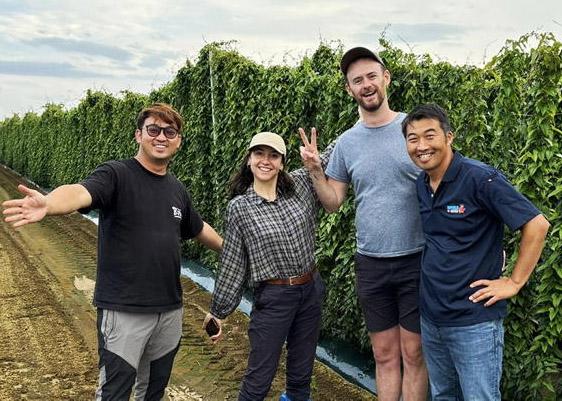
Molly Garvey, Shota Morigami and the foundaer and of Ikari wheat, rice and soya farm in Kyoto, Japan.
In the United States, I witnessed good conflict in action: a farmer and a lobbyist, close friends who vote differently, yet still work together.
Also in the US, a national alliance of leading farming, food and environmental organisations secured agriculture’s inclusion in federal climate funding, unlocking billions for soil health, methane emissions and energy projects.
In Brussels, both Copa-Cogeca and environmental think tanks agreed on the need for professionals with mixed expertise – people fluent in agri-business and environmental science. That kind of interdisciplinary thinking accelerates innovation.
And in France, the country’s leading farm co-operative body launched a year-long consultation to elevate young farmers’ voices and ensure future policy positions reflect the hopes and needs of the next generation.
Some of the farmers I met were master negotiators, because their livelihoods required it.
In Japan, green onion grower Shota Morigami farms over 20 separate plots, each belonging to a different neighbour. Every boundary change and efficiency improvement requires careful negotiation, skills many Irish farmers increasingly need.

Michael Taylor and his father, planting oak trees with their dog at Taylor's Run super-fine merino wool operation. \ Molly Garvey
In California and Australia’s Murray-Darling Basin, water debates spanning generations showed that even the most high-stakes conflicts can be navigated through persistence, respect and long-view thinking.
Ireland has a history of resolving conflict and forging alliances. There is huge potential in building coalitions, not only around emissions, but nature restoration, public procurement and rural development.
For example, securing adequate funding for nature restoration will require alliances strong enough to compete with other national priorities.
Top tips for collaboration
From all I’ve seen, a few lessons stand out:
Focus on the 60% you agree on, not the 40% you don’t.Avoid conflict entrepreneurs, the people who thrive on division and offer no solutions.Break down silos by investing in spaces where farmers, foresters, ecologists and policymakers can meet meaningfully. Develop mixed-professional expertise in both agri-business and environmental science.Teach the skills of good conflict, including negotiation and disagreement such as a junior debating programme.A lead farmer on the Food, Agriculture and Climate Alliance summed it up: “It’s easier to divide and point your finger… but you don’t get anything done. Sometimes you have to do something uncomfortable to move forward.”If Ireland wants to unlock its agri-food edge, strategic collaboration will be our greatest competitive advantage.
Ireland’s farming community is no stranger to pressure. Between volatile markets, rising costs, environmental decline and complex regulations, the demands on farmers have rarely been bigger.
Yet, despite a desire for stability and sustainability, it often feels like working together is getting harder, not easier.
Public debate has become more polarised, opinions more entrenched, and finding common ground more elusive.
But during my Nuffield farming scholarship travels, I saw something far more hopeful: farmers, organisations and policymakers across the world proving that collaboration is still possible, even across deep divides. These partnerships weren’t driven by obligation or ideology, but by the fact that they made business sense.
Leading by example
In Australia, sixth-generation farmer Michael Taylor is well on his way to achieving 30% tree cover on his superfine Merino farm by 2030. His reason is practical: trees keep sheep healthier and hold moisture in drought years. Nearby, first-generation Wagyu producer Ben Poschelk has cut costs by brewing beneficial microbes to replace synthetic fertiliser.
In Denmark, pig farmer Bertel Hestbjerg transitioned from an intensive system to an extensive, high-welfare, regenerative model, without sacrificing profitability. For these farmers, environmental improvements were not burdens, but smart decisions.
True collaboration requires navigating disagreement. Not all conflict is bad; in fact, productive conflict is essential for innovation. What destroys progress is high conflict – the entrenched “us vs them” stand-offs.
My research focused on regions and organisations managing to avoid this trap.
In Denmark, while the government negotiated a challenging green tripartite agreement on agriculture and land use, farming representatives chose to stay at the table.
Though uneasy about the final outcome, they believed engagement would secure more workable regulations.
And it did; the measures, shaped with farmers, rather than imposed on them, have so far avoided the backlash seen elsewhere.
Molly Garvey, Shota Morigami and the foundaer and of Ikari wheat, rice and soya farm in Kyoto, Japan.
In the United States, I witnessed good conflict in action: a farmer and a lobbyist, close friends who vote differently, yet still work together.
Also in the US, a national alliance of leading farming, food and environmental organisations secured agriculture’s inclusion in federal climate funding, unlocking billions for soil health, methane emissions and energy projects.
In Brussels, both Copa-Cogeca and environmental think tanks agreed on the need for professionals with mixed expertise – people fluent in agri-business and environmental science. That kind of interdisciplinary thinking accelerates innovation.
And in France, the country’s leading farm co-operative body launched a year-long consultation to elevate young farmers’ voices and ensure future policy positions reflect the hopes and needs of the next generation.
Some of the farmers I met were master negotiators, because their livelihoods required it.
In Japan, green onion grower Shota Morigami farms over 20 separate plots, each belonging to a different neighbour. Every boundary change and efficiency improvement requires careful negotiation, skills many Irish farmers increasingly need.
Michael Taylor and his father, planting oak trees with their dog at Taylor's Run super-fine merino wool operation. \ Molly Garvey
In California and Australia’s Murray-Darling Basin, water debates spanning generations showed that even the most high-stakes conflicts can be navigated through persistence, respect and long-view thinking.
Ireland has a history of resolving conflict and forging alliances. There is huge potential in building coalitions, not only around emissions, but nature restoration, public procurement and rural development.
For example, securing adequate funding for nature restoration will require alliances strong enough to compete with other national priorities.
Top tips for collaboration
From all I’ve seen, a few lessons stand out:
Focus on the 60% you agree on, not the 40% you don’t.Avoid conflict entrepreneurs, the people who thrive on division and offer no solutions.Break down silos by investing in spaces where farmers, foresters, ecologists and policymakers can meet meaningfully. Develop mixed-professional expertise in both agri-business and environmental science.Teach the skills of good conflict, including negotiation and disagreement such as a junior debating programme.A lead farmer on the Food, Agriculture and Climate Alliance summed it up: “It’s easier to divide and point your finger… but you don’t get anything done. Sometimes you have to do something uncomfortable to move forward.”If Ireland wants to unlock its agri-food edge, strategic collaboration will be our greatest competitive advantage. 





SHARING OPTIONS