


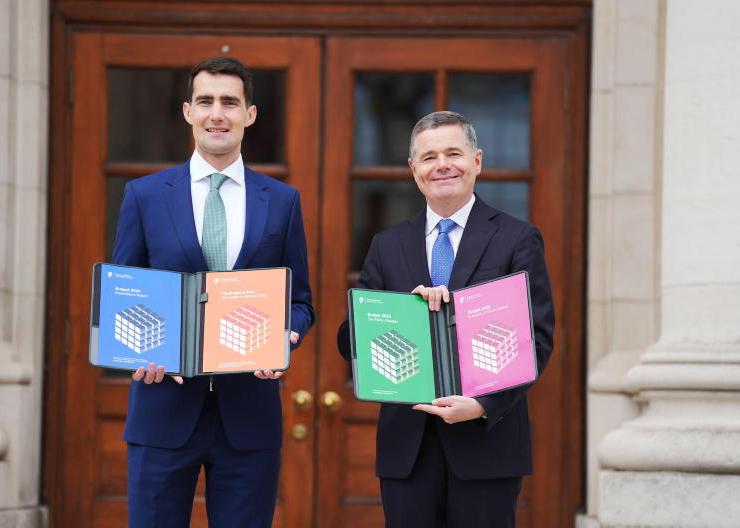
Last week’s budget was followed by the release of the Central Statistics Office’s (CSO) monthly figures on the Consumer Price Index (CPI).
The give-away budget was criticised by economic experts for taking risks with the public finances but just about everyone else expressed disappointment at the failure to address a cost of living crisis which they regard as self evident.
The print and broadcast media focused on the 12-month CPI increase, from September 2024 to September 2025, which registered at 2.7 % and looked like an acceleration in the inflation rate from the 12-month readings earlier in the year.
The last time the 12-month rate exceeded the most recent figure was 18 months ago in March 2024. Why did inflation recede for over a year and then suddenly shoot back up in September?
The fast answer is that the apparent acceleration is an illusion that did not happen at all. The one-month reading from August to September this year showed an actual decline of 0.2%.
The careful statisticians at the CSO did not miscount anything either: prices in September 2025 were indeed ahead of the same month in 2024, but they had actually fallen a year earlier in the month from August 2024 and the 12-month calculation automatically deletes whatever monthly change happened 13 months ago.
Effects
This is what the statisticians call a ‘base-year’ effect. Base-year effects are a trap for the unwary, or the just plain careless.
The recent slowdown in the CPI inflation rate would spoil a good story, both for the media and opposition politicians, so the public were treated to reports of the 12-month change at 2.7%, even though the CSO press release gave the full run of figures back several years and drew attention to the fall in the month to September 2024.
Month-to-month figures can fluctuate for all sorts of reasons but the 12-month measure has rarely been above the 2% level since early last year, when the bout of higher inflation post-2023 began to subside.
It was caused by the relaxation of monetary policy across Europe in the aftermath of COVID-19 and the impact on energy prices of the Russian invasion of Ukraine.
This 2% figure is important because it is the official target rate for Eurozone countries adopted by the European Central Bank.
The CSO figures, interpreted with only a little attention, have been signalling that the inflation surge has passed, the rate has come back to the target and the case for cost-of-living supports has disappeared, in the data if not in the Dáil.
Reporting inflation over several months helps to even out the sharp swings that can occur with the one-month estimate.
If the CSO compared the last three months with the corresponding three months from a year earlier, the figure for September 2025 would have been almost exactly in line with the 2% target, depriving the media of the ‘inflation shock’ headlines and opposition TDs of talking points for radio and TV chat shows.
Since Ireland has no independent currency, it can have no exchange rate policy.
A small, open economy exports a large portion of output and meets from imports a high percentage of the demand for goods and services, all at prices which are externally determined in a currency, the Euro, over which domestic policy can exercise no control.
This means that the overall rate of inflation rises and falls roughly in line with the prevailing trends in the Eurozone.
Government cannot meaningfully affect the general price level – all they can do is adjust taxes and social transfers in annual budgets.
It is particularly important to protect the long-run capacity to support living standards when the economy hits a downturn, and the criticism from the Irish Fiscal Advisory Council, the Central Bank and the Economic and Social Research Institute of last week’s budget can readily be summarised. The Government has been trying to spend their way, not out of a bust, but out of a boom.
The economy is at, or close to, full employment. Spending liberally now runs the risk that the budget will soon run into deficit, compromising the ability to spend freely when softer budget policy might be needed.
There is a further objection to the disappointment voiced in the media about the absence of cost-of-living measures.
Real consumer incomes, taking higher employment and wage growth into account, are likely to rise this year, beating inflation, and the latest forecasts are for continued improvement in overall consumer spending in 2026.
Not merely are the CPI inflation figures as good as could reasonably be expected, the best index of the standard of living is the strength of consumer spending and that looks healthy too.
The bad news is that the public’s inflation expectations, which feed into cost-push decisions about wages and margins, have been exacerbated by the slapdash media coverage.






SHARING OPTIONS