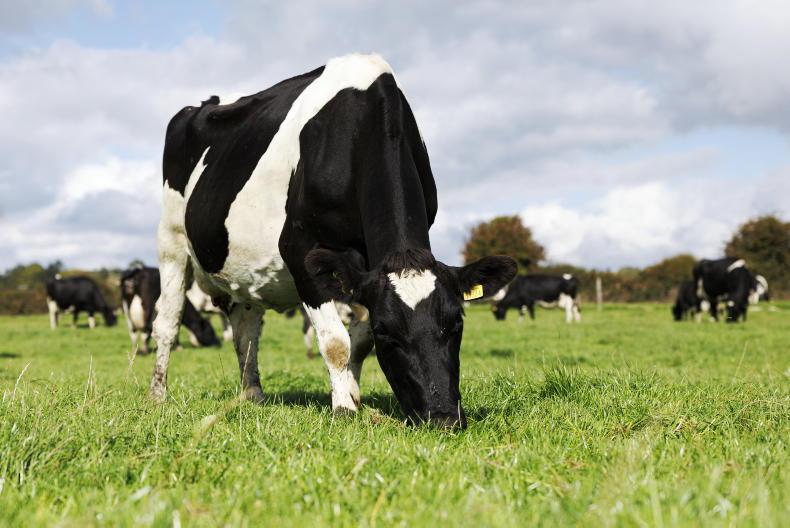
Notwithstanding the turbulent final months, 2025 should be remembered as a positive year for dairy in Ireland. Excellent grass-growing conditions in the spring and through the summer months supported milk collections that are trending towards being more than 5% up for the year.
Farmgate milk prices, before bonuses, ranged from 47c/l to over 50c/l from March to July, a period when approximately 60% of all annual milk is collected. This is a peak season that delivered commercially for farmers and the Irish dairy industry better than any in recent memory.
There was an abrupt sentiment change, however, towards the end of the summer as a sharp decline in global market values for butter and cheese began to be reflected in a milk price in Ireland that has fallen by around 12c/l over the four months of August to October.
This fall in milk price hasn’t just affected Ireland, with similar trends being seen in Europe in particular. However, with 95% of Irish dairy production destined for export, price reactions based on global conditions are more pronounced here, where reactions to market changes are more sharply felt, whether markets are rising or falling. In other markets, higher reliance on domestic retail demand insulate from these factors to some extent.
For farmers and processors alike, the challenge is clear: how do we safeguard profitability and future growth, while building in stability that allows the industry to navigate fluctuating market conditions with more predictability?
The answer lies in identifying and capturing ‘added value’ markets, both at home and abroad.
The global dairy price challenge
Price volatility is a factor of the global dairy market given its fine balance between supply and demand. Factors such as oversupply, changing consumer preferences, changing tariff landscapes and economic uncertainties have all contributed to unpredictability in commodity prices.
In 2025, for example, there was a rush of milk in Europe in the summer months combined with lower costs of production and higher output in the United States, as well as a positive start to the season in New Zealand. These have been key contributors to the increased global supply that has influenced the decline in market prices for key products, for example butter and cheese.
For dairy in Ireland, where certain costs can be higher than for global competitors due to economies of scale, currency fluctuations or tariff disadvantages, overly relying solely on bulk markets for commodity products is becoming a greater challenge.
Defining ‘added value’ in dairy
‘Added value’ refers to products or services that command a premium due to their unique qualities, branding, or functionality. In dairy, this can include grass-fed consumer products, nutritional supplements to support healthy living, speciality cheeses and premium yoghurts.
It also encompasses strong branding and provenance – leveraging Ireland’s green image underpinned by the Bord Bia grass-fed standard, to provide fact-based credentials on what Irish grass-fed stands for.
An important example of this is the success of the Kerrygold brand in markets like the United States and Germany.
Increasingly, added value can relate to data provided to support positions around ‘lower carbon,’ or ‘higher welfare,’ for large-scale bulk ingredient customers. Customers like Danone, Mars, Unilever, Nestlé and all major global dairy companies are committing to science-based environmental targets and are actively pursuing suppliers who can provide proof that their products are more sustainable and independently accredited, to help them meet their targets.
These companies, the largest global buyers of dairy ingredients, view these credentials as a valuable added-value proposition. The progress made on Irish farms in establishing and developing the Bord Bia Sustainable Dairy Assurance Scheme over the last 10 years positions Irish dairy to the forefront for these important customers (see Table 1).
Why added value matters now more than ever
Resilience against price fluctuations: value-added products are less susceptible to global commodity price swings, offering more stable returns.Market differentiation: Irish dairy can stand out by emphasising quality, sustainability, and traceability, appealing to discerning consumers worldwide.Higher margins: added-value segments, such as functional dairy and speciality cheeses, deliver better margins compared to bulk commodities.Alignment with consumer trends: there is growing demand globally for health-focused, sustainable, and ethically produced foods – areas where Irish dairy excels.
The Ornua owned Kerrygold brand has earned market leading positions in premium markets of United States and Germany based on strong grass-fed credentials that appeal to consumers.’
Strategies for identifying and accessing added-value markets
Market research and innovation: Invest in understanding emerging consumer needs, from nutrition to convenience, and innovate accordingly.Brand Ireland: harness the power of Ireland’s reputation for grass-fed purity and sustainability in marketing campaigns targeting international premium markets.Product diversification: expand into niche segments, such as fortified, or speciality dairy products that command higher prices.Export partnerships: collaborate with distributors and retailers in target regions to position Irish dairy at the top end of the market.Sustainability credentials: continue to improve environmental performance, as sustainability is increasingly a prerequisite for premium market access.
Bord Bia stand at Food Ingredients Europe, Paris, December 2025 - Bord Bia has been working with Irish dairy exporters to identify opportunities for value added ingredients with key European customers.
Case studies: added-value opportunities in Asia
The dairy industry in Asia has seen some structural changes in the last five years, with increased milk production in China and a move towards domestic production of high-value dairy products. Irish dairy processors are looking to target these new manufacturers of specialised nutritional products by leveraging the expertise they’ve gained from supplying international manufacturers in Ireland and across Europe over the last decade. Bord Bia is supporting this endeavour, having secured the opportunity in 2025 to represent European dairy in a three-year campaign. ‘European Dairy: Ireland, where nature meets science’, promotes Ireland’s capability to supply high-quality functional ingredients and expertise to potential partners in China, Vietnam and Singapore. This €3.2m campaign is 80% funded by Europe, with the balance provided by the Irish dairy industry, and will see Irish dairy present at trade shows in each market in 2026, as well as over 30 high-potential customers visiting Ireland in June 2026.
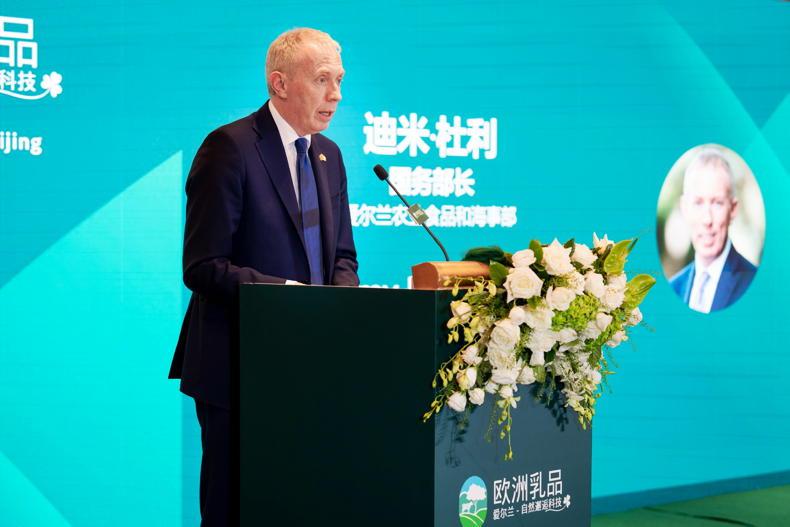
Minister Timmy Dooley T.D. addresses 120 Chinese dairy professionals at the ‘Ireland, Where Nature meets Science,’ EU funded seminar in Beijing, September 2025
Comment: a call to action
As Irish dairy faces the reality of deflated global prices in the early months of 2026, the pursuit of value-added markets is not just an opportunity– it is a necessity. By championing innovation, sustainability and quality, while leaning on its unique grass-fed production model, Irish dairy farmers and processors can secure better returns and ensure the sector’s long-term viability. The time to act is now, lest we risk being left behind in a commoditised world.
Notwithstanding the turbulent final months, 2025 should be remembered as a positive year for dairy in Ireland. Excellent grass-growing conditions in the spring and through the summer months supported milk collections that are trending towards being more than 5% up for the year.
Farmgate milk prices, before bonuses, ranged from 47c/l to over 50c/l from March to July, a period when approximately 60% of all annual milk is collected. This is a peak season that delivered commercially for farmers and the Irish dairy industry better than any in recent memory.
There was an abrupt sentiment change, however, towards the end of the summer as a sharp decline in global market values for butter and cheese began to be reflected in a milk price in Ireland that has fallen by around 12c/l over the four months of August to October.
This fall in milk price hasn’t just affected Ireland, with similar trends being seen in Europe in particular. However, with 95% of Irish dairy production destined for export, price reactions based on global conditions are more pronounced here, where reactions to market changes are more sharply felt, whether markets are rising or falling. In other markets, higher reliance on domestic retail demand insulate from these factors to some extent.
For farmers and processors alike, the challenge is clear: how do we safeguard profitability and future growth, while building in stability that allows the industry to navigate fluctuating market conditions with more predictability?
The answer lies in identifying and capturing ‘added value’ markets, both at home and abroad.
The global dairy price challenge
Price volatility is a factor of the global dairy market given its fine balance between supply and demand. Factors such as oversupply, changing consumer preferences, changing tariff landscapes and economic uncertainties have all contributed to unpredictability in commodity prices.
In 2025, for example, there was a rush of milk in Europe in the summer months combined with lower costs of production and higher output in the United States, as well as a positive start to the season in New Zealand. These have been key contributors to the increased global supply that has influenced the decline in market prices for key products, for example butter and cheese.
For dairy in Ireland, where certain costs can be higher than for global competitors due to economies of scale, currency fluctuations or tariff disadvantages, overly relying solely on bulk markets for commodity products is becoming a greater challenge.
Defining ‘added value’ in dairy
‘Added value’ refers to products or services that command a premium due to their unique qualities, branding, or functionality. In dairy, this can include grass-fed consumer products, nutritional supplements to support healthy living, speciality cheeses and premium yoghurts.
It also encompasses strong branding and provenance – leveraging Ireland’s green image underpinned by the Bord Bia grass-fed standard, to provide fact-based credentials on what Irish grass-fed stands for.
An important example of this is the success of the Kerrygold brand in markets like the United States and Germany.
Increasingly, added value can relate to data provided to support positions around ‘lower carbon,’ or ‘higher welfare,’ for large-scale bulk ingredient customers. Customers like Danone, Mars, Unilever, Nestlé and all major global dairy companies are committing to science-based environmental targets and are actively pursuing suppliers who can provide proof that their products are more sustainable and independently accredited, to help them meet their targets.
These companies, the largest global buyers of dairy ingredients, view these credentials as a valuable added-value proposition. The progress made on Irish farms in establishing and developing the Bord Bia Sustainable Dairy Assurance Scheme over the last 10 years positions Irish dairy to the forefront for these important customers (see Table 1).
Why added value matters now more than ever
Resilience against price fluctuations: value-added products are less susceptible to global commodity price swings, offering more stable returns.Market differentiation: Irish dairy can stand out by emphasising quality, sustainability, and traceability, appealing to discerning consumers worldwide.Higher margins: added-value segments, such as functional dairy and speciality cheeses, deliver better margins compared to bulk commodities.Alignment with consumer trends: there is growing demand globally for health-focused, sustainable, and ethically produced foods – areas where Irish dairy excels.
The Ornua owned Kerrygold brand has earned market leading positions in premium markets of United States and Germany based on strong grass-fed credentials that appeal to consumers.’
Strategies for identifying and accessing added-value markets
Market research and innovation: Invest in understanding emerging consumer needs, from nutrition to convenience, and innovate accordingly.Brand Ireland: harness the power of Ireland’s reputation for grass-fed purity and sustainability in marketing campaigns targeting international premium markets.Product diversification: expand into niche segments, such as fortified, or speciality dairy products that command higher prices.Export partnerships: collaborate with distributors and retailers in target regions to position Irish dairy at the top end of the market.Sustainability credentials: continue to improve environmental performance, as sustainability is increasingly a prerequisite for premium market access.
Bord Bia stand at Food Ingredients Europe, Paris, December 2025 - Bord Bia has been working with Irish dairy exporters to identify opportunities for value added ingredients with key European customers.
Case studies: added-value opportunities in Asia
The dairy industry in Asia has seen some structural changes in the last five years, with increased milk production in China and a move towards domestic production of high-value dairy products. Irish dairy processors are looking to target these new manufacturers of specialised nutritional products by leveraging the expertise they’ve gained from supplying international manufacturers in Ireland and across Europe over the last decade. Bord Bia is supporting this endeavour, having secured the opportunity in 2025 to represent European dairy in a three-year campaign. ‘European Dairy: Ireland, where nature meets science’, promotes Ireland’s capability to supply high-quality functional ingredients and expertise to potential partners in China, Vietnam and Singapore. This €3.2m campaign is 80% funded by Europe, with the balance provided by the Irish dairy industry, and will see Irish dairy present at trade shows in each market in 2026, as well as over 30 high-potential customers visiting Ireland in June 2026.
Minister Timmy Dooley T.D. addresses 120 Chinese dairy professionals at the ‘Ireland, Where Nature meets Science,’ EU funded seminar in Beijing, September 2025
Comment: a call to action
As Irish dairy faces the reality of deflated global prices in the early months of 2026, the pursuit of value-added markets is not just an opportunity– it is a necessity. By championing innovation, sustainability and quality, while leaning on its unique grass-fed production model, Irish dairy farmers and processors can secure better returns and ensure the sector’s long-term viability. The time to act is now, lest we risk being left behind in a commoditised world.






SHARING OPTIONS