The job churn rate in Ireland was 11.3% in Q2 of last year, according to the Central Statistics Office (CSO), with a high proportion of the workforce saying that they planned to change jobs within 12 months. Statistics from various surveys suggest that people in Ireland are generally willing to move for better pay, work-life balance, and career progression opportunities.
With the tight labour market now seen across Ireland, the trend of moving jobs isn’t going anywhere in 2026 as employees continue to change positions.
The early part of the year is often a time for reflection, a new year brings a fresh start or perhaps a new way of thinking. There is always a lot of movement in the employment market in the first quarter of the year, as people reflect on their career development to date.
Although a lot of people make calculated moves on what jobs they are applying for and weigh up their options to stay or go, there is an increase in the amount of people feeling lost in their current role of career.
They often ask themselves questions like, is my career fulfilling? Am I passionate about my role? Do I see progression in the company I am working for?
It is extremely common to feel lost, especially when it comes to the direction of your career, and it can also occur at any stage from recent graduates all the way up to senior leaders.
A lack of motivation, focus and uncertainty can leave people looking for their next move or wondering where to go for advice and guidance. This where career coaches come into play.
A career coach is a professional guide who helps individuals define, plan, and achieve their career goals. They can offer practical strategies for everything from career changes and skill development to interview preparation and leadership growth.
In addition, a career coach can act as a focused, accountable partner to help you get out a rut and move forward in your professional journey.
Cathy Balfe, founder of Career Coach Me in Limerick explains, “A career coach/adviser will not – or at least should not – tell you what to do. They are there to support you to explore your options and help you make a well-informed and research-based decision about how to move forward with your career.”
International Coaching Federation (ICF) Ireland is the professional body for coaches in Ireland and has almost 500 members, with many specialising in career development, business, or executive coaching.
Starting out
After qualifying with a degree in finance and economics, Cathy first tried a few roles in finance, but found that she didn’t enjoy working in the sector. She switched to economics and went on to complete a PhD. After starting a family, Cathy decided to retrain as a careers adviser to give her a better work-life balance. After spending three years working as a career adviser at University of London, she relocated to Ireland. In 2019, Cathy set up my own career coaching business, Career Coach Me.
“Career coaching is a job I love – working with and supporting people to find careers that give them what they are looking for in a job. I now work with clients across the country, helping to support their career development – including clients living in rural areas.
“I have worked with people across practically every industry at this stage and at different seniority levels,” says Cathy.
Several of her recent clients have worked in agriculture, with some combining outside employment with income streams from farming. She also works with people in agricultural sales, veterinary practice, environmental science and landscape gardening.
“What I offer my clients is a structured approach to career decision making, I hopefully ask them the right questions to get them to reflect on what is important to them, support them in coming up with a shortlist of career options they are potentially interested in pursuing and come up with an action plan for them to research these options and make informed decisions about their future career direction,” she explains.

Cathy Balfe, founder of Career Coach Me.
Reflecting on skills
Cathy has developed a career report tool that she uses to help make the most of the time she has with clients.
“They complete a 20-30-minute online questionnaire before we meet, answering questions on their transferable skills, work type preferences and other factors/constraints impacting their career choices,” she explains.
When it comes to making career choices, Cathy emphasises it is important that people reflect on what they are good at and what they enjoy.
“We often explore career options linked to their top strengths and work type preferences. Similarly, we discuss previous work experiences – to explore what they liked/disliked from previous experiences, as this can often suggest career options that might be more suited to them,” Cathy says.
Other avenues explored are the industries of interest. “What others with a similar background might have gone on to do, and also careers linked to any interests they might have,” she says.
Cathy helps clients come up with a shortlist of options the client is interested in exploring and potentially pursuing in the future.
Over 75% of CVs are rejected before a hiring manager sees them, primarily due to large companies filtering candidates based on key words, formatting and skills. This means that job seekers must tailor their CVs for these systems using clean formats and relevant keywords.
“In terms of CVs, cover letters and application writing, it is important to study the job description and understand what the employer is looking for, and to reflect on past experiences and education and ensure you are providing evidence of what the employer is looking for.
Give the appropriate weight to the
most relevant parts of their career
history in their application materials,” says Cathy.
Looking at the next step
For those who are stuck in a career rut and are unsure of what direction to go in, Cathy underlines the importance of scheduling time for career development.
“It is easy to put it on the long finger, or to spend all your downtime doom scrolling on Indeed [jobs website]. Use this scheduled time to follow a structured approach to career exploration and decision-making. I recommend clients follow a three-step career transition model.
“Step 1 – Career choice, Step 2 – Getting any education/experience required, Step 3 – Searching for and applying for jobs,” she explains.
In her experience the career choice step is often the hardest, which is why Cathy breaks it into four steps.
“Knowing yourself – skills, preferences, interests. Knowing the world of work – what occupations are a good fit for you now you know your skills, preferences and interests. Testing it out – researching the shortlisted options – and finally, decision making,” she says.
Cathy also recommends talking to others as a very helpful way to get clarity, but be careful not to just follow their advice unless it is right for you.
“You are responsible for doing your research, reflecting on your own priorities and making decisions that are in your own best interests.
“Nobody knows you as well as you know yourself,” she concludes.
See careercoachme.ie
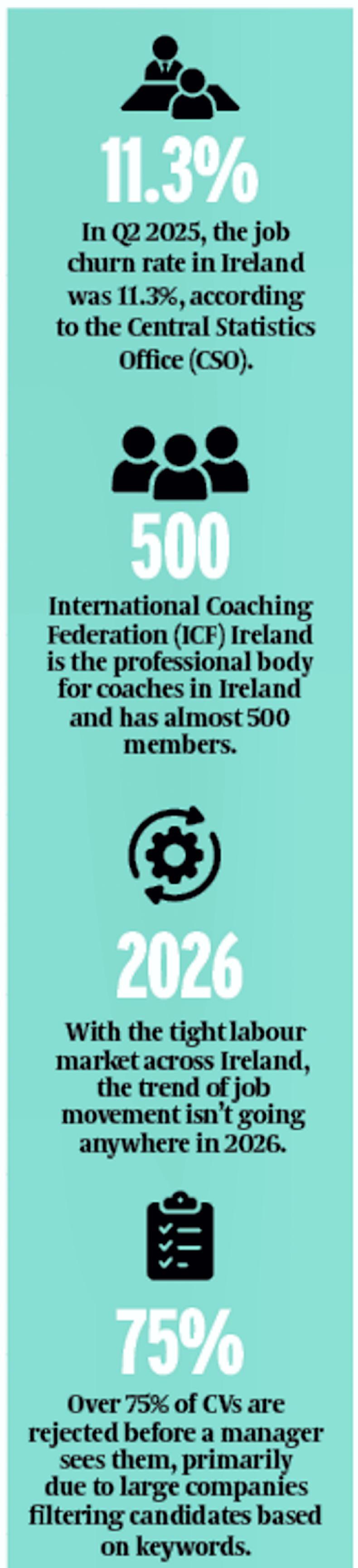
Figure 1.
The job churn rate in Ireland was 11.3% in Q2 of last year, according to the Central Statistics Office (CSO), with a high proportion of the workforce saying that they planned to change jobs within 12 months. Statistics from various surveys suggest that people in Ireland are generally willing to move for better pay, work-life balance, and career progression opportunities.
With the tight labour market now seen across Ireland, the trend of moving jobs isn’t going anywhere in 2026 as employees continue to change positions.
The early part of the year is often a time for reflection, a new year brings a fresh start or perhaps a new way of thinking. There is always a lot of movement in the employment market in the first quarter of the year, as people reflect on their career development to date.
Although a lot of people make calculated moves on what jobs they are applying for and weigh up their options to stay or go, there is an increase in the amount of people feeling lost in their current role of career.
They often ask themselves questions like, is my career fulfilling? Am I passionate about my role? Do I see progression in the company I am working for?
It is extremely common to feel lost, especially when it comes to the direction of your career, and it can also occur at any stage from recent graduates all the way up to senior leaders.
A lack of motivation, focus and uncertainty can leave people looking for their next move or wondering where to go for advice and guidance. This where career coaches come into play.
A career coach is a professional guide who helps individuals define, plan, and achieve their career goals. They can offer practical strategies for everything from career changes and skill development to interview preparation and leadership growth.
In addition, a career coach can act as a focused, accountable partner to help you get out a rut and move forward in your professional journey.
Cathy Balfe, founder of Career Coach Me in Limerick explains, “A career coach/adviser will not – or at least should not – tell you what to do. They are there to support you to explore your options and help you make a well-informed and research-based decision about how to move forward with your career.”
International Coaching Federation (ICF) Ireland is the professional body for coaches in Ireland and has almost 500 members, with many specialising in career development, business, or executive coaching.
Starting out
After qualifying with a degree in finance and economics, Cathy first tried a few roles in finance, but found that she didn’t enjoy working in the sector. She switched to economics and went on to complete a PhD. After starting a family, Cathy decided to retrain as a careers adviser to give her a better work-life balance. After spending three years working as a career adviser at University of London, she relocated to Ireland. In 2019, Cathy set up my own career coaching business, Career Coach Me.
“Career coaching is a job I love – working with and supporting people to find careers that give them what they are looking for in a job. I now work with clients across the country, helping to support their career development – including clients living in rural areas.
“I have worked with people across practically every industry at this stage and at different seniority levels,” says Cathy.
Several of her recent clients have worked in agriculture, with some combining outside employment with income streams from farming. She also works with people in agricultural sales, veterinary practice, environmental science and landscape gardening.
“What I offer my clients is a structured approach to career decision making, I hopefully ask them the right questions to get them to reflect on what is important to them, support them in coming up with a shortlist of career options they are potentially interested in pursuing and come up with an action plan for them to research these options and make informed decisions about their future career direction,” she explains.
Cathy Balfe, founder of Career Coach Me.
Reflecting on skills
Cathy has developed a career report tool that she uses to help make the most of the time she has with clients.
“They complete a 20-30-minute online questionnaire before we meet, answering questions on their transferable skills, work type preferences and other factors/constraints impacting their career choices,” she explains.
When it comes to making career choices, Cathy emphasises it is important that people reflect on what they are good at and what they enjoy.
“We often explore career options linked to their top strengths and work type preferences. Similarly, we discuss previous work experiences – to explore what they liked/disliked from previous experiences, as this can often suggest career options that might be more suited to them,” Cathy says.
Other avenues explored are the industries of interest. “What others with a similar background might have gone on to do, and also careers linked to any interests they might have,” she says.
Cathy helps clients come up with a shortlist of options the client is interested in exploring and potentially pursuing in the future.
Over 75% of CVs are rejected before a hiring manager sees them, primarily due to large companies filtering candidates based on key words, formatting and skills. This means that job seekers must tailor their CVs for these systems using clean formats and relevant keywords.
“In terms of CVs, cover letters and application writing, it is important to study the job description and understand what the employer is looking for, and to reflect on past experiences and education and ensure you are providing evidence of what the employer is looking for.
Give the appropriate weight to the
most relevant parts of their career
history in their application materials,” says Cathy.
Looking at the next step
For those who are stuck in a career rut and are unsure of what direction to go in, Cathy underlines the importance of scheduling time for career development.
“It is easy to put it on the long finger, or to spend all your downtime doom scrolling on Indeed [jobs website]. Use this scheduled time to follow a structured approach to career exploration and decision-making. I recommend clients follow a three-step career transition model.
“Step 1 – Career choice, Step 2 – Getting any education/experience required, Step 3 – Searching for and applying for jobs,” she explains.
In her experience the career choice step is often the hardest, which is why Cathy breaks it into four steps.
“Knowing yourself – skills, preferences, interests. Knowing the world of work – what occupations are a good fit for you now you know your skills, preferences and interests. Testing it out – researching the shortlisted options – and finally, decision making,” she says.
Cathy also recommends talking to others as a very helpful way to get clarity, but be careful not to just follow their advice unless it is right for you.
“You are responsible for doing your research, reflecting on your own priorities and making decisions that are in your own best interests.
“Nobody knows you as well as you know yourself,” she concludes.
See careercoachme.ie
Figure 1.











SHARING OPTIONS