


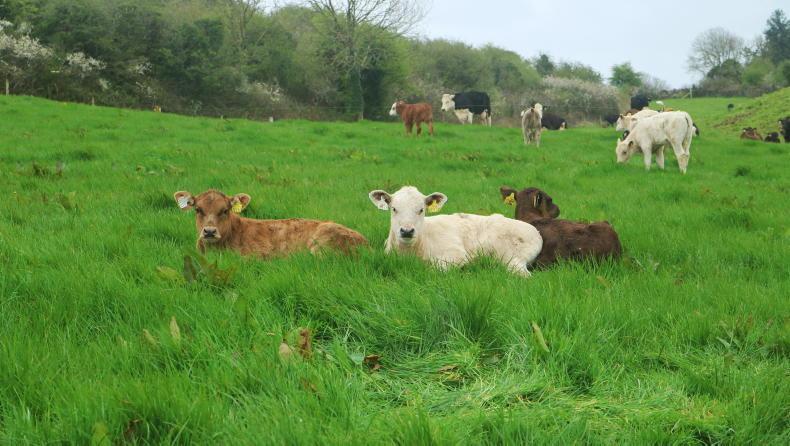
Attention is turning away from calving and on to this year’s breeding season in Newford Farm, the 90-cow suckler-to-beef demonstration farm located in Scrine, Co Roscommon.
The farm has consistently delivered in terms of reproductive performance and recorded a six week calving rate of 87% in 2026, with 96% of cows calved inside nine weeks.
Calving has concluded in the last week, with 91 cows calved and 90 calves on the ground. There were three cases of mortality – one calf died shortly after birth and another died at grass at three weeks of age, while a cow died in February.
The exact cause of the deaths will be available on the results of post-mortem.
The top line herd production figures, as summarised in table 1, are impressive. The farm produced 1.01 calves per cow in 2025, with the positive figure underpinned by the herd consistently maintaining a 365-day calving interval.
Mortality at birth in 2025 was 1.2% and 4.9% at 28 days.
There is a strong focus on calving ease, with 88% of cows experiencing a normal calving and requiring no assistance. Approximately 10% of cows required slight assistance with one cow noted as experiencing considerable difficulty. Just one required veterinary assistance.
Calving ease
Calving ease has been an important parameter in sire selection since the demonstration farm was set up. The general target for calving difficulty in sires used on mature cows is 5%. There is some leeway above this for sires selected from the Gene Ireland progeny test programme.
Teagasc’s Michael Fagan explains that such sires are only used on larger-framed mature cows with a history of calving ease. The target reliability figure for calving ease is a minimum of 85%, with a lower figure of upwards of 60% accepted for test bulls selected.
Sire selection is matched to cow type, with the easiest-calving sires matched to smaller-framed or younger cows which are more at risk to experiencing calving difficulty issues. Another metric used in recent years when selecting sires is the age at finish.
The aim is to get the best balance between sires whose progeny are more likely to lay down fat and as a result suit finishing at a younger age, while still possessing good beef characteristics to account for plainer-type Aberdeen Angus-cross and Hereford-cross cows bred from the dairy herd.
Selecting replacements
There has also been a greater focus in recent years in trying to improve the beef characteristics of replacements entering the herd, and in particular paying more attention to the predicted transmitting ability (PTA) for carcase weight.
The average PTA for carcase weight in the cow herd is 0.68kg with a carcase conformation PTA of 0.18 (R-). The equivalent carcase weight figure for replacement heifers which entered the herd in 2025 was 3.26kg and 0.28 (R=) respectively, while the figures for the 2026 crop of replacements is 5.2kg and 0.4 (R+).
The beef calving interval is -3.17 days for the main herd, -4.22 for replacements purchased in 2025 and -5.06 for the 2026 crop of heifers.
Age of finish is -5.91 days for the herd, -2.89 for 2025 replacement heifers and -3.65 for the 2026 crop. The overall replacement index value is heading in the right direction, with the cow herd averaging €153, 2025 replacement heifers at €173 and 2026 replacement heifers at €191.
Breeding season
The breeding season is due to start in the main cow herd on 21 April with 100% artificial insemination (AI). A synchronised breeding programme is in place for replacement heifers.
This began on 9 April with the insertion of CIDR’s and administration of GnRH (receptal). Heifers received 2ml estrumate on 14 April and a further 2ml on 15 April when CIDRs were removed. Fixed time AI will be carried out on 17 April along with administering 2ml GnRH.
Michael explains that the synchronisation programme is costing approximately €28 per heifer. Replacement heifers were weighed on 7 April, and at an average of 347kg liveweight are well on target for breeding (340kg breeding target).
Heat detection used on the farm includes vasectomised bulls fitted with a chin-ball. The Moocall heat detection system has also been used since 2021, with bulls fitted with a collar and electronic tags used on cows.
Farm manager Shane McGuinness receives a text message to notify him what cows have been picked up in heat by the vasectomised bull with the chin-ball and visual checking backing up this information.
Once-a-day AI is carried out whereby cows are inseminated at noon daily. Any cow still in standing heat on the evening following AI will be inseminated again the following day. This practice has worked to good effect in recent years in reducing labour input and facilitating 100% AI use. Cows are in good condition despite the challenging spring, with the average weight recorded at 551kg on 2 April 2026 and an average body condition score of 2.47.
Grass management
The first cows and their calves were turned out to grass on 12 February. Numbers turned out have slowly increased since then, with Shane balancing maintaining a smaller number outdoors initially rather than finding himself in a situation of possibly being faced with rehousing a larger number.
Yearling cattle were turned outdoors on 6 March. Bullocks were housed for just 91 days and went to grass at an average weight of 423kg. ADG over the winter was 0.44kg/day, with bullocks gaining 1.01kg on average since birth. Heifers were housed for a shorter period of just 75 days and went to grass weighing an average of 422kg. ADG over the winter was recorded, according to Michael, at 0.78kg per day. This has supported a similar ADG since birth to bullocks.
Shane explains that in recent weeks the aim has been to achieve the best balance between grazing out paddocks and avoiding weather-related sward damage.
Open day
An open day will take place in Newford Farm, run by Dawn Meats and Teagasc with support from McDonald’s, on 22 April at 4pm on the farm in Scrine, Athleague, Roscommon (F42 AH57). The event will showcase the production system in place, fertility and heat detection aids and smart technologies used on the farm.
Other discussion points include grassland management, physical and financial performance and farmyard infrastructure. event is free to attend.



SHARING OPTIONS