Our final six winners to be featured in our ICBF Beef Quality Awards are our dairy farmer finishers; farmers who not alone are milking cows but are bringing some, if not all, their own beef through to slaughter, with some also purchasing in additional cattle.
Much like the suckler farmer finishers profiled two weeks ago, these farmers are able to make conscious decisions on their own farm surrounding the use of high DBI (dairy beef index) bulls to produce these high CBV cattle, with the results speaking for themselves.
While we have gone in to very specialised systems in Ireland, with farmers usually being solely dairy or beef, it’s refreshing to see this cohort of farms blending the best of both worlds and reaping the rewards for it.
Using ground away from the milking platform and concentrating on good nutrition and genetics is allowing these farmers to add value to their beef animals and their enterprise as a whole, while the blend of beef and dairy insulates farm profitability and cash flow, with one sector able to support the other where there is a downturn in price.
These awards are sponsored by ICBF, FBD and the participating processors.
Letterkenny, Co Donegal
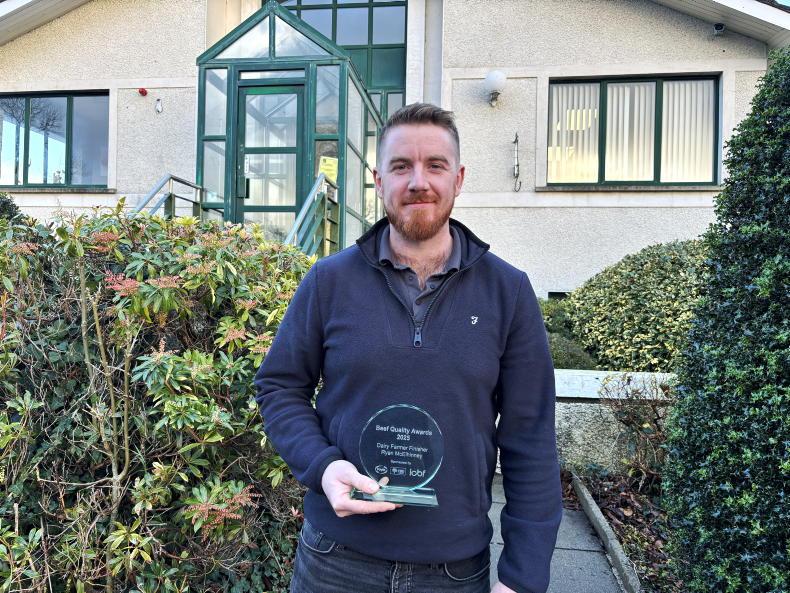
Ryan McElhinny, Letterkenny, Co. Donegal
Farming outside Letterkenny town, the McElhinnys see all beef brought through to slaughter, with half of the 140-strong dairy herd being served to beef bulls, while Friesian bull calves are also finished on farm.
Nearly all beef animals are sired by Angus bulls, with Foyle supplying some of this Angus semen for use on the herd, with a Limousin stock bull used for sweeping.
A heat detection system was installed this year on farm – the plan being to use 100% AI next year.
Better quality bulls are brought through to slaughter at 16 months old indoors, with lighter bulls turned out on to grass for their second summer before bring brought indoors in September and slaughtered at roughly 20-22 months of age, with heifers treated in a similar manner.
Concentrates are introduced at grass prior to housing, with cattle then housed and fed 5kg/head/day before gradually building the bulls up to 9kg/head/day, with heifers maintained at 5kg.
CBV is something that Ryan is looking at more, with carcase weight, conformation and days to slaughter being important factors when selecting AI sires, without compromising on calving ease.
“We would select bulls for individual cows. If we thought a bigger cow would be ok calving wise with a slightly harder calving bull, then we would go down that route, looking at all those beef traits and CBV at the same time.’’ Ryan processes all cattle through Foyle Foods.
foyle food group logo
Walter and
Caroline Murphy
Carrick on Suir,
Co Waterford
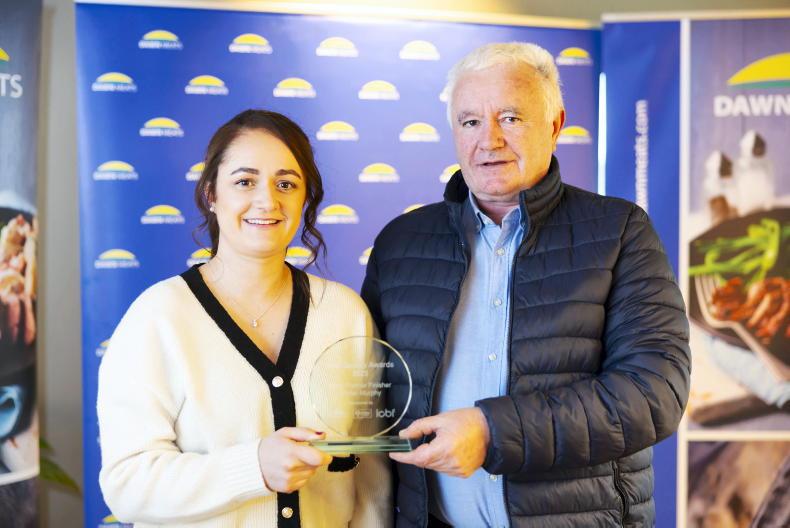
Beef Quality Awards at Dawn Meats. Pictured are award winners Walter Murphy and his daughter Caroline from Carrick on Suir. \ Patrick Browne
A father and daughter partnership, they milk 140 cows on their 300ac farm along with finishing over 200 cattle. The family have been dairy farming since the 1800s and a beef finishing system has run hand in hand with it.
All their own stock are finished as well as 80 continental heifers which are bought in Cahersiveen, Dungarvan and Kilkenny marts. These are bought from July to September and graze on after grass on the silage ground until they are housed in the middle of October.
They have a preference for continentals as they want better grades and higher carcase weights. All cattle grade R and a 340kg to 350kg is the target carcase weight for heifers at 24 to 26 months of age.
About 40 of their oldest bull calves are finished in an U16 month bull system and they averaged 325kg carcase weight this year. They are confident of having a higher average of 340kg next year as the calves are 40kg heavier at housing than the 2024 crop. The lighter bulls are finished at 24 months bulls and get a second season at grass.
Sexed semen used on their heifers for replacements meaning nearly all cows get a beef straw. Belgian Blue AI is used on most of the cows with a few Aubrac straws used too and a Limousin bull to clean up after AI.
The average CBV of their dairy-cross heifers is €238 while for their own bred bulls it’s €271 and €398 for the suckler beef heifers they buy.
They used to finish more cattle before but dropped numbers when the nitrates derogation stocking rate dropped to 220kg N/ha. All cattle are processed through Dawn Meats.
Dawn Meats logo
Stradbally, Co Waterford
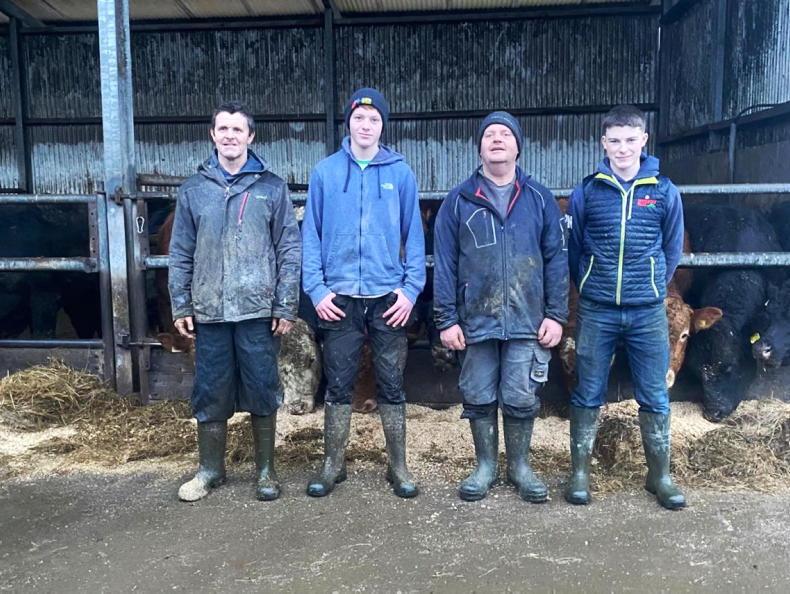
Larurence, Emmet, John and Darragh Walsh, Stradbally, Co Waterford.
Laurence along with his wife, Áine and their children, Darragh, Emmet and Breffní and Laurence’s brother, John, farm 280ac, of which 100ac is on a long-term lease.
The Walsh’s got into dairy four years ago and are milking 90 spring-calving cows and still have 25 autumn-calving sucklers. They finish all their own stock and buy in some calves too.
To reduce the amount of bull calves they have been using sexed semen. They use Belgian Blue, Hereford and Charolais AI on the dairy cows for a month with a Limousin bull to clean up after.
The forward bull calves are castrated and the younger ones are left as bulls.
They target a carcase weight of 340kg to 350kg at 18 to 20 months of age for the dairy bulls and 400kg at U16 months for the suckler stock.
For dairy-beef heifers they aim for 300kg at two years of age and aim for a heavier carcase weight for steers.
The suckler bulls grade U with the heifers all R while most of the dairy stock would be O= and O+.
The average CBV of their dairy-beef heifers is €156 and €201 for the bulls.
Their suckler heifers averaged €298 and bulls €337. Life is busy away from the farm for the Walsh’s.
Áine runs a boarding kennels and the family is heavily involved in hurling, hockey, camogie and ponies and Laurence says the help he gets from John and his other brothers plays a big part in having the farm at the scale it’s at. Cattle are processed through Kepak.

Kepak logo
Enniscorthy, Co Wexford
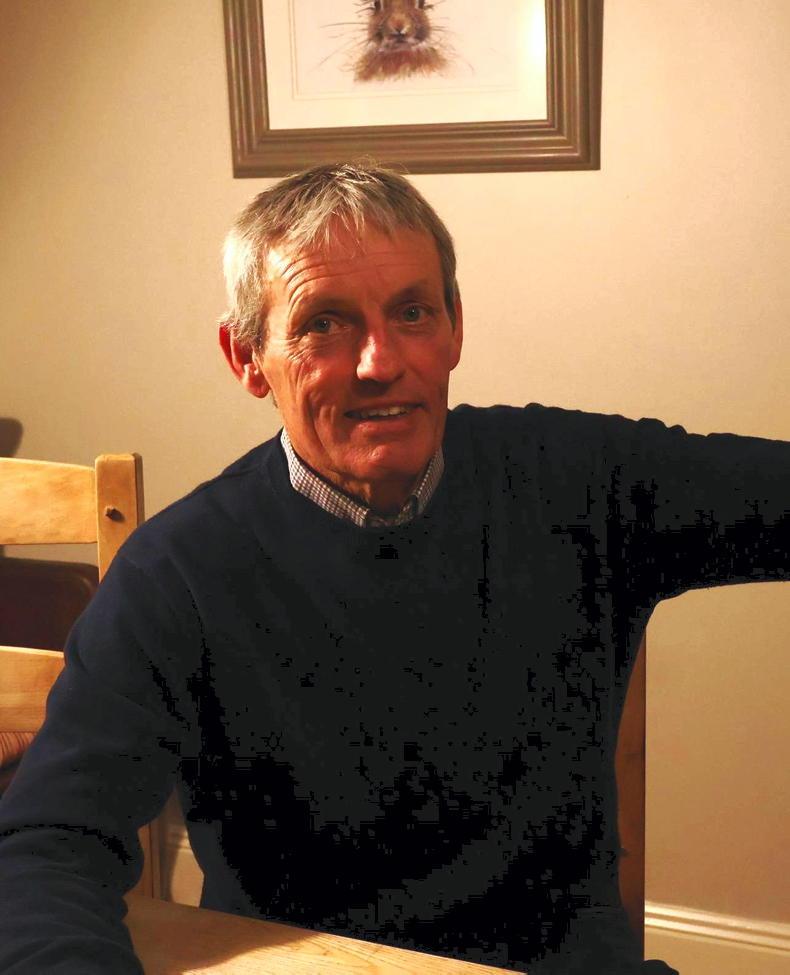
Kevin Murphy, Enniscorthy, Co Wexford.
Kevin farms with his wife Ann and their children, Alice, Kevin, Edmund, John and Aidan and is also helped by his nephew, Ciaran.
Operating on 220ac with two thirds of it owned, they milk 112 cows and they try to finish most of their own cattle with an odd few sold from time to time.
Calving begins at the end of January and runs to the middle of April.
He mainly uses Belgian Blue, Charolais and Simmental AI on the cows and a Limousin bull to tidy up most years but ran an Angus this year.
The bulls from Progressive Genetics that he used this year were BB9535, BB8496, BB9786, BB8283, BB9103, CH6490 and SI2152.
The average CBV for the dairy-cross stock is €266 for heifers and €268 for bulls.
From the middle of April, the oldest calves go out to grass and in their second year they get out in early March or the middle of February depending on ground conditions.
Bulls go out to grass last and are kept out until October before being brought onto slats with rubber mats for a final finishing period.
He aims to have heifers finished at between 22 to 26 months of age with a target carcase weight of 340kg.
The earliest-born bull calves are left as bulls and later ones castrated.
He targets a 360kg carcase from those in a 24-month-old bull system as he gets a better carcase weight from a mature bull.
Most of the cattle grade R with some of the Belgian Blue crosses grading U.
All cattle are processed through APB.

ABP logo
Nenagh, Co Tipperary
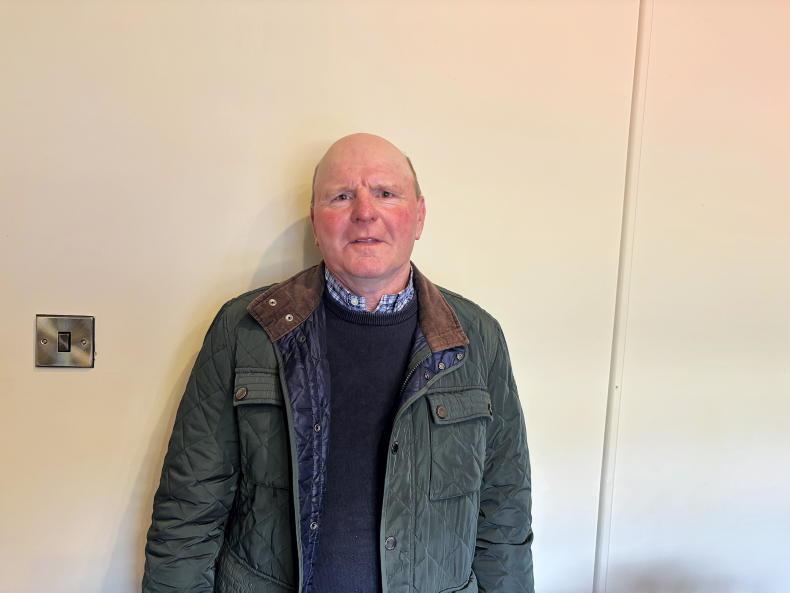
Michael Hogan, Neenagh, Co. Tipperary
Doing the simple things right is working well for Michael Hogan on his mixed dairy and beef farm. All dairy bulls and beef calves are brought through to slaughter on farm, with a combination of quality grass, high quality silage and minimal concentrates used. High DBI stockbulls are used, with one bull carrying a carcase figure of 16.7kg, well above the breed average of 6.25kg. Calves are fed 1-1.5kg concentrates/head post weaning until mid-summer with a grass-only diet after this until just before housing, where 1kg concentrates/head is reintroduced to transition weanlings pre housing. This year, 50 weanlings are grazing kale, with concentrates front loaded to the start of winter before weaning off post turnout the following spring, with the target being to get yearlings out to grass in early March.
Again, good quality grass is the key to achieving cheap gain on the Hogan farm in their second summer, with cattle then slaughtered off a mix of silage and concentrates indoors at 22-24 months. Harvesting the silage themselves with a wagon, Michael believes the longer chop length is better for rumen function, while having his own means of harvesting silage allows greater flexibility around harvesting time.
Some later born or lighter animals are turned out to grass for their third summer, with these slaughtered at under 30 months off grass and 3kg of concentrates. Hereford stock bulls are used on farm for beef breeding, with Michael noting that a high growth rate in a bull’s progeny is key to achieving performance, marrying this with conformation and calving ease. Michael processes his cattle through Ashbourne Meats.
Ashbourne meats logo
Clonfert, Ballinasloe,
Co Galway
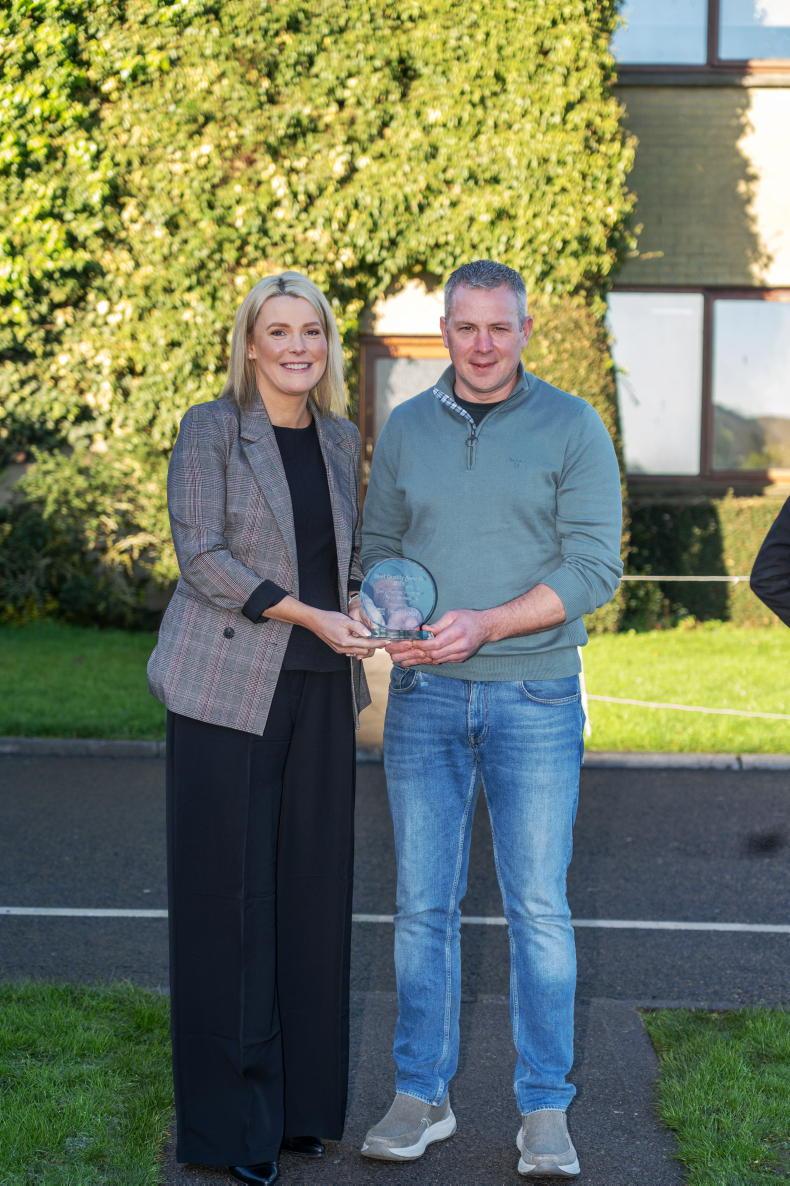
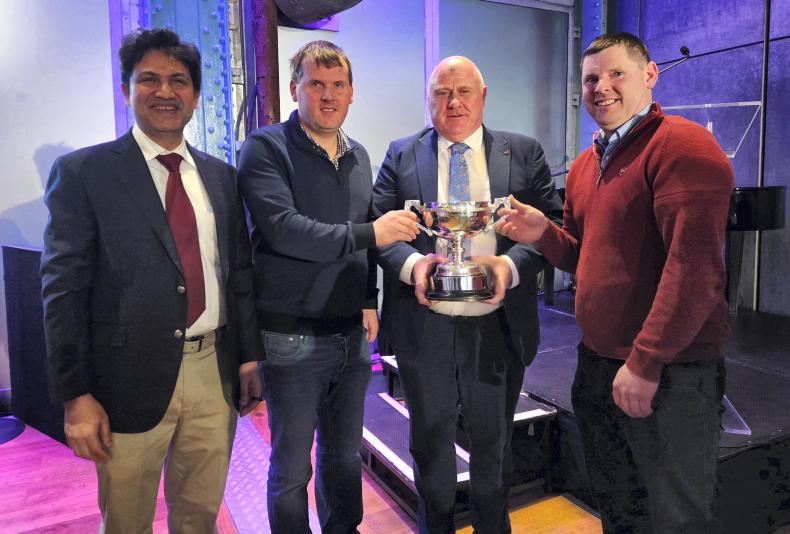
CBV Awards presented in Liffey Meats, Ballyjamesduff, County Cavan. Pictured from left: , Peter and Alice Stones (Clonfert, Ballinasloe, Co. Galway) E. \ Barry Cronin
Peter and Alice Stones are farming on the rented Garbally College farm, where the couple milk 150 cows as well as bringing over 200 cattle through to slaughter.
Fifty per cent of the dairy farm’s calves are finished on farm, with additional bulls, heifers and cull cows bought in as stores and finished indoors.
Two beef bulls are ran on farm; a Limousin bull sourced from the local Lisna herd, as well as a Hereford bull. Both bulls are performing exceptionally well, with Peter purchasing a purebred Limousin heifer to cross on to the Limosuin stock bull to hold on to the genetics that are working so well for them.
‘’His progeny are grading well, with good fat scores to match on both our heifers and young bulls’’.
While a portion of young bulls were killed indoors at under 16 months this year, the majority of bulls get a second summer at grass before being housed in early autumn and finished indoors, with heifers also being housed early and killed between 18-20 months for the majority.
Heifers are slaughtered at 280-320kg carcase weight, with young bulls killing in to 340-350kg carcase weight and higher.
Ad lib whole milk feeding is followed up with concentrates and straw with high quality grass for the first summer.
For their first winter, young bulls are on a mix of grass silage, home grown maize silage, beet and meal, ensuring there is no lag on growth over the winter. Peter and Alice process their cattle through Liffey Meats in Ballyjamesduff.
Liffey Meats logo
Our final six winners to be featured in our ICBF Beef Quality Awards are our dairy farmer finishers; farmers who not alone are milking cows but are bringing some, if not all, their own beef through to slaughter, with some also purchasing in additional cattle.
Much like the suckler farmer finishers profiled two weeks ago, these farmers are able to make conscious decisions on their own farm surrounding the use of high DBI (dairy beef index) bulls to produce these high CBV cattle, with the results speaking for themselves.
While we have gone in to very specialised systems in Ireland, with farmers usually being solely dairy or beef, it’s refreshing to see this cohort of farms blending the best of both worlds and reaping the rewards for it.
Using ground away from the milking platform and concentrating on good nutrition and genetics is allowing these farmers to add value to their beef animals and their enterprise as a whole, while the blend of beef and dairy insulates farm profitability and cash flow, with one sector able to support the other where there is a downturn in price.
These awards are sponsored by ICBF, FBD and the participating processors.
Letterkenny, Co Donegal
Ryan McElhinny, Letterkenny, Co. Donegal
Farming outside Letterkenny town, the McElhinnys see all beef brought through to slaughter, with half of the 140-strong dairy herd being served to beef bulls, while Friesian bull calves are also finished on farm.
Nearly all beef animals are sired by Angus bulls, with Foyle supplying some of this Angus semen for use on the herd, with a Limousin stock bull used for sweeping.
A heat detection system was installed this year on farm – the plan being to use 100% AI next year.
Better quality bulls are brought through to slaughter at 16 months old indoors, with lighter bulls turned out on to grass for their second summer before bring brought indoors in September and slaughtered at roughly 20-22 months of age, with heifers treated in a similar manner.
Concentrates are introduced at grass prior to housing, with cattle then housed and fed 5kg/head/day before gradually building the bulls up to 9kg/head/day, with heifers maintained at 5kg.
CBV is something that Ryan is looking at more, with carcase weight, conformation and days to slaughter being important factors when selecting AI sires, without compromising on calving ease.
“We would select bulls for individual cows. If we thought a bigger cow would be ok calving wise with a slightly harder calving bull, then we would go down that route, looking at all those beef traits and CBV at the same time.’’ Ryan processes all cattle through Foyle Foods.
foyle food group logo
Walter and
Caroline Murphy
Carrick on Suir,
Co Waterford
Beef Quality Awards at Dawn Meats. Pictured are award winners Walter Murphy and his daughter Caroline from Carrick on Suir. \ Patrick Browne
A father and daughter partnership, they milk 140 cows on their 300ac farm along with finishing over 200 cattle. The family have been dairy farming since the 1800s and a beef finishing system has run hand in hand with it.
All their own stock are finished as well as 80 continental heifers which are bought in Cahersiveen, Dungarvan and Kilkenny marts. These are bought from July to September and graze on after grass on the silage ground until they are housed in the middle of October.
They have a preference for continentals as they want better grades and higher carcase weights. All cattle grade R and a 340kg to 350kg is the target carcase weight for heifers at 24 to 26 months of age.
About 40 of their oldest bull calves are finished in an U16 month bull system and they averaged 325kg carcase weight this year. They are confident of having a higher average of 340kg next year as the calves are 40kg heavier at housing than the 2024 crop. The lighter bulls are finished at 24 months bulls and get a second season at grass.
Sexed semen used on their heifers for replacements meaning nearly all cows get a beef straw. Belgian Blue AI is used on most of the cows with a few Aubrac straws used too and a Limousin bull to clean up after AI.
The average CBV of their dairy-cross heifers is €238 while for their own bred bulls it’s €271 and €398 for the suckler beef heifers they buy.
They used to finish more cattle before but dropped numbers when the nitrates derogation stocking rate dropped to 220kg N/ha. All cattle are processed through Dawn Meats.
Dawn Meats logo
Stradbally, Co Waterford
Larurence, Emmet, John and Darragh Walsh, Stradbally, Co Waterford.
Laurence along with his wife, Áine and their children, Darragh, Emmet and Breffní and Laurence’s brother, John, farm 280ac, of which 100ac is on a long-term lease.
The Walsh’s got into dairy four years ago and are milking 90 spring-calving cows and still have 25 autumn-calving sucklers. They finish all their own stock and buy in some calves too.
To reduce the amount of bull calves they have been using sexed semen. They use Belgian Blue, Hereford and Charolais AI on the dairy cows for a month with a Limousin bull to clean up after.
The forward bull calves are castrated and the younger ones are left as bulls.
They target a carcase weight of 340kg to 350kg at 18 to 20 months of age for the dairy bulls and 400kg at U16 months for the suckler stock.
For dairy-beef heifers they aim for 300kg at two years of age and aim for a heavier carcase weight for steers.
The suckler bulls grade U with the heifers all R while most of the dairy stock would be O= and O+.
The average CBV of their dairy-beef heifers is €156 and €201 for the bulls.
Their suckler heifers averaged €298 and bulls €337. Life is busy away from the farm for the Walsh’s.
Áine runs a boarding kennels and the family is heavily involved in hurling, hockey, camogie and ponies and Laurence says the help he gets from John and his other brothers plays a big part in having the farm at the scale it’s at. Cattle are processed through Kepak.
Kepak logo
Enniscorthy, Co Wexford
Kevin Murphy, Enniscorthy, Co Wexford.
Kevin farms with his wife Ann and their children, Alice, Kevin, Edmund, John and Aidan and is also helped by his nephew, Ciaran.
Operating on 220ac with two thirds of it owned, they milk 112 cows and they try to finish most of their own cattle with an odd few sold from time to time.
Calving begins at the end of January and runs to the middle of April.
He mainly uses Belgian Blue, Charolais and Simmental AI on the cows and a Limousin bull to tidy up most years but ran an Angus this year.
The bulls from Progressive Genetics that he used this year were BB9535, BB8496, BB9786, BB8283, BB9103, CH6490 and SI2152.
The average CBV for the dairy-cross stock is €266 for heifers and €268 for bulls.
From the middle of April, the oldest calves go out to grass and in their second year they get out in early March or the middle of February depending on ground conditions.
Bulls go out to grass last and are kept out until October before being brought onto slats with rubber mats for a final finishing period.
He aims to have heifers finished at between 22 to 26 months of age with a target carcase weight of 340kg.
The earliest-born bull calves are left as bulls and later ones castrated.
He targets a 360kg carcase from those in a 24-month-old bull system as he gets a better carcase weight from a mature bull.
Most of the cattle grade R with some of the Belgian Blue crosses grading U.
All cattle are processed through APB.
ABP logo
Nenagh, Co Tipperary
Michael Hogan, Neenagh, Co. Tipperary
Doing the simple things right is working well for Michael Hogan on his mixed dairy and beef farm. All dairy bulls and beef calves are brought through to slaughter on farm, with a combination of quality grass, high quality silage and minimal concentrates used. High DBI stockbulls are used, with one bull carrying a carcase figure of 16.7kg, well above the breed average of 6.25kg. Calves are fed 1-1.5kg concentrates/head post weaning until mid-summer with a grass-only diet after this until just before housing, where 1kg concentrates/head is reintroduced to transition weanlings pre housing. This year, 50 weanlings are grazing kale, with concentrates front loaded to the start of winter before weaning off post turnout the following spring, with the target being to get yearlings out to grass in early March.
Again, good quality grass is the key to achieving cheap gain on the Hogan farm in their second summer, with cattle then slaughtered off a mix of silage and concentrates indoors at 22-24 months. Harvesting the silage themselves with a wagon, Michael believes the longer chop length is better for rumen function, while having his own means of harvesting silage allows greater flexibility around harvesting time.
Some later born or lighter animals are turned out to grass for their third summer, with these slaughtered at under 30 months off grass and 3kg of concentrates. Hereford stock bulls are used on farm for beef breeding, with Michael noting that a high growth rate in a bull’s progeny is key to achieving performance, marrying this with conformation and calving ease. Michael processes his cattle through Ashbourne Meats.
Ashbourne meats logo
Clonfert, Ballinasloe,
Co Galway
CBV Awards presented in Liffey Meats, Ballyjamesduff, County Cavan. Pictured from left: , Peter and Alice Stones (Clonfert, Ballinasloe, Co. Galway) E. \ Barry Cronin
Peter and Alice Stones are farming on the rented Garbally College farm, where the couple milk 150 cows as well as bringing over 200 cattle through to slaughter.
Fifty per cent of the dairy farm’s calves are finished on farm, with additional bulls, heifers and cull cows bought in as stores and finished indoors.
Two beef bulls are ran on farm; a Limousin bull sourced from the local Lisna herd, as well as a Hereford bull. Both bulls are performing exceptionally well, with Peter purchasing a purebred Limousin heifer to cross on to the Limosuin stock bull to hold on to the genetics that are working so well for them.
‘’His progeny are grading well, with good fat scores to match on both our heifers and young bulls’’.
While a portion of young bulls were killed indoors at under 16 months this year, the majority of bulls get a second summer at grass before being housed in early autumn and finished indoors, with heifers also being housed early and killed between 18-20 months for the majority.
Heifers are slaughtered at 280-320kg carcase weight, with young bulls killing in to 340-350kg carcase weight and higher.
Ad lib whole milk feeding is followed up with concentrates and straw with high quality grass for the first summer.
For their first winter, young bulls are on a mix of grass silage, home grown maize silage, beet and meal, ensuring there is no lag on growth over the winter. Peter and Alice process their cattle through Liffey Meats in Ballyjamesduff.
Liffey Meats logo








SHARING OPTIONS