


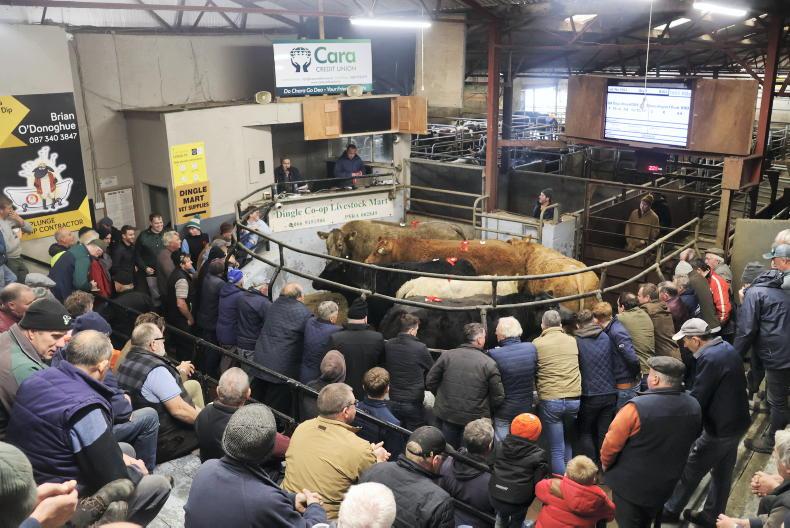
The last 12 months will go down as one of the best ever for selling weanlings in the last few decades.
It was a perfect storm for prices, with Irish weanling producers benefiting from a number of external factors driving the trade during much of 2025.
One of these was the bluetongue outbreak across Europe.
Movement restrictions across much of Europe in bluetongue-affected countries meant that customers couldn’t source from their usual supply routes.
Ireland was the only country deemed bluetongue-free, so that meant that some of those customers chose Ireland as their destination to purchase weanlings.
A reduction in the number of weanlings for sale across Europe also meant that top-quality weanlings were in short supply.
Speaking to a number of Italian feedlot owners on a visit to Ireland earlier in 2025, they expressed concerns that buying top-quality U grading weanlings wasn’t as easy as it once was, with a general move away from high-quality stock across much of Europe.
This reduction in numbers has meant there has been more customers for the top-quality calves, with some exceptional prices being paid in marts during much of the autumn to secure the best calves in sales.
Mart managers are reporting that the big money being paid for high-end weanlings has placed a renewed focus on quality, with a lot of farmers reducing the number of cows they have on the farm in the last two years, but have increased the quality of cows that they are working with.
Weanling exports
Weanling exports in 2025 will finish up about 30% behind the 2024 figure.
It has to be noted that 2024 was an exceptional year for weanling exports, up 70% that year to bring the total number of weanlings exported in 2024 to 65,715.
The last 12 months has seen that figure drop by 18,570 weanlings to 47,145 head in 2025.
Italy and Spain remain the big destinations for Irish weanlings, with exports to third countries back in 2025.
Store cattle exports also took a dip on the back of increased prices. There was 37,024 store cattle exported over the last 12 months, back 13,512 head on the previous two months.
Much of this was driven by lower numbers being exported to Northern Ireland, with 9,992 fewer head exported there over the last 12 months.
Finished cattle exports were also back, with 15,737 fewer head exported in 2025.
The previous 12 months had seen finished cattle exports reach 56,533 head.
The stock category that recorded a growth in exports in 2025 was calf exports, with a massive 223,307 head exported in 2025.
The Netherlands, which continues to be one of Ireland’s largest markets for calves, took 85,426 calves over the last 12 months, an increase of 6,679 calves on the previous 12 months.
Poland and Spain were also very important markets for Irish calves in 2025. Table 1 outlines the export figures for the past two years.
Top third v bottom third
For our weekly Martbids analysis, we split all our stock categories into bottom third, average and top third in terms of prices and quality.
As with previous years, there is a large gap between top-quality weanlings and bottom-quality weanlings.
This gap wasn’t always as pronounced as it has been in the last two years.
If we take a look at the Aberdeen Angus 300kg to 400kg bull weanling category, the top third came in at €5.06/kg, while the bottom third came in at €3.42/kg – a difference of €1.64/kg of €574/head.
There was an even bigger spread in the Charolais bull weanling section.
The top third here came in at €5.93/kg, while the bottom third came in at €4.07/kg, a difference of €1.86/kg or €650/head.
If a farmer with 20 sucklers was breeding top-quality Charolais weanlings as opposed to lower-quality weanlings, it would mean an extra €13,000 in weanling sales from the 20-cow herd.
Moving to lighter weanling in the Limousin breed, we see that quality had an even bigger effect on price.
Top-quality Limousin weanlings in the 200kg to 300kg weight bracket came in at €6.57/kg, as opposed to €4.28/kg for the bottom third, a difference of €2.29/kg or €572/head.
2025 v 2024 prices
Comparing prices with 2024, weanlings were up well over €2/kg across most stock categories.
In the weanling heifer 200kg to 300kg category, it was the Belgian Blue breed that claimed top spot, with top-quality 200kg to 300kg Belgian Blue heifers coming in at an average price of €6.13/kg in 2025, up from €4.12/kg in 2024 or €502/head.
The Charolais breed took the top spot in the 300kg to 400kg bull weanling category.
Top-quality bull Charolais bull weanlings came in at €6.45/kg, up €2.55/kg on the 2024 price.
That means a top-quality 300kg to 400kg Charolais weanling came in at an average price of €2,257/head, up €892/head on the 2024 price.
Belgian Blue bulls in the 300kg to 400kg weight category came in at €6.35/kg, while Limosuin bulls in the same weight bracket came in at €6.13/kg.
Charolais, Belgian Blue and Limousin breeds took the top spots across all the weanling categories in 2025.
Top-quality Charolais weanling heifers were up €650 head in the last 12 months. To put that in context, the 2024 increase on 2023 was €62/head.
In the heavier weanling sections, it was again the Belgian Blues that dominated the top prices.
Heavy Belgian Blue heifers in the 400kg to 450kg weight bracket exceeded all expectations, coming in at €7.95/kg for 2025, an increase of €3.39/kg on the previous 12 months.
Five-year analysis
There has been a big increase in weanling values over the last five years.
Our Martbids analysis goes back to 2020 and we have compared the last five years in the weanling analysis tables.
One of the biggest increases in prices over the last five years has been the Belgian Blue breed, up over €3/kg in many cases and up by a massive €4.64/kg in the heavy weanling heifer category.
Top-quality Limousin bull weanlings in the 300kg to 400kg weight bracket are up €3/kg over the last five years, while Charolais weanlings are up €3.04/kg.
That equates to €1,050/head, with much of that increase taking place in the last 12 months.
Breed breakdown
Most breeds saw a steady 2025 in terms of market share with no big changes.
For the last number of years, it’s been a tight battle for top spot between the Charolais and Limousin breeds and it’s the Charolais breed that just shades it this year with 36.24% of the weanling market share following by the Limousins with 35.83%.
The Limousin and Charolais breeds dominate weanling sales, with both breeds accounting for over 70% of weanling sales.
The Belgian Blue breed declined slightly from 3.79% in 2024 to 3.36% in 2025.
The Aberdeen Angus breed continues to gain market share, increasing to 11.46% in 2025, up from 11.31% in 2024.
The Hereford breed remained steady at 4.84%, similar to the 2024 figure, with the Simmental breed losing some ground on the 2024 figure.
Figure 1 outlines the breed breakdown in terms of percentages in the 2025 weanling analysis.



SHARING OPTIONS