


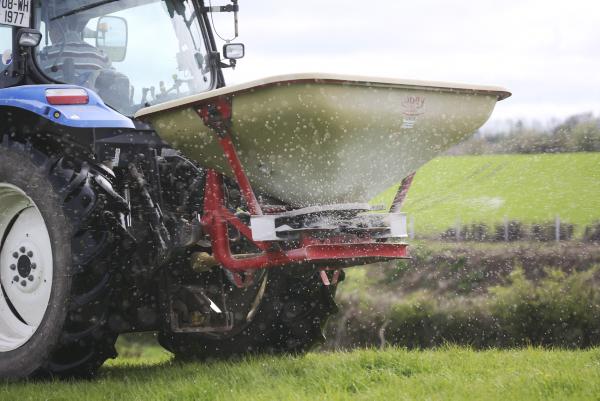
Fertilizer prices have come off the peaks seen in 2013, but global markets have rebounded in recent months. This makes fertilizer appear good value today as the outlook for prices is set to increase in the first six months of this year.
Data from the CSO shows that 2013 was a relatively flat year for fertilizer prices, with price ranges of about €10 to €20 per tonne across the main fertilizer products. The message remains to shop around and that competition for business should ensure that prices remain competitive. As always, paying up front and taking delivery of full loads will secure the best prices.
Nitrogen
CAN followed an almost identical price pattern to 2012 for the first 10 months of 2013, ranging from €324 to €336 a tonne, according to CSO data. The price dropped away in the summer months, leveling off in Q3 of 2013. During 2012, the price of Urea rose to start the 2013 season at a higher level. Urea remained relatively flat over the 2013 season, weakening only in quarter three and four.
Current wholesale prices in the trade suggest CAN will move to retail between €320 and €330/tonne, while granular Urea may move closer to €440/tonne by the end of February, reflecting the volatile market for this commodity. However, some deals on pre-Christmas urea were at prices below this level in the range €335/t to €350/t. More recent prices being quoted for urea are in the range €390-€420. Pre-Christmas deals on CAN were completed in the range €280-€295, with current quotes in the range €295-€320.
No cargos of prilled urea were imported as international markets were unwilling to discount prills, showing strength in the urea market. With 50% of urea still to come into the country, any urea already in appears good value. It is likely the lower prices for urea are now gone as international markets have moved on significantly, with upwards of $80 added to FOB cargos in recent weeks.
In the past eight weeks, the CIF-imported CAN price has moved €45 a tonne as Europe wakes up. Germany, one of the main users of CAN in Europe, has very little bought. International CAN prices have moved to €235 CIF, with importers reporting prices today for late Jan shipments of €255. Urea is also now in tighter supply due to issues in Algeria interacting and affecting the price of CAN.
Phosphorus
Phosphate rock is found in only five countries, with China, US and Morocco controlling almost 70%. DAP, the main source of P in compounds, moved lower during 2013 with international markets falling about $100/T over the year. However, in the past four weeks this drop has been diminished, with the price today moving upwards by at least $40. DAP is trading today at around $485 FOB, while late January prices are in the range of $495-$500 FOB.
Potash
Looking at the CSO graphs for the past two years, the most significant price difference can be found in potash. Since January 2012, prices have been stable and in the range €455 to €465. The opposite was the case in 2013, when potash prices fell almost €100/T during the year. This circled around the potash uncertainty on international markets as a result of the collapse of a major international trading cartel. Current muriate of potash (MOP) CIF prices are in the range €290-295 CIF, back around 10% on this time last year.
As P and K are the main ingredients used in 18-6-12 and 10-10-20, the prices of these moved in line with the fall in the global commodities in 2013. 10-10-20 fell more due to the higher percentage of potash in the blend, falling about €20 over the 10 months to end of October. 18-6-12 prices fell from €444 to €432 over 2013.
27-2.5-5 and 24-2.5-10 both saw much more volatile prices in 2013 compared to 2012. Price rises were seen in the first half of the year followed by a fall in the second half due to the high nitrogen content. The price range moved from lows of €430 to highs of €441 for 27s, again emphasising the need to get timing of fertilizer purchase right.
Market hits 1.5 million tonnes
Overall, fertilizer tonnage sold to retailers by Irish wholesalers was up by about 20% in 2013 to 1.5 million tonnes according to Department of Agriculture figures – a height not seen since 2004. This reverses the trend of the past 10 years, where almost 200,000 tonnes vanished from the sector. The main reasons for the decline include restrictions on spreading due to environmental schemes, nitrates directive and the high prices of the commodity bubble in 2008/2009.
Some of the reported increases this year may be related to importation of fertilizers from Northern Ireland. Import statistics into the country show a similar, if somewhat lower increase of 15%. The fodder crisis increased fertilizer application as grass needed to be pushed to fill silage pits for the winter. With a significant proportion of grassland in indices 1 and 2 for P and K, there is also ongoing necessary P and K investment happening on farms.




SHARING OPTIONS