The Community Sports Hall in Ballinamore, Co Leitrim was transformed by over 200 projects for STEMtacular on 26 and 27 February.
Powered by Analog Devices, the event was founded by Leitrim secondary science teacher Louise Gallagher, who recognised the importance of engaging children in STEM from an early age, particularly in rural communities where agriculture, engineering and environmental science intersect daily.
Across both days, judges from industry, agricultural education and science travelled from all over Ireland to engage directly with the primary school students.
“Ballinamore became a showcase for innovation rooted in rural life. From calving shed safety improvements to hydroponic systems for future food production, the projects on display demonstrated that the next generation of farmers and agricultural scientists are already thinking critically about safety, sustainability and efficiency,” explains Louise.
She believes agricultural innovation in Ireland has 'a bright future' grounded in practical experience and strengthened by scientific thinking.
While the event celebrated Science, Technology, Engineering and Maths, agriculture featured prominently, with practical farm-based investigations sitting alongside sustainability and food production research.
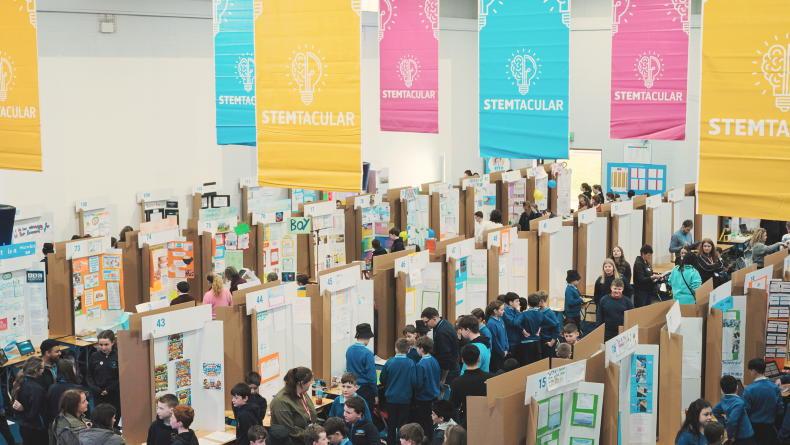
Over 1,000 students attended STEMtacular.
Agricultural innovation
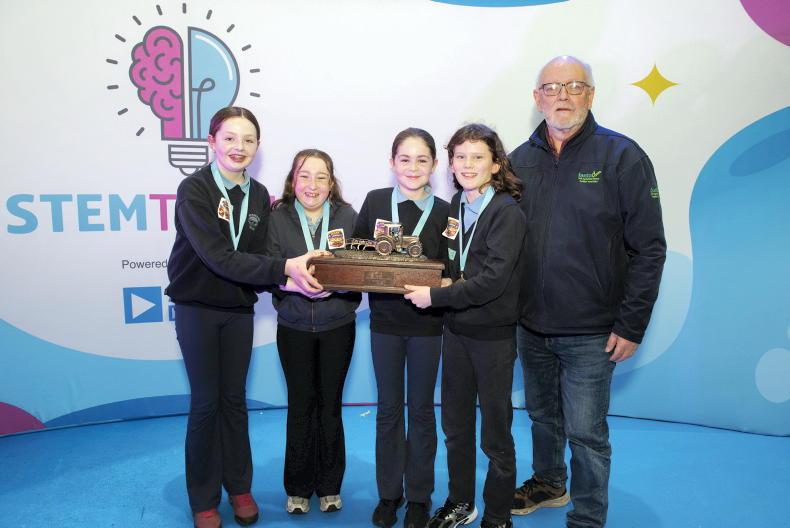
The Irish Agricultural Science Teachers’ Association (IASTA) Award on Wednesday went to students from Saint Hugh’s National School, Dowra, Co Leitrim for their investigation into how astronauts could grow food on Mars.
The team built a working hydroponics system and tested a range of crops, including leafy vegetables such as lettuce and spinach, flowering plants like French beans and root vegetables such as carrots.
Their results showed that leafy and flowering crops grew successfully within the hydroponic system, while root crops struggled.
The students also researched the nutritional value of each plant, identifying key vitamins including A, C and K – essential nutrients for maintaining human health in challenging environments. The group’s findings suggested that hydroponic growing systems could play a critical role in sustaining future space exploration.
While the setting was interplanetary, the science behind the project has direct relevance to modern agriculture, particularly as farmers explore controlled-environment growing systems and resource-efficient food production.
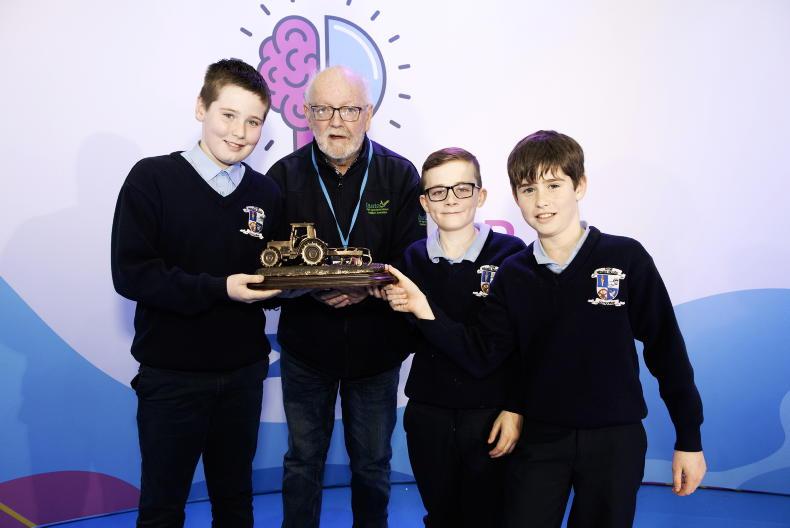
John Simms with IASTA presents the award to Harry McHugh, Dallan Smith and Thomas Tully from Scoil Mhuire Naofa, Carrigallen.
Farm safety
On Thursday, the Irish Agricultural Science Teachers’ Association Award was presented to Harry McHugh, Dallan Smith and Thomas Tully from Scoil Mhuire Naofa, Carrigallen, Co Leitrim for their project ‘Farm Safety: From Calving Gates to Calving Gear.’
Coming from farming backgrounds, the students identified a safety concern with the traditional calving gate system.
In many sheds, a chain bolted to the wall is attached behind the cow during calving. If the cow lies down unexpectedly, the chain can pose a serious risk potentially injuring the calf or creating a hazard for the farmer if a calving jack becomes caught.
The students designed a bracket system allowing a chain to be safely positioned over the cow’s back, between the pin bones and tail, removing the risk posed by the traditional chain placement.
They also developed practical additions including a crush platform, a latch for securing gates in an open position, a girder-mounted holder for calving jacks and tools, and a mounted shelf for essential calving supplies such as iodine, ropes and feeding equipment.
Judges described the project as “an outstanding example of applied agricultural science – combining lived farming experience with mechanical problem-solving to deliver a safety improvement with immediate real-world impact”.
Louise Gallagher says these projects reflected growing awareness among young people of sustainability challenges facing Irish agriculture.
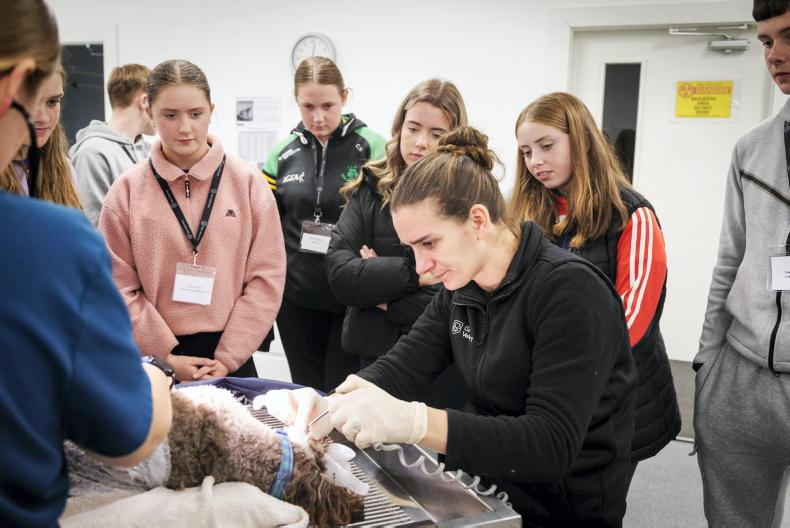
“The Discovery Zone reinforced the farming connection. Students engaged in a hands-on simulation demonstrating how to safely inject a cow, highlighting the science and precision involved in modern livestock care.
“Renewable energy and water monitoring have further demonstrated how technology and agriculture are increasingly intertwined,” Louise explains.

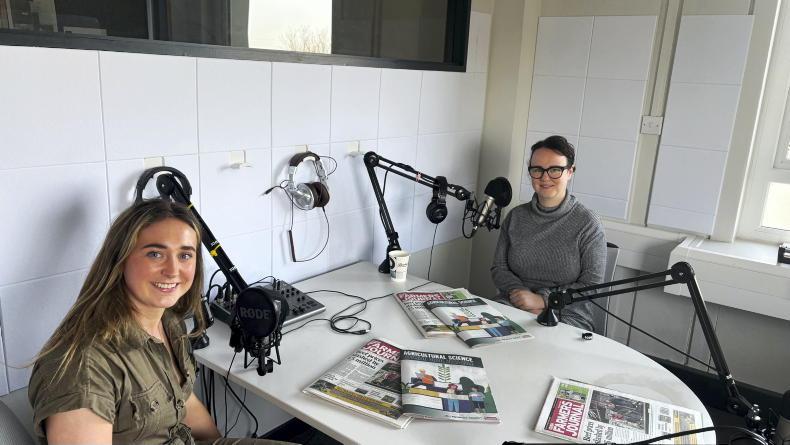
Louise Gallagher, Science teacher and founder of STEMtacular.
The Community Sports Hall in Ballinamore, Co Leitrim was transformed by over 200 projects for STEMtacular on 26 and 27 February.
Powered by Analog Devices, the event was founded by Leitrim secondary science teacher Louise Gallagher, who recognised the importance of engaging children in STEM from an early age, particularly in rural communities where agriculture, engineering and environmental science intersect daily.
Across both days, judges from industry, agricultural education and science travelled from all over Ireland to engage directly with the primary school students.
“Ballinamore became a showcase for innovation rooted in rural life. From calving shed safety improvements to hydroponic systems for future food production, the projects on display demonstrated that the next generation of farmers and agricultural scientists are already thinking critically about safety, sustainability and efficiency,” explains Louise.
She believes agricultural innovation in Ireland has 'a bright future' grounded in practical experience and strengthened by scientific thinking.
While the event celebrated Science, Technology, Engineering and Maths, agriculture featured prominently, with practical farm-based investigations sitting alongside sustainability and food production research.
Over 1,000 students attended STEMtacular.
Agricultural innovation
The Irish Agricultural Science Teachers’ Association (IASTA) Award on Wednesday went to students from Saint Hugh’s National School, Dowra, Co Leitrim for their investigation into how astronauts could grow food on Mars.
The team built a working hydroponics system and tested a range of crops, including leafy vegetables such as lettuce and spinach, flowering plants like French beans and root vegetables such as carrots.
Their results showed that leafy and flowering crops grew successfully within the hydroponic system, while root crops struggled.
The students also researched the nutritional value of each plant, identifying key vitamins including A, C and K – essential nutrients for maintaining human health in challenging environments. The group’s findings suggested that hydroponic growing systems could play a critical role in sustaining future space exploration.
While the setting was interplanetary, the science behind the project has direct relevance to modern agriculture, particularly as farmers explore controlled-environment growing systems and resource-efficient food production.
John Simms with IASTA presents the award to Harry McHugh, Dallan Smith and Thomas Tully from Scoil Mhuire Naofa, Carrigallen.
Farm safety
On Thursday, the Irish Agricultural Science Teachers’ Association Award was presented to Harry McHugh, Dallan Smith and Thomas Tully from Scoil Mhuire Naofa, Carrigallen, Co Leitrim for their project ‘Farm Safety: From Calving Gates to Calving Gear.’
Coming from farming backgrounds, the students identified a safety concern with the traditional calving gate system.
In many sheds, a chain bolted to the wall is attached behind the cow during calving. If the cow lies down unexpectedly, the chain can pose a serious risk potentially injuring the calf or creating a hazard for the farmer if a calving jack becomes caught.
The students designed a bracket system allowing a chain to be safely positioned over the cow’s back, between the pin bones and tail, removing the risk posed by the traditional chain placement.
They also developed practical additions including a crush platform, a latch for securing gates in an open position, a girder-mounted holder for calving jacks and tools, and a mounted shelf for essential calving supplies such as iodine, ropes and feeding equipment.
Judges described the project as “an outstanding example of applied agricultural science – combining lived farming experience with mechanical problem-solving to deliver a safety improvement with immediate real-world impact”.
Louise Gallagher says these projects reflected growing awareness among young people of sustainability challenges facing Irish agriculture.
“The Discovery Zone reinforced the farming connection. Students engaged in a hands-on simulation demonstrating how to safely inject a cow, highlighting the science and precision involved in modern livestock care.
“Renewable energy and water monitoring have further demonstrated how technology and agriculture are increasingly intertwined,” Louise explains.
Louise Gallagher, Science teacher and founder of STEMtacular.





SHARING OPTIONS