Grazing: I think its fair to say that for the majority of farmers who would classify themselves as “early grazers”, a plan B is needed for 2026. The target to have 30% grazed in February will have been missed by the majority of farmers.
With more rain forecast over the coming days, feelings of disillusionment are beginning to set in.
However, the long range forecast is looking better and high pressure is forecast for the early part of March. I firmly believe that if March weather comes somewhat normal, then this spring won’t be near as bad as it’s looking right now. That being said, a new plan is needed based on percentage grazed. Because so little of farms has been grazed to date, the recovery time between what will be grazed first and when it needs to be grazed again will be less than normal. This means that the second rotation may have to be delayed to allow this area longer to recover.
One of the big problems with delaying the start of grazing until March is that if growth is good in early April, covers can get out of hand. As a result, farmers will have no choice but to close the highest covers for silage. This means that the area available for grazing in April gets smaller, quicker. As April growth rates are so variable, this means a grass deficit in the second round is often inevitable. A good target is to get one third grazed by 17 March, one third grazed by end of March and the last third grazed by 10 to 15 April.
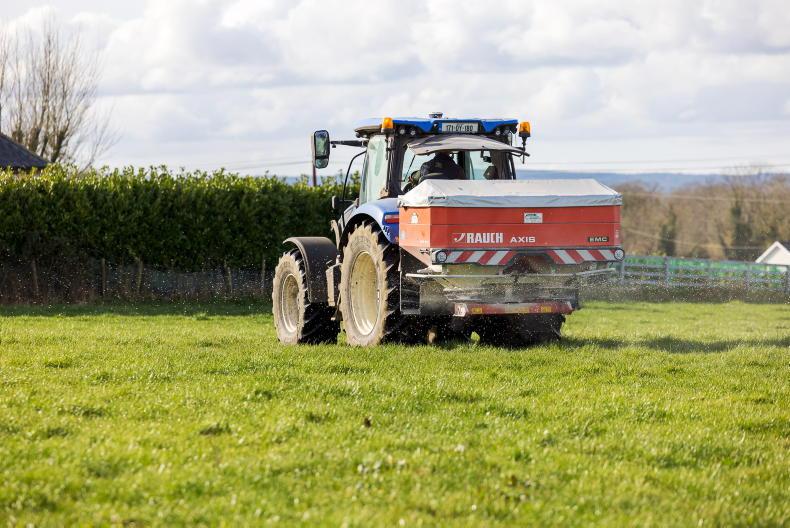
Fertiliser: if the weather does indeed dry up a bit next week, the first thought should be to get cows out grazing and the second thought should be to get fertiliser and slurry applied. On fertiliser, I think that more N should be applied in the first application than usual, given that it’s almost one month later than normal.
Typically, the advice is to go with 23 units/acre in early February and around 40 units/acre in March. This year, I think two applications of 30 units/acre at the start and end of March is best policy. Of course, this is only required where there is a demand for grass, and any farm stocked over two cows/hectare has a high demand for grass in spring.
Avoid any wet spots or poor performing fields where the response will be low anyway. Fields that have recently been spread with slurry need not be spread with fertiliser now. There is about nine units of N in every 1,000 gallons of slurry.
Bluetongue: Daire Cregg has a good explainer of bluetongue on pages 30 and 31. The key message around vaccinating is that there is still plenty of time to make your mind up on it. The high-risk time for bluetongue is late summer.
That is when most of the midge activity takes place and when animals presented clinical signs on affected farms in the continent. Essentially, it means that decisions around whether a herd should vaccinate can be delayed until later in the year.
There is some talk about it being better to vaccinate prior to breeding, but that’s a discussion for a vet. Remember, two shots are needed for the first time a herd is vaccinated with one annual booster thereafter.
Grazing: I think its fair to say that for the majority of farmers who would classify themselves as “early grazers”, a plan B is needed for 2026. The target to have 30% grazed in February will have been missed by the majority of farmers.
With more rain forecast over the coming days, feelings of disillusionment are beginning to set in.
However, the long range forecast is looking better and high pressure is forecast for the early part of March. I firmly believe that if March weather comes somewhat normal, then this spring won’t be near as bad as it’s looking right now. That being said, a new plan is needed based on percentage grazed. Because so little of farms has been grazed to date, the recovery time between what will be grazed first and when it needs to be grazed again will be less than normal. This means that the second rotation may have to be delayed to allow this area longer to recover.
One of the big problems with delaying the start of grazing until March is that if growth is good in early April, covers can get out of hand. As a result, farmers will have no choice but to close the highest covers for silage. This means that the area available for grazing in April gets smaller, quicker. As April growth rates are so variable, this means a grass deficit in the second round is often inevitable. A good target is to get one third grazed by 17 March, one third grazed by end of March and the last third grazed by 10 to 15 April.
Fertiliser: if the weather does indeed dry up a bit next week, the first thought should be to get cows out grazing and the second thought should be to get fertiliser and slurry applied. On fertiliser, I think that more N should be applied in the first application than usual, given that it’s almost one month later than normal.
Typically, the advice is to go with 23 units/acre in early February and around 40 units/acre in March. This year, I think two applications of 30 units/acre at the start and end of March is best policy. Of course, this is only required where there is a demand for grass, and any farm stocked over two cows/hectare has a high demand for grass in spring.
Avoid any wet spots or poor performing fields where the response will be low anyway. Fields that have recently been spread with slurry need not be spread with fertiliser now. There is about nine units of N in every 1,000 gallons of slurry.
Bluetongue: Daire Cregg has a good explainer of bluetongue on pages 30 and 31. The key message around vaccinating is that there is still plenty of time to make your mind up on it. The high-risk time for bluetongue is late summer.
That is when most of the midge activity takes place and when animals presented clinical signs on affected farms in the continent. Essentially, it means that decisions around whether a herd should vaccinate can be delayed until later in the year.
There is some talk about it being better to vaccinate prior to breeding, but that’s a discussion for a vet. Remember, two shots are needed for the first time a herd is vaccinated with one annual booster thereafter.







SHARING OPTIONS