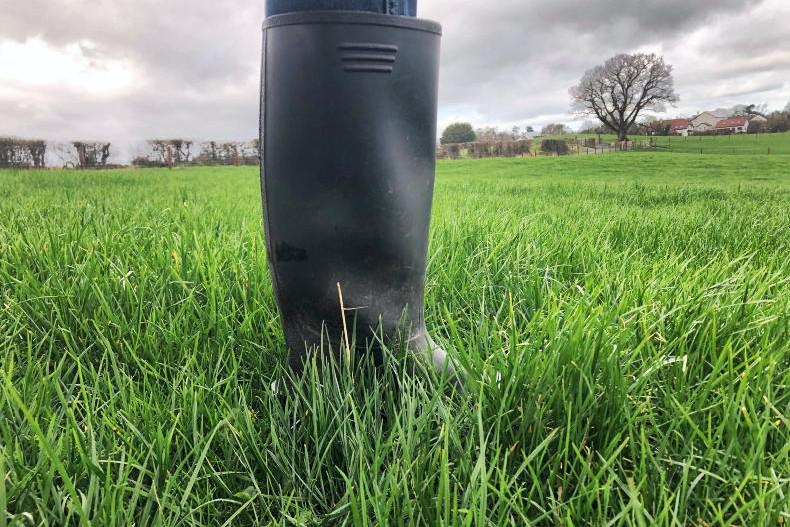
Feeding rates: the next four weeks are critical from a grassland management point of view. With calving gone very compact, many herds that started calving in early February have over 80% calved and are heading towards 90% calved.
Herd demand – how much cows are eating each day – is like a train building up power and speed. For the majority of farmers that are well behind target in terms of percentage grazed and have plenty of grass, the priority is to keep grazing away and let the train build up speed.
But for those who have a nice bit grazed, over 40%, and the farm cover is down around 800kg DM/ha, then they may need to start pulling a few levers to slow down the train.
The end of the line for these farmers is between 1 April and 5 April, with an average farm cover of 550kg DM/ha or thereabouts. If they arrive at that cover too quickly, it will take a serious amount of feeding to keep the herd on track. Think of silage as being a bit like dirty diesel. The train will chug along but it will lose power and speed and it will take a long time to recover.
By putting in a bit of silage now, it might be sufficient to keep the herd on track and hit the target cover in early April. Of course, better again if no silage has to be fed at all – but if it does, it’s better to do this now rather than at the end of March. Finally, make sure that cleanouts are being met where ground conditions allow. All of the grass plant is highly digestible at this time of year so there is no excuse for not grazing down very tight provided ground conditions are good enough.
Breeding: this week’s focus is on spring AI, with the active bull list published on page 44. The list isn’t as valuable as it once was because there are young bulls that have high EBI but that aren’t on the list because they haven’t got a calving proof or, in some cases, they also don’t have field fertility data. However, they are generally higher EBI than the bulls on the list because they are younger.
For me, the key thing is to ensure that whatever bull team is chosen that genetic progress is being made. The starting point should then be to print off the first sheet of the EBI report for the herd and ensure that each bull delivers progress in all of the key areas.
A word of warning on the milk kilo value. Most herds now find themselves with a negative PD for milk but this is not a concern as even bulls and herds with -200kg of milk will deliver over 6,000kg of milk per year.
Bluetongue: there is a lot of interest in the bluetongue vaccine for breeding stock. Two doses need to be given three weeks apart and full protection takes about four weeks to develop after the second shot is given.
There are mixed views on it, but the general advice is that the vaccine offers good protection against BTV 3, which is the strain that has been detected in Ireland so far. Other strains have been detected in Britain but BTV is by far the most common. Many farmers are hoping to finish the vaccination programme a few weeks before breeding starts.
Feeding rates: the next four weeks are critical from a grassland management point of view. With calving gone very compact, many herds that started calving in early February have over 80% calved and are heading towards 90% calved.
Herd demand – how much cows are eating each day – is like a train building up power and speed. For the majority of farmers that are well behind target in terms of percentage grazed and have plenty of grass, the priority is to keep grazing away and let the train build up speed.
But for those who have a nice bit grazed, over 40%, and the farm cover is down around 800kg DM/ha, then they may need to start pulling a few levers to slow down the train.
The end of the line for these farmers is between 1 April and 5 April, with an average farm cover of 550kg DM/ha or thereabouts. If they arrive at that cover too quickly, it will take a serious amount of feeding to keep the herd on track. Think of silage as being a bit like dirty diesel. The train will chug along but it will lose power and speed and it will take a long time to recover.
By putting in a bit of silage now, it might be sufficient to keep the herd on track and hit the target cover in early April. Of course, better again if no silage has to be fed at all – but if it does, it’s better to do this now rather than at the end of March. Finally, make sure that cleanouts are being met where ground conditions allow. All of the grass plant is highly digestible at this time of year so there is no excuse for not grazing down very tight provided ground conditions are good enough.
Breeding: this week’s focus is on spring AI, with the active bull list published on page 44. The list isn’t as valuable as it once was because there are young bulls that have high EBI but that aren’t on the list because they haven’t got a calving proof or, in some cases, they also don’t have field fertility data. However, they are generally higher EBI than the bulls on the list because they are younger.
For me, the key thing is to ensure that whatever bull team is chosen that genetic progress is being made. The starting point should then be to print off the first sheet of the EBI report for the herd and ensure that each bull delivers progress in all of the key areas.
A word of warning on the milk kilo value. Most herds now find themselves with a negative PD for milk but this is not a concern as even bulls and herds with -200kg of milk will deliver over 6,000kg of milk per year.
Bluetongue: there is a lot of interest in the bluetongue vaccine for breeding stock. Two doses need to be given three weeks apart and full protection takes about four weeks to develop after the second shot is given.
There are mixed views on it, but the general advice is that the vaccine offers good protection against BTV 3, which is the strain that has been detected in Ireland so far. Other strains have been detected in Britain but BTV is by far the most common. Many farmers are hoping to finish the vaccination programme a few weeks before breeding starts.






SHARING OPTIONS