


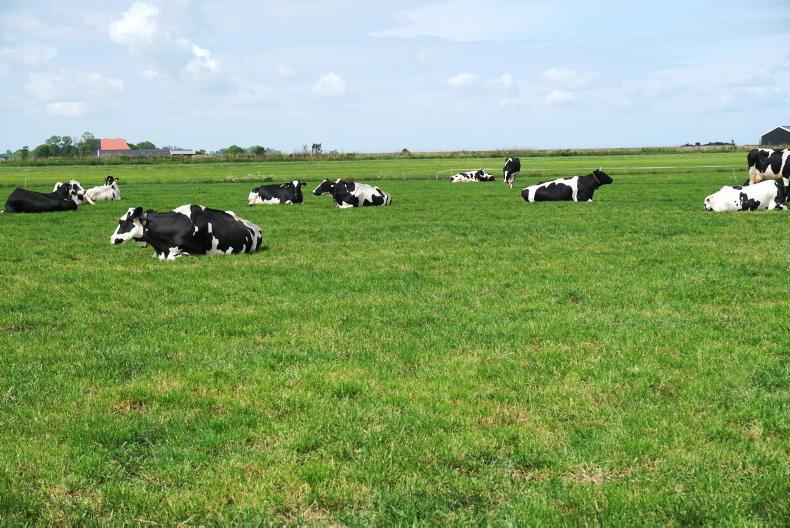
From 1 June this year, dairy farmers in the Netherlands will be given the opportunity to apply for a subsidy scheme aimed at reducing cow numbers.
In an effort to de-intensify emissions and reduce manure production, farmers who register for the scheme can choose to keep 10% to 20% fewer cows compared to 2025.
The annual compensation for income loss amounts to €1,606 per cow and will be based on the milk yield of the average cow.
As well as reducing the cow numbers, farmers will also have to surrender the phosphate rights attached to that cow.
In the Netherlands, phosphate rights are similar to “quota” in that a farmer must have enough phosphate rights per animal to produce milk. These rights can be purchased or sold and have been worth upwards of €200 per kilo or per right in recent years.
Dutch cows produce an average of 45kg phosphate/year, meaning a farmer could be giving up the value of €9,000/cow in rights.
Compensation
The compensation for surrendering a phosphate right is €110 per right or €4,500/cow however, these phosphate rights would be permanently removed from the market.
Participation in the scheme requires that the area of grassland on the farm does not decrease over the three-year period and that the number of other grazing animals does not increase.
After three years, dairy farmers may choose to return to their original number of cows by purchasing or leasing new phosphate rights.
Additionally, farmers will be able to benefit from interest rate discounts at banks when making sustainable investments for their businesses.
A total of €627m has been made available for the scheme, the Netherlands Ministry of Agriculture, Fisheries, Food Security and Nature has announced.
It will open on 1 June 2026 and close on 29 July 2026, according to Dutch media.



SHARING OPTIONS