The torrential rainfall experienced in recent weeks is hitting at a challenging time for mid-season lambing flocks who are in the thick of breeding, with ground conditions deteriorating and grass utilisation suffering.
This is apparent on Tullamore Farm, with ewes coming towards the end of their second breeding cycle and ewe lambs coming towards the end of their first breeding cycle.
Drier areas of the farm are holding up better but are still under pressure following over two and a half inches of rainfall in recent weeks.
The problem is that the availability of such areas of drier ground is reducing, as these are typically the areas being grazed first and closed and targeted for early grazing next spring.
Heavier areas of the farm have come under considerable pressure this week, with water lying on the surface of the ground.
Farm manager Shaun Diver says the focus is now to try and achieve the best balance between grazing out swards satisfactorily and ensuring the intake of ewes is not overly restricted at a critical stage in breeding/early gestation.
Temporary electric fencing is being used to good effect in this regard to reduce residency times in smaller areas and be able to move sheep to fresh grass more often.
Forage rye
The farm is this year experimenting with forage rye. The area of ground sown in tillage increased in 2025, with approximately 10 acres of spring barley and three acres of wholecrop silage sown.
This has delivered an opportunity to still follow wholecrop silage with a forage rape brassica crop to graze a portion of weanling heifers while forage rye was sown after spring barley.
Forage rye is best described as a cover or catch crop, and is often sown after maize due to its suitability to late sowing. It’s deep and extensive rooting system is seen as highly beneficial for conditioning soil, with the crop capable of trapping available nutrients in the soil and reducing nitrogen leaching over the winter.
It has a high yield capacity of high-energy forage and is suitable for early spring grazing. Shaun is looking at the possibility of using it to lamb twin bearing Easycare ewes outdoors next March before closing up for a cut of silage and then returning this area back to grass.
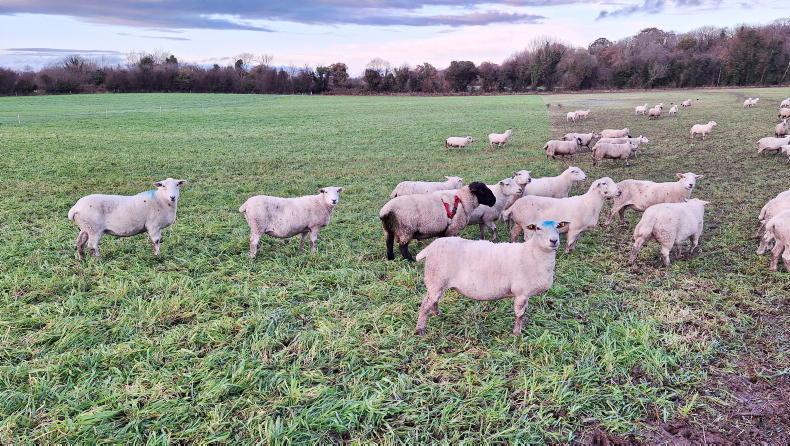
A batch of 95 ewes and two rams started grazing the crop at the end of last week. The crop is essentially a cereal crop, and ewes transitioned easily from grass and grazed the first allocation excellently.
The second allocation was more challenging due to heavy rain and the fact it was lower lying, with pools of water lying on it on Tuesday.
As such, ewes were moved to a fresh allocation on Wednesday to prevent damaging the crop, with the grazed area back fenced to aid recovery in growth.
Some of the crop is starting to lodge under the weight of this week’s rain, but it is not expected to cause any issues with grazing.
Regular updates on how the crop is working will be featured over the coming months, including costs of incorporating, yield achieved etc.
Breeding activity
Getting back to breeding, Shaun says there has been very little repeat breeding activity in mature ewes, while breeding in ewe lambs appears to also be progressing swiftly in their first cycle.
Mature ewes were single sire mated for the first breeding cycle, meaning there were eight breeding groups in place.
Three batches which are now grazing the forage rye were joined together for the second cycle, with these ewes joined with a Suffolk and Texel ram.
In addition to raddling it will be possible to get a good handle on the sire of lambs born to such ewes at lambing.
The farm has achieved good success in breeding ewe lambs in recent years, and a big contributing factor is the weight of joining. The batch of 19 Texel x Mule-cross lambs weighed an average of 57kg on joining with rams, with the range in liveweight from 53kg to 61kg.
Sixteen of the 17 Suffolk-cross ewe lambs joined are Suffolk x Easycare cross which were also on par to the Texel-crosses at an average of 56kg liveweight. The weights also ranged mainly from 53kg to 61kg, with one ewe lamb weighing 51kg, while the single Suffolk x Mule-cross ewe lamb weighed 55kg.
Easycare ewes have a lower mature weight, and this is reflected in a lower liveweight in ewe lambs. The batch of 10 homebred Easycare ewe lambs averaged just over 48kg. The general run of weights were from 43kg to 45kg, with two outliers at 63kg and 67.5kg.
There was also a batch of 14 purchased Easycare ewe lambs and these averaged 42kg. Lambs weighed in the main from 41kg to 47kg, with two lighter lambs on the batch at 35kg and 38kg not joined to rams. Breeding in ewe lambs will be confined to two cycles to keep lambing compact with attention on the farm quickly turning to breeding in the suckler herd.
Lambs are currently being prioritised with access to good-quality grass, and the aim will be to retain these outdoors until early January. This will be dependent on weather and grass utilisation recovering.
Lamb finishing
There is a small batch of about 20 ewe lambs remaining on the farm. Many of these were ewe lambs born to yearling hoggets and have been allowed time to develop a frame before finishing. Concentrates will be introduced this week and built up to 0.8kg to 1kg per head in the coming weeks, with the aim of likely finishing them before the end of the year.
Weanling management
Bull weanlings are currently receiving ad lib access to high-quality grass and wholecrop silage and are also receiving 3kg concentrates daily. A finishing budget will be completed to inform a decision on whether to finish bulls in an under-16 month finishing system or to sell live.
Bulls were sold live in 2024 and exported. If sold it is likely that there will be a split in sale dates, with the best 17 or 18 bulls in the batch estimated to be weighing in the region of 370kg to 380kg while the remaining 10 bulls are weighing in the region of 300kg to 320kg. This was also the route taken with a larger batch of 2024-born bulls.
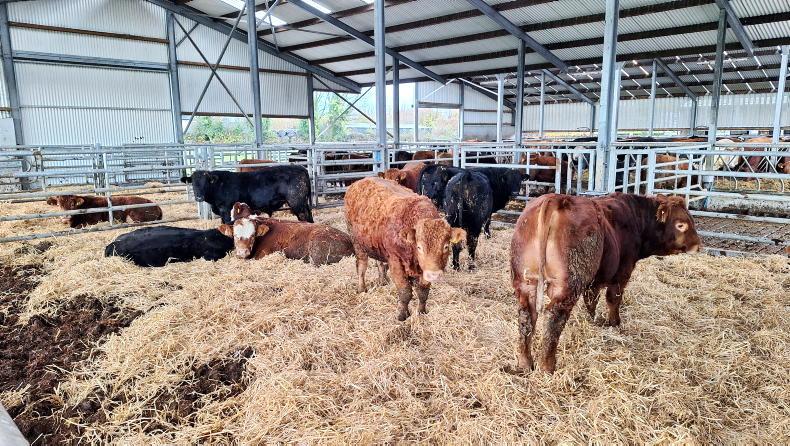
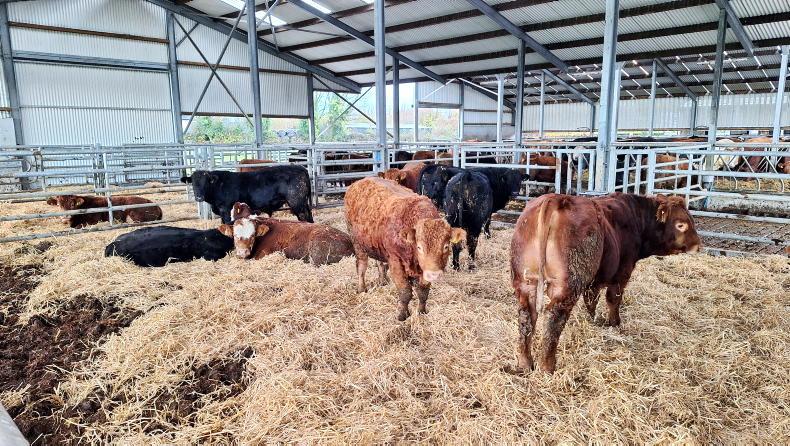
Bulls have access to a straw lie-back. A budget will be completed in the coming week to inform a decision whether to sell live or finish under 16 months.
The use of sexed semen has delivered a higher ratio of 48 weanling heifers to 28 bulls. Heifers will have their backs and tails clipped in the coming days, with cattle also receiving a worm dose.
Heifers are also being fed wholecrop bale silage along with grass silage, and are receiving 1.5kg concentrates. A batch of about 18 heavier heifers are currently on straw bedding and these will be turned outdoors in the coming week to 10 days to redstart. Target daily gain is 0.6kg to 0.7kg over the winter.
Suckler cows
Cows and in-calf heifers are currently being fed first second cut silage of 64 DMD. Shaun is disappointed with quality but the crop was allowed to bulk up to compensate for a lower yield of higher-quality 72DMD first-cut silage which will be fed pre-and- post-calving. In-calf heifers are receiving 1kg concentrates to compensate for lower-quality.
Pre-calving mineral supplementation will commence in the coming weeks to give a period of at least six to eight weeks supplementation before the first cows calve. Minerals are supplemented in powder form and simply spread along silage daily.
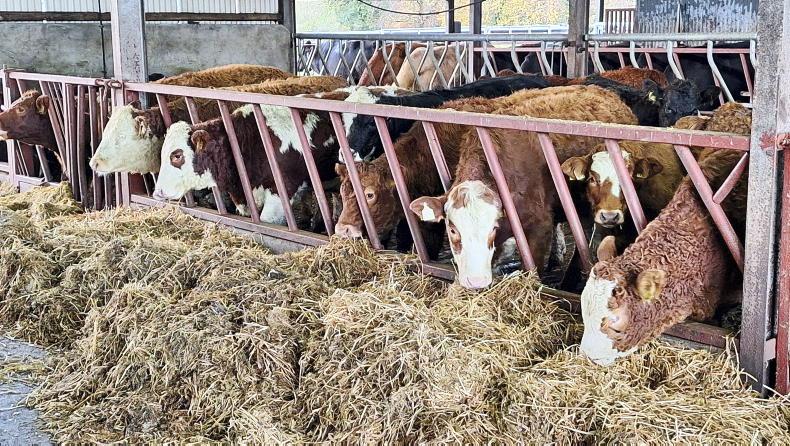
The lighter heifers are currently receiving wholecrop silage along with grass silage and 1.5kg concentrate supplementation.
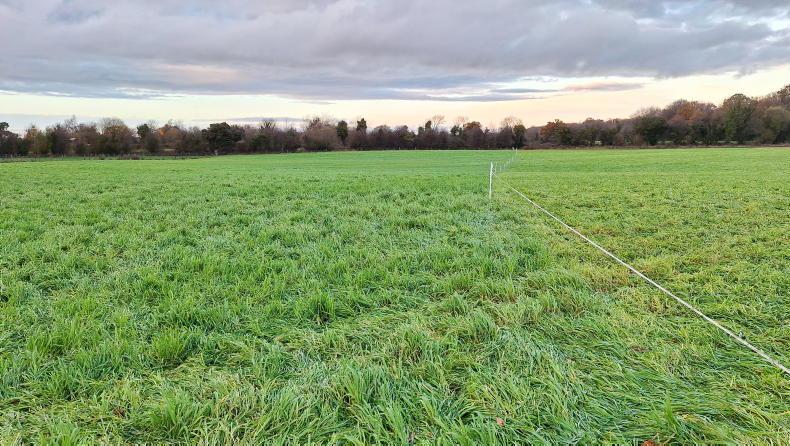
Forage rye will be used to graze ewes now and be ready for grazing again in early spring with the possibility of lambing Easycare ewes outdoors on the crop. Some lodging of the crop has occurred due to heavy rainfall.
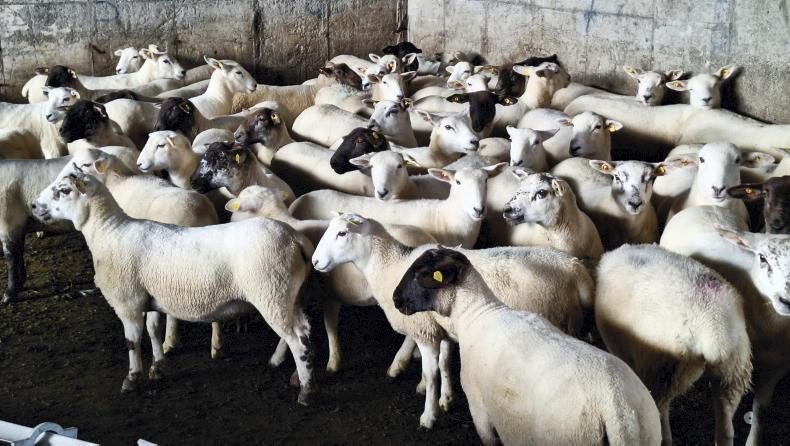
The foundation to successful breeding of ewe lambs in Tullamore Farm is lambs joining with the ram in excess of 60% of mature liveweight.
The torrential rainfall experienced in recent weeks is hitting at a challenging time for mid-season lambing flocks who are in the thick of breeding, with ground conditions deteriorating and grass utilisation suffering.
This is apparent on Tullamore Farm, with ewes coming towards the end of their second breeding cycle and ewe lambs coming towards the end of their first breeding cycle.
Drier areas of the farm are holding up better but are still under pressure following over two and a half inches of rainfall in recent weeks.
The problem is that the availability of such areas of drier ground is reducing, as these are typically the areas being grazed first and closed and targeted for early grazing next spring.
Heavier areas of the farm have come under considerable pressure this week, with water lying on the surface of the ground.
Farm manager Shaun Diver says the focus is now to try and achieve the best balance between grazing out swards satisfactorily and ensuring the intake of ewes is not overly restricted at a critical stage in breeding/early gestation.
Temporary electric fencing is being used to good effect in this regard to reduce residency times in smaller areas and be able to move sheep to fresh grass more often.
Forage rye
The farm is this year experimenting with forage rye. The area of ground sown in tillage increased in 2025, with approximately 10 acres of spring barley and three acres of wholecrop silage sown.
This has delivered an opportunity to still follow wholecrop silage with a forage rape brassica crop to graze a portion of weanling heifers while forage rye was sown after spring barley.
Forage rye is best described as a cover or catch crop, and is often sown after maize due to its suitability to late sowing. It’s deep and extensive rooting system is seen as highly beneficial for conditioning soil, with the crop capable of trapping available nutrients in the soil and reducing nitrogen leaching over the winter.
It has a high yield capacity of high-energy forage and is suitable for early spring grazing. Shaun is looking at the possibility of using it to lamb twin bearing Easycare ewes outdoors next March before closing up for a cut of silage and then returning this area back to grass.
A batch of 95 ewes and two rams started grazing the crop at the end of last week. The crop is essentially a cereal crop, and ewes transitioned easily from grass and grazed the first allocation excellently.
The second allocation was more challenging due to heavy rain and the fact it was lower lying, with pools of water lying on it on Tuesday.
As such, ewes were moved to a fresh allocation on Wednesday to prevent damaging the crop, with the grazed area back fenced to aid recovery in growth.
Some of the crop is starting to lodge under the weight of this week’s rain, but it is not expected to cause any issues with grazing.
Regular updates on how the crop is working will be featured over the coming months, including costs of incorporating, yield achieved etc.
Breeding activity
Getting back to breeding, Shaun says there has been very little repeat breeding activity in mature ewes, while breeding in ewe lambs appears to also be progressing swiftly in their first cycle.
Mature ewes were single sire mated for the first breeding cycle, meaning there were eight breeding groups in place.
Three batches which are now grazing the forage rye were joined together for the second cycle, with these ewes joined with a Suffolk and Texel ram.
In addition to raddling it will be possible to get a good handle on the sire of lambs born to such ewes at lambing.
The farm has achieved good success in breeding ewe lambs in recent years, and a big contributing factor is the weight of joining. The batch of 19 Texel x Mule-cross lambs weighed an average of 57kg on joining with rams, with the range in liveweight from 53kg to 61kg.
Sixteen of the 17 Suffolk-cross ewe lambs joined are Suffolk x Easycare cross which were also on par to the Texel-crosses at an average of 56kg liveweight. The weights also ranged mainly from 53kg to 61kg, with one ewe lamb weighing 51kg, while the single Suffolk x Mule-cross ewe lamb weighed 55kg.
Easycare ewes have a lower mature weight, and this is reflected in a lower liveweight in ewe lambs. The batch of 10 homebred Easycare ewe lambs averaged just over 48kg. The general run of weights were from 43kg to 45kg, with two outliers at 63kg and 67.5kg.
There was also a batch of 14 purchased Easycare ewe lambs and these averaged 42kg. Lambs weighed in the main from 41kg to 47kg, with two lighter lambs on the batch at 35kg and 38kg not joined to rams. Breeding in ewe lambs will be confined to two cycles to keep lambing compact with attention on the farm quickly turning to breeding in the suckler herd.
Lambs are currently being prioritised with access to good-quality grass, and the aim will be to retain these outdoors until early January. This will be dependent on weather and grass utilisation recovering.
Lamb finishing
There is a small batch of about 20 ewe lambs remaining on the farm. Many of these were ewe lambs born to yearling hoggets and have been allowed time to develop a frame before finishing. Concentrates will be introduced this week and built up to 0.8kg to 1kg per head in the coming weeks, with the aim of likely finishing them before the end of the year.
Weanling management
Bull weanlings are currently receiving ad lib access to high-quality grass and wholecrop silage and are also receiving 3kg concentrates daily. A finishing budget will be completed to inform a decision on whether to finish bulls in an under-16 month finishing system or to sell live.
Bulls were sold live in 2024 and exported. If sold it is likely that there will be a split in sale dates, with the best 17 or 18 bulls in the batch estimated to be weighing in the region of 370kg to 380kg while the remaining 10 bulls are weighing in the region of 300kg to 320kg. This was also the route taken with a larger batch of 2024-born bulls.
Bulls have access to a straw lie-back. A budget will be completed in the coming week to inform a decision whether to sell live or finish under 16 months.
The use of sexed semen has delivered a higher ratio of 48 weanling heifers to 28 bulls. Heifers will have their backs and tails clipped in the coming days, with cattle also receiving a worm dose.
Heifers are also being fed wholecrop bale silage along with grass silage, and are receiving 1.5kg concentrates. A batch of about 18 heavier heifers are currently on straw bedding and these will be turned outdoors in the coming week to 10 days to redstart. Target daily gain is 0.6kg to 0.7kg over the winter.
Suckler cows
Cows and in-calf heifers are currently being fed first second cut silage of 64 DMD. Shaun is disappointed with quality but the crop was allowed to bulk up to compensate for a lower yield of higher-quality 72DMD first-cut silage which will be fed pre-and- post-calving. In-calf heifers are receiving 1kg concentrates to compensate for lower-quality.
Pre-calving mineral supplementation will commence in the coming weeks to give a period of at least six to eight weeks supplementation before the first cows calve. Minerals are supplemented in powder form and simply spread along silage daily.
The lighter heifers are currently receiving wholecrop silage along with grass silage and 1.5kg concentrate supplementation.
Forage rye will be used to graze ewes now and be ready for grazing again in early spring with the possibility of lambing Easycare ewes outdoors on the crop. Some lodging of the crop has occurred due to heavy rainfall.
The foundation to successful breeding of ewe lambs in Tullamore Farm is lambs joining with the ram in excess of 60% of mature liveweight.






SHARING OPTIONS