


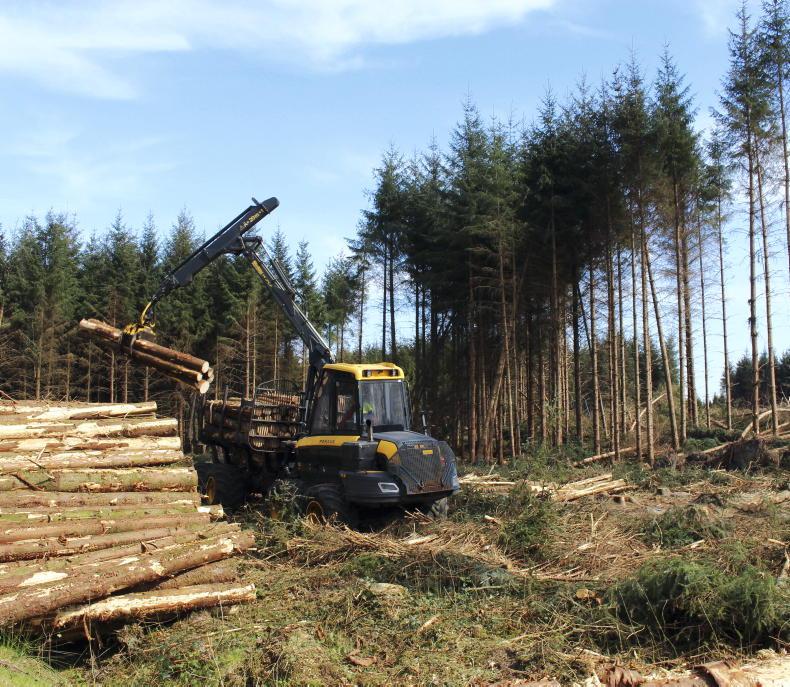
This Focus feature looks at current forestry issues, from salvaging windblown forests to afforestation.
Minister Healy-Rae provides his views on achieving a viable forestry programme, including the need to increase afforestation, especially at farm level, while his promise to introduce a windblow reconstitution is reassuring.
It is impossible to avoid issues such as windblow and ash dieback, as these have damaged confidence in forestry. You can never eliminate risk, regardless of the crop, but reducing it is vital in a long-term land use such as forestry.
In 2018, the Forest Land Availability Implementation Group (FLAIG), established by the Department’s forestry advisory group COFORD, acknowledged this.
“Farmers need certainty in relation to long-term decisions,” the report stated.
It maintained the damage caused by storm Darwin four years previously, “caused a lot of uncertainty in the sector”.
Since then, we have had more serious windblow culminating in storm Éowyn last January.
In its web page on forest insurance, Teagasc offers the following advice to forest owners: “Insurance for fire, storm, lightning and other specified perils should be considered.”
While an increasing number of forest owners insure for public liability and fire, blanket insurance to cover other threats, including storm damage and disease, is either cost prohibitive or simply not available.
Forest owners should not have to wait for a reconstitution scheme after major natural damage to a crop, outside their control. The FLAIG report acknowledges this.
It stated: “Consideration could be given to the establishment of a State insurance scheme for forestry. State provision is justified on the basis of insurance market failures in the forestry sector.”
This advice needs to be heeded. The afforestation programme required to deliver multipurpose benefits should be viewed as a State-private partnership, if it is to succeed.
It is time to revisit FLAIG and assess the need for a State-private forest insurance scheme.



SHARING OPTIONS