


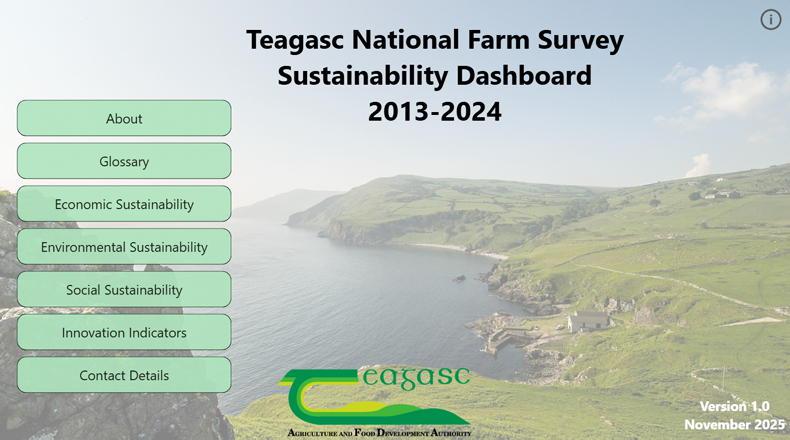
Teagasc published its Sustainability Report for Irish Agriculture recently.
The report focuses on 2024 and provides the latest available information on the sustainability performance of farms in Ireland, based on detailed analysis of data collected through the Teagasc National Farm Survey (NFS).
Economic, social, environmental and innovation sustainability metrics are produced for dairy, cattle, sheep and tillage farms.
The report, which has now been published for a decade, also includes results for previous years, which allows an assessment of how farm sustainability has changed over time.
Outcomes for 2024
After a very challenging year in 2023 (especially on dairy and tillage farms) most economic sustainability metrics (eg gross output, gross margin) recovered strongly in 2024.
The strong economic performance in 2024 was above the long term average on dairy and drystock system.
The report illustrates that dairy farming remains an economic powerhouse in Irish agriculture with economic returns that are multiples of those achieved in the other farm systems in Ireland.
With higher economic returns in 2024, the level of household vulnerability (how financially exposed or at risk a farm household is to economic shocks) was lower across all farm systems.
Dairying continues to exhibit stronger social sustainability (long-term ability to keep farming) relative to other farm systems.
However, the main dairy farm operator continues to work a lot more hours than the farm operator in other farm systems, even when time spent in off-farm work is included.
In terms of environmental sustainability (‘green’ or environmentally friendly farm practices), measured on a whole farm or per hectare basis, it is notable that GHG emissions declined across the average dairy, cattle and sheep farm in 2024.

Lower stocking rates contributed to lower animal related GHG emissions which was sufficient to offset the higher GHG emissions associated with an increase in chemical nitrogen (N) fertiliser application rates.
A declining trend was also evident for ammonia emissions. Across all livestock systems, N surpluses (difference between N input and N output) increased and N use efficiencies declined in 2024 compared to the previous years on foot of increased rates of chemical N application and higher rates of concentrate use, while farm output was relatively static.
Due to the more intensive nature of production on dairy farms compared to other farm systems, N surpluses were significantly higher on dairy farms versus all other systems. Conversely, N use efficiency improved slightly on tillage farms.
The report also illustrates the continuing adoption of positive actions by Irish farmers to address environmental emissions, particularly in the case of dairy farmers.
For example, in 2024, 45% of slurry application on cattle farms and 85% of slurry application on dairy farms was undertaken using Low Emissions Slurry Spreading (LESS) equipment.
Dairy farmers also made further progress in the transition towards the use of lower emissions chemical fertiliser in 2024, with 40% of the total nitrogen applied in 2024 in the form of protected urea.
However, the usage of protected urea on drystock farms remains low, at between 9% to 14% of total chemical N applied for sheep and cattle farms respectively.
Click here see the full 2024 report.
New developments in 2024
Since it was first published in 2013, the number of indicators across economic, environmental, social and innovation dimensions has grown.
Indeed, two new food security-based social sustainability indicators, and a new sustainability data visualisation dashboard are featured in the launch of this year’s report.
The Sustainability Dashboard uses Teagasc National Farm Survey (NFS) data to track the progress of Irish dairy, cattle, sheep and tillage farms in improving their economic, environmental and social sustainability since 2013.
For the dashboard’s home page click here.
Protein production
Two new social sustainability indicators have been included in this year’s report.
These indicators are measures of food security and are based on an assessment of the protein generated across the different farm systems.
Results indicate that the average dairy farm generates enough protein per hectare to meet the yearly requirement of 20 people, while the corresponding figures for the average tillage, cattle and sheep farm are 15, four and three respectively.
Collectively, these systems generate enough protein to meet the requirement of circa 36 million people.
Even when allowance is made for the protein in animal feed, results indicate these systems collectively provide protein provision to meet the requirement of 30 million people.




SHARING OPTIONS