


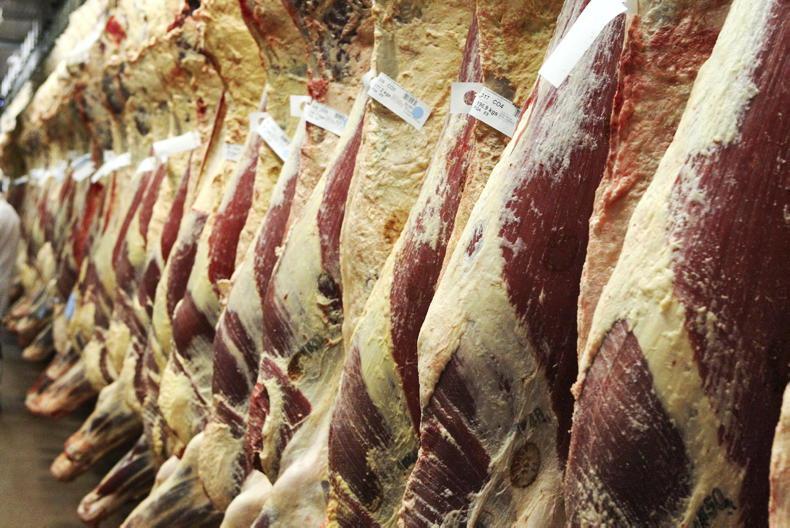
The announcement that ABP Waterford is consulting with staff on possible redundancies is the third such declaration in the first six weeks of 2026. It will affect approximately 230 employees, and involve potential redundancies at its cutting and deboning operation, but does not impact the abattoir side of the business at the Waterford site.
The company says that “the proposed changes are driven by reduced livestock supply and increasing costs in Ireland. The group will maximise other facilities to maintain its efficiency and competitiveness”.
This latest announcement follows a similar process that is being undertaken by ABP Linden at its Dungannon factory in Northern Ireland and Kepak at its Clonee factory.
As a result of these consultations, several hundred job losses in meat processing on the island of Ireland are a real possibility, as processors look to align their capacity in line with raw material (cattle) supply.
So far it is just ABP and Kepak that are reviewing their processing capacity, but others may well follow in the coming weeks and months if cattle numbers remain at or below last years levels.
All about numbers
As Figure 1 shows, the number of cattle slaughtered in Republic of Ireland factories in 2025 was the lowest since 2015 at just under 1.6m head.
Figure 2 shows the NI cattle kill was also down in 2025, falling by 5% to just over 491,000 head and DEFRA data for the whole UK shows that numbers of cattle through factories were down by 117,000 head.
These numbers matter, because beef-processing on the island of Ireland is closely linked with Britain, as ABP, Dawn and Kepak all operate in both and the big retail and food service customers source supplies from Britian and Ireland.
From the processing perspective each of these groups have ample processing capacity in Britain as well as Ireland. In Northern Ireland, companies regularly brought carcase beef across the Irish sea from their factories in Britain for deboning, further processing and retail packing.
This was then shipped back again to customers in Britain. While this makes business sense if processing capacity in Britain is fully utilised, it doesn’t make any sense if it isn’t.
Currently there is ample capacity in Britain to accommodate extra processing of beef from the island of Ireland as well as the cattle killed there. For retail packing of beef, it also makes sense to do this work as close as possible to the market the finished product is being delivered to.
This is because retail packs of beef take up much more space on a container than skin tight vacuum packs of beef and are therefore more expensive to transport per kilo of product.
This could have been part of ABP’s thinking in relation to its decision on ABP Linden, particularly as the acquisition of Scotbeef just over two years ago, brought with it a modern further processing plant in Glasgow, the primary factory in Bridge of Allen.
Abattoir capacity
It is interesting that so far all announcements about adjusting capacity to reflect cattle supply are confined to deboning and further processing.
Given that cattle supply is the problem, it might be expected that the larger groups with multiple abattoir locations, would consider taking one out of production and redirecting the cattle to other factories in the group.
This may be a good idea in theory, but there are major obstacles. For all beef processors, having a steady cattle supply is the starting point for the functioning of the business.
The map in Figure 3 shows the approximate location of all the beef abattoirs that slaughter 20,000 cattle or more across the island of Ireland.
By way of examples, in theory, Dawn Meats could divide the cattle slaughtered in its Kildare factory between Rathdowney and Slane, Kepak could divide Kilbeggan cattle between Clonee and Athleague, and ABP could handle Waterford cattle between Cahir and Slaney.
Cattle spread
Table 1 is an estimate by the Irish Farmers Journal of the breakdown of the cattle kill across these locations last year, as individual factory kill data isn’t published. As the numbers in table 1 suggest, taking an abattoir out of production would involve rerouting tens of thousands of cattle and that could be a challenge for the closest group factories.
Even more importantly, there would likely be a huge leakage of cattle supply to other factories outside the group.
Again by way of example, if Kepak Kilbeggan stopped slaughtering cattle, their suppliers might well opt to go to Moyvalley meats instead of another Kepak factory.
ABP Waterford suppliers might look at Dawn Grannagh as an alternative to either Slaney or Cahir, and if Dawn Kildare ceased operation its suppliers could switch to either Liffey Hacketstown or Kepak Kilbeggan as alternatives to another Dawn factory.
Despite advice from the Irish Farmers Journal for farmers to shop around, many farmers opt to sell cattle to their closest factory or one with whom they have a long-standing relationship.
If that factory ceases production, they are not guaranteed to bring their cattle to another factory in the group, several kilometres away. Taking a factory out of production isn’t even an option in theory for standalone single abattoir businesses, and for the larger groups it comes with risks and logistical difficulties.
This isn’t an issue with carcase beef because as soon as it is in a chill, the carcases can be transported anywhere in the group for deboning and further processing.
These parts of the business are also where benefits can be gained from automation and economy of scale.
They lend themselves more to the use of robotics than the abattoir end of the process and in future could be the area of processing where artificial intelligence has a role.
There is also one further final reason why taking an abattoir out of production is the option of (almost) last resort. For beef factory owners, the abattoir can be compared with the family farm and personal pride can have as much influence as the business case!
Not just an Irish issue
The drop in the Irish cattle kill last year of 200,000 head to below 1.6m means that the number of cattle slaughtered is at the lowest in over a decade, as shown in Figure 2.
However, the annual kill does fluctuate and it has indeed been below 1.5m head for some years in this century. With most large Irish factories capable of handling 70,000 head or more, then mathematically three fewer factories could have handled the kill in 2025, compared with the previous year.
Fewer cattle numbers wasn’t just an Irish issue in 2025. In the US, the world’s largest commercial beef producer, the cattle herd was at a 75-year low. This has been reflected in major losses in the published accounts of beef processors and capacity has been removed from the system there also.
Most recently, Cargill announced the closure of a further processing factory, as did JBS towards the end of last year. The biggest announcement to date has been by Tyson Foods, that closed a factory in Nebraska capable of handling 5,000 head per day, and put another one in Texas on a single shift.
Comment: problem of fewer cattle could drive innovation
Three announcements since the start of the year about consultations with potential redundancies involving several hundred people suggest all isn’t well in Irish beef-processing. Fewer cattle mean less processing capacity is required and, as explained, this is easier to achieve beyond the abattoir stage of the beef processing chain.
Also, given the difficulty and cost of securing staff in what is a very labour-intensive business, factories, particularly the larger groups, will no doubt be exploring how AI and the further use of robotics and automation can be introduced to drive greater efficiency.
Further processing and even deboning of carcases lends itself more to this than the abattoir side of the business.
Tighter cattle supply squeezes beef processors. However, these consultations demonstrate that Kepak and ABP will adjust their businesses and adapt to the new situation. Others may follow suit in the weeks and months ahead if they consider it to be necessary.



SHARING OPTIONS