


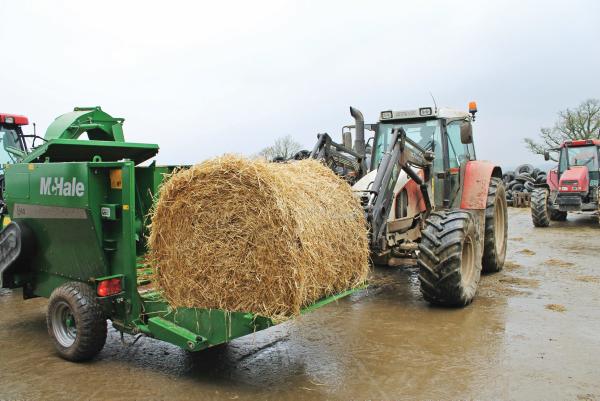
Both were tested in real farm conditions at straw blowing and feeding round bale silage.
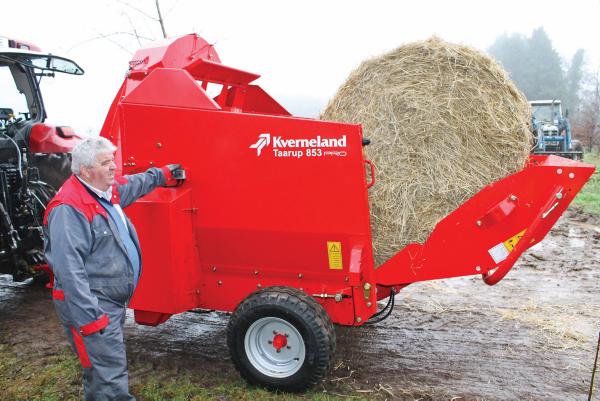
For the 2012 season, Kverneland revised its bale chopper/feeder range with a number of improvements, principally to its chopper and blower elements. The Kverneland Taarup 853 Pro is a 3m3 machine with a capacity for two round bales of one very large square bale.
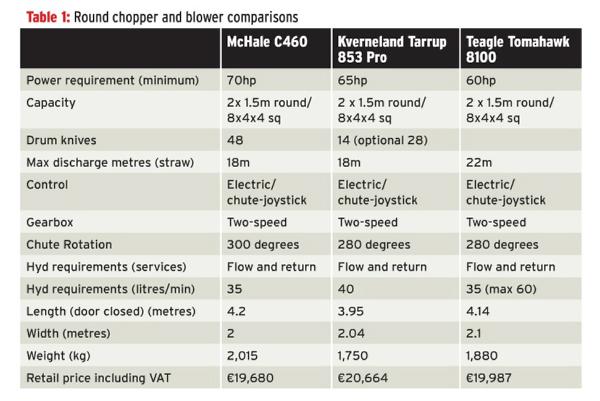
Kverneland produces a three-point linkage machine — the 852 — and a larger trailed machine — the 856 — plus a couple of self-loaders. The 853 Pro is likely to be the firm’s most popular machine on the Irish market competing directly with the McHale C460 and Teagle Tomahawk 8100.
McHale introduced the new C460 feeder and straw blower in 2010. The C460, which is a high specification machine at the top end of the spectrum, is designed to compete with similar machines from the likes of Kühn, Kverneland, Teagle and Lucas.
Kverneland features
John Colgan from Kverneland Ireland went through the features of the 853 before we did any work. The Kverneland Taarup 853 Pro, McHale C460 and Teagle 8100 are similar in that they all share the same principle components, such as slatted floor, stripper rotor and flywheel.
A wide-angle pto equipped with slip clutch and over-run clutch is standard. This is driving a two-speed Comer gearbox with the lower speed for feeding out silage and the higher speed for straw blowing. Kverneland uses a horizontal rotor with combine harvester-like sections to pull the bale apart and feed the flywheel to blow out the feeding or bedding material.
A double-acting hydraulic service is required or, alternatively, a single acting service with a quick coupling returning oil to the tractor’s hydraulic system. A good electrical supply is needed because Kverneland uses electrical linear motors, which is an electrical version of an hydraulic ram, in two positions instead of hydraulic rams. These are controlled from the in-cab control box in the same manner as the hydraulic services.
||PIC2||
There are 14 knives attached to the rotor. This can be doubled to 28 for more aggressive action on the bale. The rotor is belt driven with four belts but, unlike the McHale, drive to the rotor is constant.
Above the rotor, Kverneland introduced its new Drum Feed Control System (DCFS) on its Pro versions.
The tailgate and hydraulically-driven floor can be operated by switches from the ground to keep an eye on proceedings. These are placed far more forward than the McHale version, which does not give you as clear a picture of the tailgate closing.
Bedding and Feeding
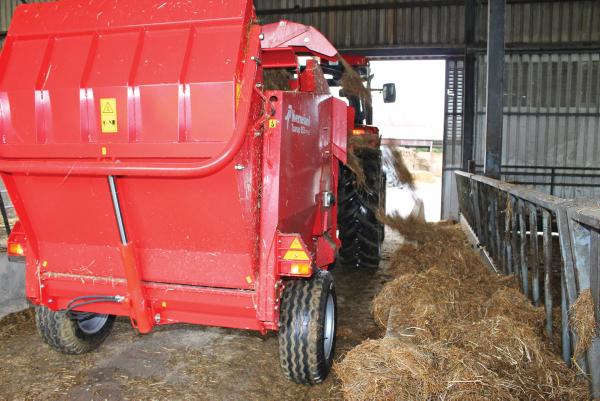
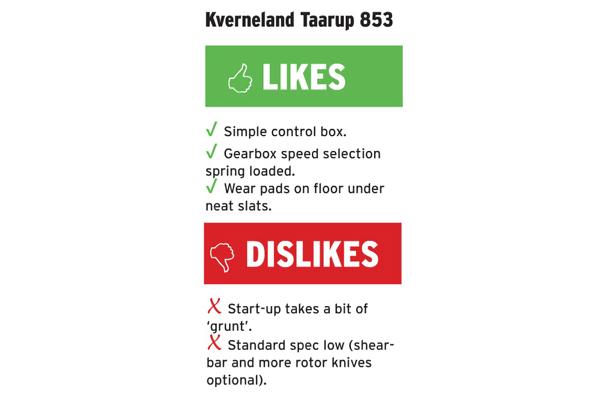
We took a run up the road to Stephen Nolan’s farm in Enniscorthy to both blow straw into his shed and feed out a bale of silage. In the cab, the Kverneland controls were simple and intuitive, perhaps not as much as the McHale controls.
||PIC3||
The pto start-up takes a bit more grunt with the Kverneland because you are starting both the flywheel and rotor at the same time. This could be taxing on lower horsepower tractors if you were close to the machine’s minimum power requirement.
Once loaded and up to pto speed, the floor is set in motion with the first switch and a dial above it controls floor speed. Like the McHale, floor movement is indicated by a spinning disc at the lower front right-hand corner of the machine.
||PIC4||
The feed or blow-out rate is controlled by a combination of the floor speed and Kverneland’s DCFS system. Chopping and blowing out straw was no problem and the joystick-controlled chute gave good direction.
Feeding out silage was a bit trickier because we were using a non-chopped bale which would probably have required the fitting of the extra knives on the rotor to help even the feed-out rate and loading on the tractor. The main thing, though, was that it could do it and do it without blocking. John said that a flywheel shearbar knife is available for tougher materials.
The chute uses an hydraulic motor for rotating it and a linear motor for controlling its curvature. Both are operated by the joystick on the control box to control material direction. The silage in this case was blown directly into the trough because, while the Kverneland had a feed-out tray, it was not as adjustment friendly as the McHale version.
||PIC5||
McHale features
John McHale from McHale Engineering delivered a C460 to us and ran through its operation. The first impression of the C460 is that it is well built and well finished. The C460 is a trailed machine and the only configuration the Mayo firm offers so far.
It will easily handle two four by four bales (figures quoted says up to 1.5m), one in the chamber and one on the door, or an 8x4x4 big square bale as uprights and chains come with it for tailgate.The McHale design is similar to other brands on the market with a chain and slat floor that feeds a horizontal rotor, which strips and shreds the material before feeding it into the flywheel. The flywheel then blows the material out through a chute which is directed with a small electric joystick in the cab.
||PIC6||
The basic tractor requirements are a minimum of 70hp at 540 pto speed, an electrical supply and oil supply — single acting will do with a free-flow return. John said that if the chopper is in regular use, a free-flow return is desirable. All of the machine’s hydraulic functions are controlled on McHale’s in-cab control unit.
Hydraulic functions include chute rotation and curvature, tailgate, floor drive, rotor top guard and engagement or rotor drive. RDS Electronics manufacture the control units for McHale.
Taking the drive from the tractor to the machine is a wide-angle pto with slip clutch and over-run clutch. A two-speed Comer gearbox drives the chopping rotor and flywheel, slow speed for feeding out silage and the faster speed for blowing straw. The chain and slat floor feeds the bale or pit silage into the rotor for blowing or feeding out.
||PIC7||
Operation
To feed out silage or blow out straw, first the appropriate gearbox speed has to be selected. It should be slow for feeding out silage and fast for blowing out straw. A bale can be loaded onto the tailgate or scooped up against a yard wall
With the bale on board, start the tractor’s pto at a little above engine tick-over, John McHale advised. This will help clear the flywheel if there is any material which hasn’t cleared completely.
Bring the pto up to speed and engage the chopping rotor. The floor can then be engaged, setting the floor speed to four or five, until you can determine the best feed rate for the baler or material on-board. Continuous or ‘pulse’ floor feed can be selected to cater for the ‘leaves’ in a large square bale.
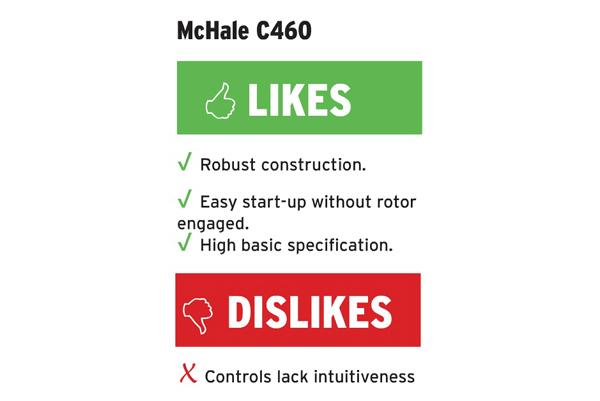
Despite what I felt was a conservative minimum power requirement quoted by McHale for the C460 of just 70hp, to my surprise the farm’s Case IH Maxxum 100 tractor handled both with absolute ease.
John assured me that the McHale C460 doesn’t require massive power and he recently set one up on a Ford 5000.
The rotor is fitted with 48 knives arranged in pairs. There is an adjustable knife-like shearbar above the flywheel to keep it clear of debris and help prevent blockages. Even if it becomes blocked, there is an access hole, plus corresponding holes in the flywheel, where it can be physically un-jammed with a lever provided.
We brought the McHale C460 to Aidan Murphy’s farm outside Enniscorthy to give it a run. Aidan was using his own three-point linkage mounted Kühn Primor 2060 for feeding silage and blowing straw.
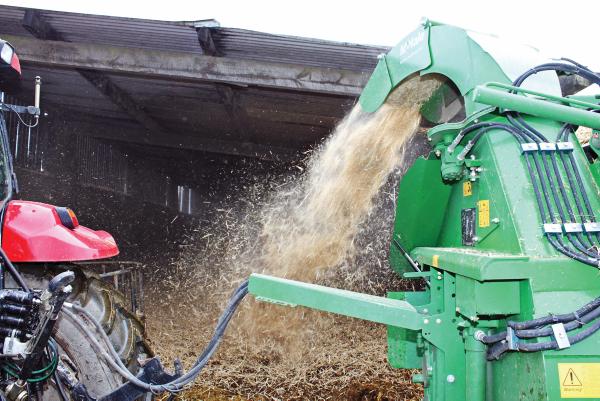
Aidan’s shed is set up for the three-point linkage chopper but the McHale trailed machine worked out well. When chopping and blowing straw, Aidan found that the C460 appeared to blow the straw a good distance.
For feeding silage with the C460, there is an adjustable tray to help with feeding out the crop.
On the McHale machine, there is an adjustable tray onto which Aidan directed the silage and it dropped off harmlessly to the waiting cattle. Feed-out was very smooth and easy, so very little messing with forward speed was required.


SHARING OPTIONS