Peter Gerrard has seen a lot in his 80 years. Think about it: the 20th century went from the infancy of industrialisation to the revolution of the digital age.
In this time, food production went from a reliance on subsistence farming to our current globalised system, where anything you might want is a mouse-click away.
In 1950s rural Ireland, many areas were yet to have electricity. Peter remembers these times.
He grew up with one foot firmly rooted in the old Ireland – a simpler, but, according to him, not always better, way of life – and adapted to the changes as they came. He has never forgotten the stories of the past.
A revered local historian and former teacher, he resides at O’Mara’s Acres near Coolbawn, Co Tipperary.
He is active within his community, and you’ll often find him leading tours for foreign visitors, talking about Irish pre-history. He works alongside his daughter, Ailbhe, who owns and operates nearby Brookfield Farm.
Peter’s home is a tangle of historic artefacts and old-world charm. Oil painting and sketches hang alongside the hunting trophies of yesteryear. Books line entire walls.
In the parlour, a cello and piano await willing ears, while in the kitchen – the clear hub of Peter’s world – an old cooking range heats up the coffee pot. Weathered utensils are hung on the walls for easy access and the windowsills are laden with antiques and family heirlooms: old butter pats, weights, oil lamps.
“We moved into this house 50 years ago,” he tells Irish Country Living Food. “I was brought up in south county Dublin, just outside where the M50 is now, on Kilmashogue Mountain. [This area] was completely in the countryside, at that time, and still is, more or less. We’re talking about the 1950s – there were no cars, no electricity, no telephone. We had a battery radio and a horse and trap. Everybody knew everybody else, they would be out on foot or by bicycle, and as cars started to trickle in by the mid 50s, if anyone was on the road you would just give them a lift. It was a very different time.
“My parents owned much of the land on the mountain, and they sold it to the forestry service for just £15 per acre – there were about 30ac in total.
"With the money, they bought a second-hand car and had a bit left over. For 30-something acres of ok land, they were paid about £450. At that time, a pound a day was around the maximum wage, anyway.”
Wartime diary
Peter’s father was born in 1892 and was a veteran, being one of the over 200,000 Irish people who fought in World War I.
Like other elements of his family’s history, this time in his father’s life is important to Peter. He explains how his wartime diary reflected a different reality to the much rosier version he portrayed in letters sent home to family.
He witnessed all kinds of horrors in WWI. In his private diary, he confessed to being miserable and frightened
“My father was always an old man when I knew him, anyway, but he kept lots of books and letters,” he says. “He witnessed all kinds of horrors in WWI. In his private diary, he confessed to being miserable and frightened, while his letters to his family were completely censored – ‘We have the Turks on the run,’ that kind of thing, which, obviously, wasn’t quite valid.
“Once I was grown, I spent several years teaching general subjects in Dunlavin and in the convent in Roscrea,” he continues.
“In 1972, we bought land near Castleleiny [Co Tipperary], mainly to keep horses for racing. Horses didn’t make money, though, and neither did cattle, so we sold that place and moved here. I worked out in the Middle East for years, then, for oil companies in Yemen, Oman, Saudi Arabia and Kuwait…”
At this stage, Peter and his wife, Meda, had their six children, and the family settled into life on the shores of Lough Derg.
He may have been working throughout the Middle East for the remainder of his career, but a teacher never truly stops being a teacher – Peter is a testament to that. He recently gave a virtual lecture on the Irish in WWI, and while speaking with him, you can tell he really enjoys his work leading historical tours, largely for visiting Americans.
As Ailbhe’s farm produces organic honey, lamb and tillage, he is also active in day-to-day farming jobs and activities. As we sit with our coffees, he openly and easily remembers stories from his own past. A favourite anecdote revolves around food, or, more specifically, it revolves around the realities of small-scale food production “back in the day”.
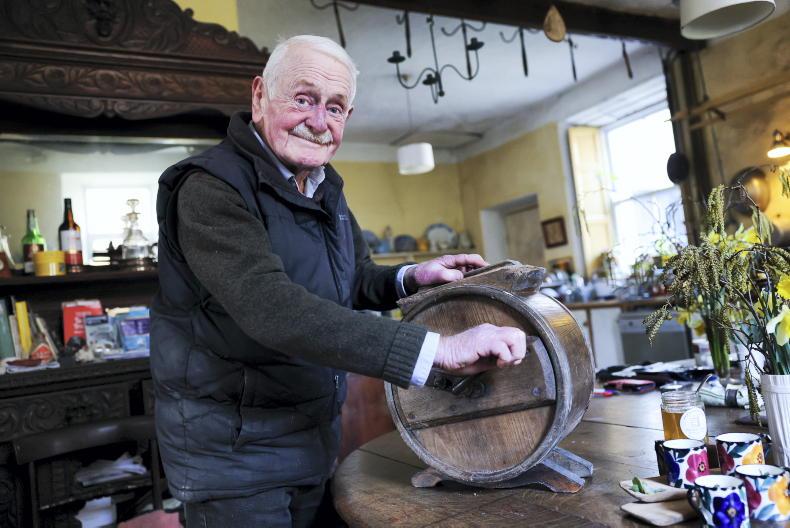
“We always had a house cow or two,” he recalls. “The milk would be in pans left out in the scullery and I’d scoop the cream off the top and keep it until there was enough to churn for butter. This was when I was probably 10 or 11. I’d been roped into turning the handle of this old wooden butter churn.
"Depending on the milk and the temperature and whatnot, the butter might come quickly or it might come slowly – it could take 30 minutes of churning or longer, sometimes. Then, you’d take the plug out of the churn and get the buttermilk out. You’d take the butter, then, and wash it in water, then using the butter pats you’d turn it into squares.
“I always preferred butter from the creamery, though,” he admits, “because often by the time there was enough cream to churn, I thought it tasted off – a bit rancid.”
Simple meals
Peter says that their meals, in those days, were simple but comprised of “a fairly healthy, natural diet” which included carrots, onions, potatoes and summer vegetables like lettuces and radish. There weren’t any supermarkets, and the range of foods found in local shops was limited, so they kept their own hens and produced as much of their own food as they could.
“Sixty plus years ago, the expensive meats were pork and chicken, because their production relied on brought-in grain,” he explains. “Where the cheaper meats at the time – mutton and beef – were fattened on grass. This is the opposite of what we see today, where chicken and pork are generally the more affordable meats.
“We got electricity in the mid-50s,” he continues. “I can’t remember it ceremoniously being switched on, though I do remember chatting with the electricians, who were putting up the boards and running wires, entertaining things to watch when I was eight or nine or whatever age I was. I remember one light switch by the door and one wall socket.
Batteries
“I also remember the radio, which worked off batteries. The batteries had to be brought down to the hardware shop to be charged. It was a wet battery and it would last for a week or two, then it would get faint and weak and would have to be charged up again. I think we only had the one battery.
"There were postal deliveries on Saturdays – no email of course! If a telegram came, it was usually because someone had died. It would come by motorbike, and it was usually bad news.”
Though Ailbhe is just down the road, Peter now lives on his own in their family home. He spends much of his time in the expansive kitchen and says although he enjoys cooking, the art of baking has largely eluded him. That said, as they produce their own raw honey, he makes use of this sweet abundance in simple desserts, like this classic lemon posset.
“There are lots of things I can cook quite well – curries and Bolognese sauce, for example – but I don’t really do much baking,” he says, laughing.
Peter’s lemon and honey posset
Luckily, posset isn’t just delicious; it is also one of the easiest desserts to prepare. Simply heat the ingredients on the stovetop before pouring into small dishes or cups to set in the fridge. Because honey is used in this recipe, the amount of caster sugar required is reduced. Using good quality cream, this is the perfect recipe for an easy Easter dessert.
Serves 8
Ingredients
400ml cream40g caster sugar40g Irish honey
(preferably locally produced)50ml freshly squeezed
lemon juiceFresh mint, to garnishMethod
1 Place the cream and caster sugar into a large saucepan and gently heat over a medium heat, stirring constantly, until the sugar has dissolved. While the cream is warming, ensure your remaining ingredients (the honey and the lemon juice) are prepared and standing by.
2 Once the sugar has dissolved, increase the heat slightly and bring the cream to light boil (make sure it doesn’t boil over the edge of the pot). Lightly boil this mixture for 3-5 minutes.
3 Remove from the heat and add the honey. Stir through so the honey is melted into the cream, then immediately add the lemon juice and stir once again to combine.
4 Place the lemon posset mixture into a jug to make pouring easier. Evenly distribute the mixture among 8 small cups or ramekins and let cool at room temperature for approximately 30 minutes.
5 Cover each cup or ramekin with cling film and place in the fridge to chill for a minimum of 2 hours. You can make the possets up to 2 days before serving and simply keep chilled in the fridge.
6 When ready to serve, simply garnish the posset with fresh mint and serve chilled.
Peter Gerrard has seen a lot in his 80 years. Think about it: the 20th century went from the infancy of industrialisation to the revolution of the digital age.
In this time, food production went from a reliance on subsistence farming to our current globalised system, where anything you might want is a mouse-click away.
In 1950s rural Ireland, many areas were yet to have electricity. Peter remembers these times.
He grew up with one foot firmly rooted in the old Ireland – a simpler, but, according to him, not always better, way of life – and adapted to the changes as they came. He has never forgotten the stories of the past.
A revered local historian and former teacher, he resides at O’Mara’s Acres near Coolbawn, Co Tipperary.
He is active within his community, and you’ll often find him leading tours for foreign visitors, talking about Irish pre-history. He works alongside his daughter, Ailbhe, who owns and operates nearby Brookfield Farm.
Peter’s home is a tangle of historic artefacts and old-world charm. Oil painting and sketches hang alongside the hunting trophies of yesteryear. Books line entire walls.
In the parlour, a cello and piano await willing ears, while in the kitchen – the clear hub of Peter’s world – an old cooking range heats up the coffee pot. Weathered utensils are hung on the walls for easy access and the windowsills are laden with antiques and family heirlooms: old butter pats, weights, oil lamps.
“We moved into this house 50 years ago,” he tells Irish Country Living Food. “I was brought up in south county Dublin, just outside where the M50 is now, on Kilmashogue Mountain. [This area] was completely in the countryside, at that time, and still is, more or less. We’re talking about the 1950s – there were no cars, no electricity, no telephone. We had a battery radio and a horse and trap. Everybody knew everybody else, they would be out on foot or by bicycle, and as cars started to trickle in by the mid 50s, if anyone was on the road you would just give them a lift. It was a very different time.
“My parents owned much of the land on the mountain, and they sold it to the forestry service for just £15 per acre – there were about 30ac in total.
"With the money, they bought a second-hand car and had a bit left over. For 30-something acres of ok land, they were paid about £450. At that time, a pound a day was around the maximum wage, anyway.”
Wartime diary
Peter’s father was born in 1892 and was a veteran, being one of the over 200,000 Irish people who fought in World War I.
Like other elements of his family’s history, this time in his father’s life is important to Peter. He explains how his wartime diary reflected a different reality to the much rosier version he portrayed in letters sent home to family.
He witnessed all kinds of horrors in WWI. In his private diary, he confessed to being miserable and frightened
“My father was always an old man when I knew him, anyway, but he kept lots of books and letters,” he says. “He witnessed all kinds of horrors in WWI. In his private diary, he confessed to being miserable and frightened, while his letters to his family were completely censored – ‘We have the Turks on the run,’ that kind of thing, which, obviously, wasn’t quite valid.
“Once I was grown, I spent several years teaching general subjects in Dunlavin and in the convent in Roscrea,” he continues.
“In 1972, we bought land near Castleleiny [Co Tipperary], mainly to keep horses for racing. Horses didn’t make money, though, and neither did cattle, so we sold that place and moved here. I worked out in the Middle East for years, then, for oil companies in Yemen, Oman, Saudi Arabia and Kuwait…”
At this stage, Peter and his wife, Meda, had their six children, and the family settled into life on the shores of Lough Derg.
He may have been working throughout the Middle East for the remainder of his career, but a teacher never truly stops being a teacher – Peter is a testament to that. He recently gave a virtual lecture on the Irish in WWI, and while speaking with him, you can tell he really enjoys his work leading historical tours, largely for visiting Americans.
As Ailbhe’s farm produces organic honey, lamb and tillage, he is also active in day-to-day farming jobs and activities. As we sit with our coffees, he openly and easily remembers stories from his own past. A favourite anecdote revolves around food, or, more specifically, it revolves around the realities of small-scale food production “back in the day”.
“We always had a house cow or two,” he recalls. “The milk would be in pans left out in the scullery and I’d scoop the cream off the top and keep it until there was enough to churn for butter. This was when I was probably 10 or 11. I’d been roped into turning the handle of this old wooden butter churn.
"Depending on the milk and the temperature and whatnot, the butter might come quickly or it might come slowly – it could take 30 minutes of churning or longer, sometimes. Then, you’d take the plug out of the churn and get the buttermilk out. You’d take the butter, then, and wash it in water, then using the butter pats you’d turn it into squares.
“I always preferred butter from the creamery, though,” he admits, “because often by the time there was enough cream to churn, I thought it tasted off – a bit rancid.”
Simple meals
Peter says that their meals, in those days, were simple but comprised of “a fairly healthy, natural diet” which included carrots, onions, potatoes and summer vegetables like lettuces and radish. There weren’t any supermarkets, and the range of foods found in local shops was limited, so they kept their own hens and produced as much of their own food as they could.
“Sixty plus years ago, the expensive meats were pork and chicken, because their production relied on brought-in grain,” he explains. “Where the cheaper meats at the time – mutton and beef – were fattened on grass. This is the opposite of what we see today, where chicken and pork are generally the more affordable meats.
“We got electricity in the mid-50s,” he continues. “I can’t remember it ceremoniously being switched on, though I do remember chatting with the electricians, who were putting up the boards and running wires, entertaining things to watch when I was eight or nine or whatever age I was. I remember one light switch by the door and one wall socket.
Batteries
“I also remember the radio, which worked off batteries. The batteries had to be brought down to the hardware shop to be charged. It was a wet battery and it would last for a week or two, then it would get faint and weak and would have to be charged up again. I think we only had the one battery.
"There were postal deliveries on Saturdays – no email of course! If a telegram came, it was usually because someone had died. It would come by motorbike, and it was usually bad news.”
Though Ailbhe is just down the road, Peter now lives on his own in their family home. He spends much of his time in the expansive kitchen and says although he enjoys cooking, the art of baking has largely eluded him. That said, as they produce their own raw honey, he makes use of this sweet abundance in simple desserts, like this classic lemon posset.
“There are lots of things I can cook quite well – curries and Bolognese sauce, for example – but I don’t really do much baking,” he says, laughing.
Peter’s lemon and honey posset
Luckily, posset isn’t just delicious; it is also one of the easiest desserts to prepare. Simply heat the ingredients on the stovetop before pouring into small dishes or cups to set in the fridge. Because honey is used in this recipe, the amount of caster sugar required is reduced. Using good quality cream, this is the perfect recipe for an easy Easter dessert.
Serves 8
Ingredients
400ml cream40g caster sugar40g Irish honey
(preferably locally produced)50ml freshly squeezed
lemon juiceFresh mint, to garnishMethod
1 Place the cream and caster sugar into a large saucepan and gently heat over a medium heat, stirring constantly, until the sugar has dissolved. While the cream is warming, ensure your remaining ingredients (the honey and the lemon juice) are prepared and standing by.
2 Once the sugar has dissolved, increase the heat slightly and bring the cream to light boil (make sure it doesn’t boil over the edge of the pot). Lightly boil this mixture for 3-5 minutes.
3 Remove from the heat and add the honey. Stir through so the honey is melted into the cream, then immediately add the lemon juice and stir once again to combine.
4 Place the lemon posset mixture into a jug to make pouring easier. Evenly distribute the mixture among 8 small cups or ramekins and let cool at room temperature for approximately 30 minutes.
5 Cover each cup or ramekin with cling film and place in the fridge to chill for a minimum of 2 hours. You can make the possets up to 2 days before serving and simply keep chilled in the fridge.
6 When ready to serve, simply garnish the posset with fresh mint and serve chilled.






SHARING OPTIONS